
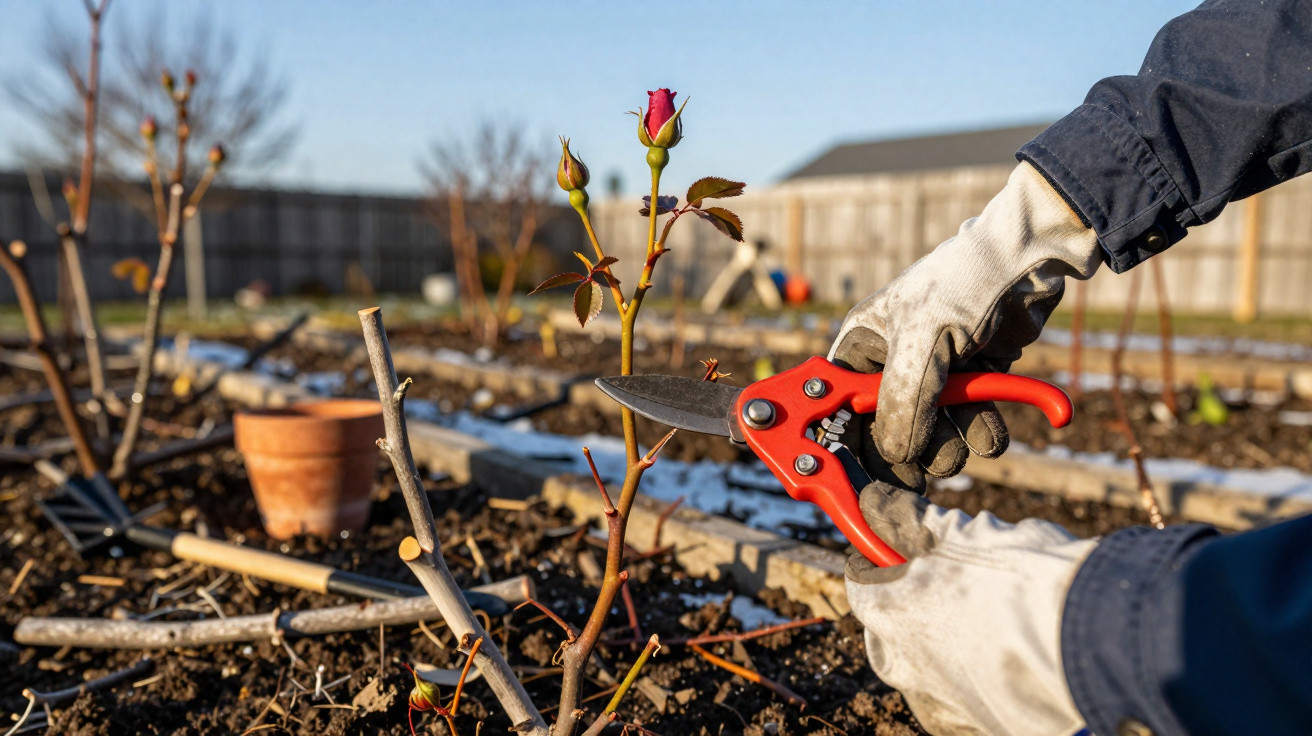
The perfect window of time is surprisingly small.
Every year, countless amateur gardeners find themselves staring at their rose bushes, unsure what to do. Winter is fading, the days are stretching out, the buds are swelling - but when is the moment to pick up the secateurs? Cut too early and frost can kill back the growth. Leave it too late and you waste precious flowering energy. If you learn to read what the plant is telling you - and match it to your local conditions - a thorny shrub can become an extraordinary sea of colour.
The crucial period: late winter, just before growth takes off
Roses are particularly sensitive to timing when it comes to pruning. The prime window is towards the end of winter, when the worst cold is easing and the plant is gearing up to break dormancy.
"As a rough guide: from mid-February to mid-March, depending on region and weather, is the ideal main pruning period for most garden roses."
At this point the rose is already preparing itself internally, but it is not yet fully in leaf. Pruning now concentrates the shrub’s reserves into a smaller number of well-positioned shoots - the foundation for lots of strong buds and large blooms.
Why pruning too early is so risky
A cut in January, or during a spell of persistent night frosts, can feel tempting because you want to “finally get something done” in the garden. The catch is that roses often respond to pruning by pushing fresh growth. Those new, water-rich shoots are extremely vulnerable to cold.
- Fresh cuts provide entry points for the cold.
- Young shoots can be killed by even brief cold snaps.
- Frost-damaged sections have to be removed later - weakening the plant twice over.
One icy night can wipe out the entire flush of new growth. The plant then needs weeks to recover, and the main flowering period is noticeably poorer.
The real starting signal: the end of hard frosts
Your best guide is not the date on the calendar, but what the thermometer is doing. The main prune should only happen once severe night frosts are no longer likely where you live. Many gardeners follow this simple rule:
"Never prune roses if hard frosts are still expected. Pruning a little later is always better than pruning too early."
In many areas, the period around mid-March is a dependable benchmark. In very mild spots it can be a little earlier; in colder locations, later. Playing it safe protects the shrub’s framework and helps prevent frost damage to the main stems.
Learning to read buds: the plant tells you when to begin
Alongside temperature, the rose itself gives clear visual cues. If you know what to look for, the buds make the decision much easier.
The moment buds begin to swell
As soon as the previously inconspicuous buds start to plump up and show as small red or pinkish swellings on the stems, the plant is entering its growth phase. Sap is rising and the rose is visibly preparing for the new gardening year.
"The ideal time to prune is when the buds are clearly swollen, but there are no leaves yet, or only tiny ones."
At this stage, roses respond especially well to a purposeful cut. Remove surplus shoots now and the plant’s energy is channelled into fewer buds - allowing each one to grow more vigorously.
If leaves are already showing: don’t delay further
Sometimes you simply don’t get to it in time, or a mild spring pushes the rose on quickly. Even if the shrub is already in fresh leaf, pruning can still be worthwhile.
- Pruning is still possible when the first leaves have appeared.
- The longer you wait, the more energy the plant wastes on shoots that will later be removed.
- After pruning, the rose continues with fewer - but more vigorous - shoots.
What matters then is a clean, decisive prune, rather than weeks of half-hearted “tweaking”.
Region matters too: mild climates, cold pockets, higher ground
There is no single date that suits every garden. Local differences can be substantial - and they are worth taking seriously.
Mild regions: start earlier
In wine-growing areas, near large towns and cities, or anywhere with generally gentle winters, pruning often shifts earlier. In such places, hard frosts in late February are less common.
Typical features of these regions:
- Temperatures above 0 °C are common as early as February.
- Many plants begin growing sooner.
- Any returning frost is usually brief and not intensely cold.
Here, roses can often be pruned in the second half of February. If you wait too long, you may be faced with shrubs already well into leaf - and pruning becomes noticeably more stressful for the plant.
Cooler areas and higher ground: better to wait
Conditions are very different in colder northern districts, on the edge of the Alps, in upland areas, or in well-known frost pockets. Late frosts into March can be a recurring problem.
"In these areas, it has proved best to prune no earlier than mid-March - and in exposed locations, closer to late March."
If you cut too early in such places, you trigger growth that is likely to be hit by frost again. The rose then has to spend energy twice, which can weaken the shrub in a clearly visible way.
What’s happening inside the rose - and why timing matters so much
Pruning is not a cosmetic tidy-up; it is a major intervention in the plant’s “energy budgeting”. Timing influences whether the rose invests mainly in leaves and wood, or in buds and flowers.
The role of sap flow
In winter, sap retreats deep towards the root zone to protect the more sensitive wood. As days lengthen and temperatures rise, the process reverses: sap moves back up into the shoots to supply the buds.
Pruning shortly before, or at the beginning of, this phase creates a clear advantage:
- Fewer buds need to be supplied.
- More energy is available for each remaining shoot.
- Flowering stems are stronger and more stable.
That is how you get the dense display and large blooms associated with well-maintained rose beds.
Roses pruned too late lose strength
If the main prune happens long after growth has started, the rose has already invested heavily in soft new shoots and leaves - and that work ends up on the compost heap. The plant must then mobilise reserves again to replace what was removed. This not only slows growth, but can also leave the rose more vulnerable to disease and pest attack.
On the day: how to prune cleanly and correctly
Once the timing is right, the next priority is sharp tools and confident cuts. Every cut is a wound, and poor technique can open the door to disease and rot.
"A sharp, disinfected pair of rose secateurs is essential - blunt blades crush wood and bark."
Before you make the first cut, stand back and assess the whole shrub. Which shoots are old, decaying or weak? Where do you want the main framework stems to be in future?
The “three-bud rule” for bushy roses
For classic bedding roses or shrub roses, a straightforward rule of thumb works well. Starting from the base of a strong stem, count upwards:
- find the third well-developed bud, ideally facing outwards,
- cut about 5 millimetres above it,
- make the cut on a slight diagonal.
This encourages new growth to develop outwards, away from the centre. The result is an open, elegant shape with good airflow and plenty of light through the middle.
The correct cutting angle
Make the cut at a slight slant, angled away from the chosen bud. This helps rainwater run off instead of sitting on the fresh wound. Standing moisture would otherwise provide ideal conditions for fungal problems.
Spring clean in the rose bed: making room for new blooms
Pruning should always go hand-in-hand with a thorough tidy-up. Only vigorous wood should remain to carry the plant; anything else consumes energy without delivering results.
Remove dead and weak wood without compromise
Dead shoots are often darker - grey-brown - and brittle. Living wood tends to look greener inside and feels slightly flexible. Thin, weak stems that will never support strong blooms simply steal light and air.
"In the end, only healthy, strong main stems should remain - they are the backbone of the coming flush of flowers."
Open the shrub from the inside
An old gardener’s saying goes that a small bird should be able to fly through a rose bush without bumping into anything. In other words, the centre should not be completely congested.
- Remove shoots growing towards the centre.
- Cut out crossing branches that rub against each other.
- Thin dense “brooms” of many fine stems heavily.
With more light and airflow through the plant, leaves dry faster, and fungal diseases such as black spot and powdery mildew have a much harder time.
Care straight after pruning: how to support your rose
After pruning, a rose is under pressure: many branches are gone, lots of wounds need to seal, and at the same time the growth phase is beginning. A few simple actions now can make a significant difference.
Lightly loosening the soil around the shrub helps the roots become active again and take up nutrients. Applying a suitable rose fertiliser at this stage provides the basis for strong shoots and plenty of flower buds. In dry springs, it is also worth watering deeply once, so the nutrients can actually reach the root zone.
One aspect that is often underestimated is monitoring in the weeks after a hard cut-back. Does the shrub sprout evenly from all main stems? If individual branches remain completely bare, they can be removed decisively at the next pruning. Over time, this produces a balanced, healthy rose bush.
If you pay close attention to your roses’ seasonal rhythm for a few years running, you develop a feel that no rigid date rule can replace: you learn to read buds, temperature and growth to judge when the secateurs should really come out - and in May and June you are rewarded with an almost spectacular display of flowers.





Comments
No comments yet. Be the first to comment!
Leave a Comment