
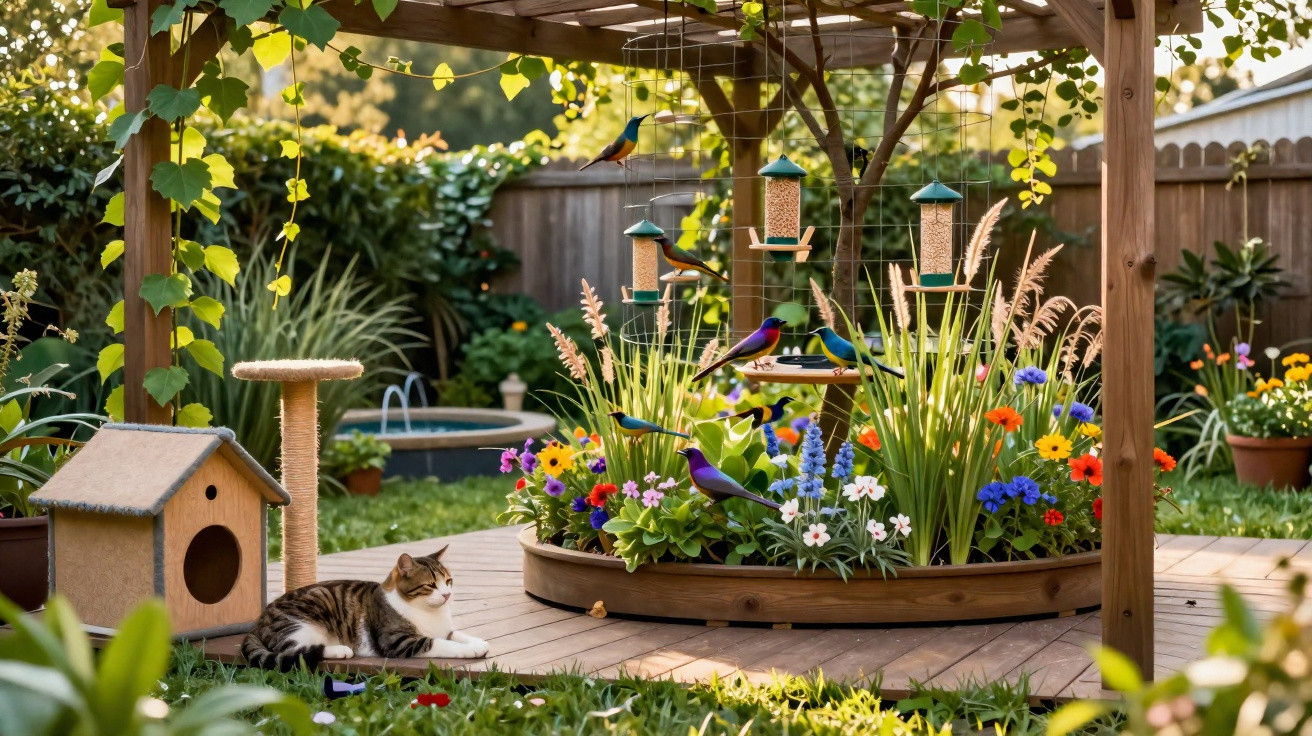
If you adore cats but also celebrate every sparrow that visits your garden, you can end up with a genuine dilemma. Pet cats may be lovable, cuddly companions - yet they are also highly effective hunters. With a few sensible changes, you can reshape your garden so birds have a better chance, while your cat still enjoys an interesting territory.
Why cats catch so many birds in the garden
Domestic cats often look laid-back, sleep for hours and get meals delivered on schedule. Even so, their hunting instinct remains. It is hard-wired and does not vanish just because the bowl is full. Research suggests that while some cats simply wander about, others spend hours patrolling their patch - particularly in spring and early summer.
That timing matters, because most garden birds nest between March and July. Many species build nests in hedges, shrubs or even right on the ground. Fledglings frequently perch clumsily on low branches, can barely fly and become easy targets. In countries with lots of pets, such as France and Germany, this adds up to millions of birds taken each year.
"The conflict doesn’t arise because cats are ‘bad’, but because modern gardens no longer offer birds many safe refuges."
Many plots are kept extremely tidy: close-mown lawns, bare borders and very little undergrowth. For birds, that means fewer hiding places, less shelter and limited nesting material. For cats, that kind of “English lawn” turns the garden into an open hunting ground with excellent visibility.
The 3-2-1 rule: turning your garden into a safe refuge
If you want to protect birds, it helps to think a little more ‘wild’ - not neglected, but naturally structured. A straightforward guide is the so-called 3-2-1 rule for a bird- and cat-friendly garden.
Three ground-level zones: a dense plant carpet
At ground level, thick groundcover gives small animals and young birds somewhere to disappear. Good options include:
- Carex species (sedges) - tough, low-maintenance and forming dense clumps
- Cranesbill (Geranium) - spreads pleasantly and fills gaps
- Cushion perennials such as lady’s mantle or coral bells
The key is to avoid having bare soil everywhere or grass cut ultra-short across the whole garden. Bands of longer grass, piles of leaves and a little deadwood provide habitat for insects and birds - and make it harder for cats to creep in unnoticed.
Two layers of protective hedges and shrubs
The second level is shrubs and hedging, ideally including thorny varieties. These provide secure roosting spots and nesting sites. Suitable choices include:
- Hawthorn
- Blackthorn
- Hedge rose / wild rose
- Barberry
- Hazel
Thorny plants offer a clear advantage: cats may be able to enter, but they cannot move through every part easily. Birds can slip into dense branches and are far more difficult to reach. If you have the space, mixing several shrubs into a varied hedge increases both shelter and food sources.
One tree layer as an “escape corridor”
The third layer is trees. They do more than provide shade - they create safe height routes. Birds can shoot upwards quickly, while cats lose their clear line of sight. A thick canopy also makes it harder for a cat to lock onto prey and launch an accurate pounce.
"The more varied the garden’s structure, the more likely birds are to find safe niches - and the less successful the cat will be when hunting."
Safe nest boxes: small details, big impact
Many gardeners put up nest boxes and then wonder why nothing moves in. Often the issue is the placement, height or design. If you want to genuinely support birds, a few basic rules make a big difference.
How to position nest boxes correctly
- Height: Around three metres above the ground, so cats cannot simply jump up or climb easily.
- Distance from branches: Avoid thick, horizontal branches nearby that could act as a route to the box.
- Orientation: East or south-east is ideal - sheltered from persistent rain and intense midday heat.
- Internal depth: There should be 15–20 centimetres between the entrance hole and the floor. This reduces the chance of cat paws or martens reaching the brood.
- No decoration: Perches may look attractive, but they give predators an easier foothold.
A sturdy fixing and a roof that comes off easily also make cleaning after the breeding season simpler. Clean boxes are taken up far more readily.
Ground rules for outdoor cats: when it’s better to keep them inside
The other lever is timing - when your cat is allowed outdoors. For birds, the most vulnerable periods are dawn and dusk in spring and early summer. That is when birds are especially active, fledglings leave the nest uncertainly, and cats tend to be at their most alert.
If you can, during the breeding season from March to July, keep in mind:
- Keep cats indoors in the early morning
- Set stricter rules in the evening as well
- Avoid outdoor access close to known nest sites
"Even a few weeks of restricted outdoor time significantly reduces the number of fledglings killed, without the cat needing to be shut in permanently."
Bright collars, scent barriers: practical everyday aids
High-visibility collars as an early-warning system
In some countries, brightly coloured fabric collars for cats are already common. Strong colours and moving patterns make a stalking hunter easier for birds to spot. A breakaway safety clasp is essential, so it releases if the cat gets caught.
These collars are not a substitute for sensible outdoor routines, but they can noticeably lower the success rate of stealth attacks.
Smells cats dislike
Some areas of a garden are particularly sensitive: beneath nesting trees, within dense hedges or around bird baths. In these spots, you can use scents that cats tend to avoid, for example:
- Dried coffee grounds scattered in places cats like to use as hiding spots
- Citrus peel (such as orange or lemon) as a short-term deterrent
- Specific ornamental plants such as Coleus canina, which many cats find unpleasant
These approaches do not work equally well everywhere, but they can help redirect cat activity away from higher-risk zones.
Technology and long-term responsibility
If you can identify heavily used hunting routes, it may be worth installing physical deterrents, including:
- Metal or plastic collars around tree trunks to make climbing more difficult
- Fine-mesh barriers in selected places, such as popular jumping points onto walls
- Motion sensors with light or a water jet for especially sensitive areas
Over the long term, the number of roaming cats also matters. Neutering and identification not only prevent uncontrolled breeding, but often reduce the urge to range far on hunting trips. Many neutered cats stay closer to home and can be accustomed more easily to set routines.
What a relaxed day-to-day compromise looks like
In practice, the best results usually come from combining several measures:
- a structurally rich garden with hiding places, thorny shrubs and trees
- securely fitted nest boxes and protected feeding areas
- adjusted outdoor access during the breeding period
- a high-visibility collar and targeted scent barriers
This way, the garden remains engaging for the cat - full of smells, cover and climbing opportunities - without every outing ending in a bloodbath for sparrows and tits. Birds gain from thicker cover, better-protected nesting spots and clearer refuges.
If you are only just starting to make changes, begin small: a wilder corner with groundcover, a thorny hedge, and a first nest box set at the right height. By next spring, you will often see how quickly the birdlife responds. And with each added shrub and each well-chosen measure, the chances improve that cats and birds can share the garden - with far less drama for everyone involved.




Comments
No comments yet. Be the first to comment!
Leave a Comment