
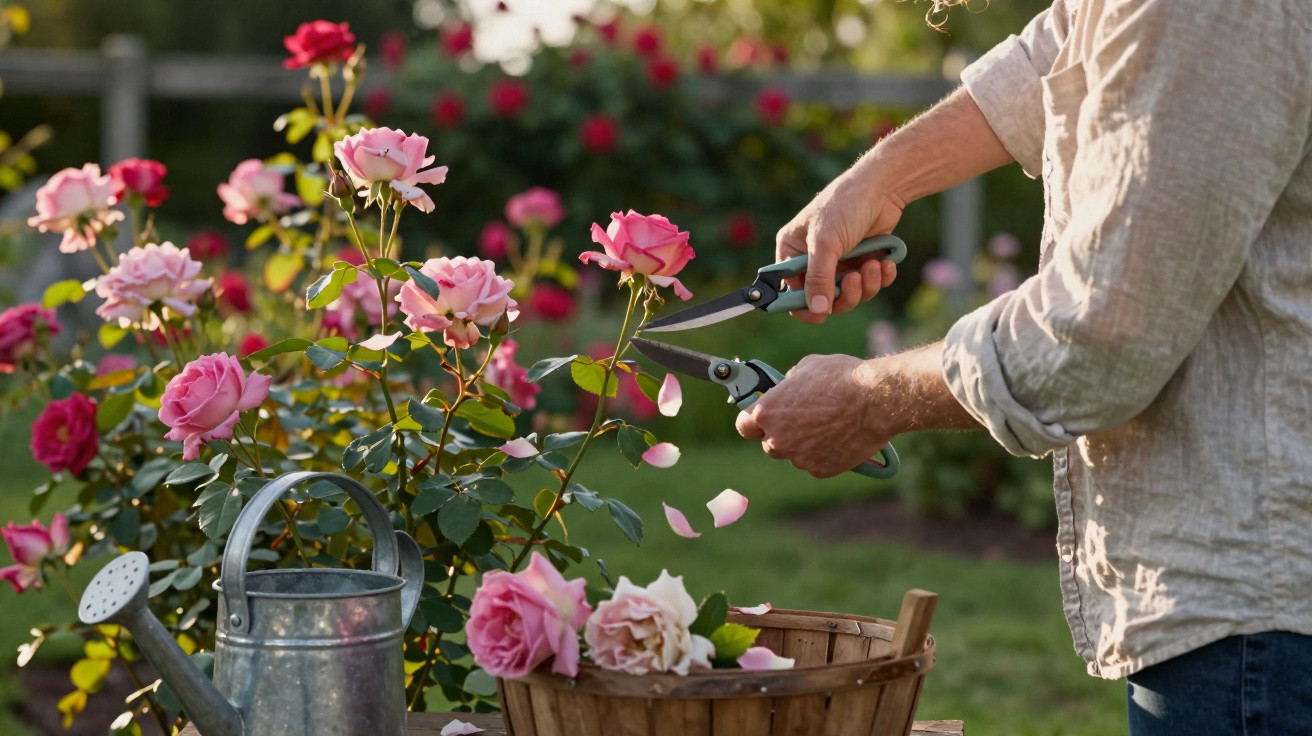
The first rose dropped on a Tuesday morning.
A velvety red flower, flawless when it opened two days before, now lay limp and battered on the earth, its petals marked like worn tissue paper. The gardener who noticed it-an elderly neighbour in a straw hat, with keen eyes-was not remotely surprised. “You cut them wrong,” she said softly, lowering herself with the ease of someone who had spent a lifetime near the soil. “You’re asking the plant for flowers, but you’re not giving her what she needs back.”
She then did something so straightforward, so traditional, that it seemed almost incongruous among booster feeds and shiny bottles from the garden centre.
She picked up the spent flower and demonstrated a gesture many people have forgotten.
The old pruning gesture that changes everything
If your roses erupt into colour before apparently giving up a few weeks later, you are certainly not the only one. Plenty of gardens enjoy a brief, enchanting display in May or June, followed by… nothing. A green, leafy nothingness. Flowers disappear, buds stall, and by August you may be looking at leaves and thorns, wondering where it all went wrong.
Oddly enough, the answer is not found in a bottle. It is in your hands, at precisely the point when a rose begins to fade.
There is a short opportunity when a single cut can effectively restart the plant’s drive to flower.
Imagine a line of pink hybrid tea roses beside a modest urban fence. Their first flush is magnificent: neighbours pause to admire them, bees work busily from morning to evening, and everyone passing catches a hint of perfume.
Three weeks on, those same roses appear weary. Browning petals remain attached to the stems, hips begin to form and fresh buds arrive only reluctantly. Feeling discouraged, the owner buys a large, brightly coloured box of “special rose food” and scatters it generously. At first, very little changes.
Then a friend walks past and starts snipping. One spent head after another comes off, each cut made just above a particular leaf. No feed. No spray. A month later, the fence is flowering all over again.
The explanation is almost painfully sensible. When old flowers are left in place, they develop into seed pods and the rose assumes its work for the season is complete. Why should it use energy on new petals when reproduction has already begun? Its focus changes from attracting pollinators to ripening seed.
Taking off fading blooms in the correct position interrupts this cycle. You remove the “mission accomplished” signal and replace it with another instruction: continue flowering.
This is the forgotten trick: a precise, respectful deadheading that speaks the rose’s own language rather than forcing it with chemicals.
How to cut so your roses keep blooming for weeks
The essential action is straightforward: deadhead roses just above the first outward-facing five-leaflet leaf. Do not cut at random, too close to the flower or wherever seems convenient. Hold the fading bloom, trace its stem downwards until you find a leaf with five leaflets-not three-facing away from the middle of the bush. Make a slightly angled cut immediately above it using clean, sharp secateurs.
It may sound rather technical on the page, but after you have done it once, it quickly becomes second nature.
In effect, you are telling the rose: “Send new growth from here, towards the light, not crowded into the middle.”
Many gardeners either leave old blooms untouched or simply pinch them away directly beneath the flower. It may look neater, but it does not properly direct the plant. The rose can still concentrate on developing hips, sending energy into seed production rather than petals.
An older gardener in my town insists that she has not bought a chemical rose treatment for twenty years. Her ritual is simple: every evening after dinner, she takes a small pair of pruners around the garden. “I only cut the finished ladies,” she laughs, “and they thank me with more dresses.” Her bushes continue flowering well into autumn, long after nearby roses have checked out for the year.
There is another element to this technique: consistency. Roses do not require an extreme trim once a month. Instead, they react well to frequent, gentle care. Realistically, nobody manages this every day. Life intervenes, the hose starts leaking, children need their supper and the phone will not stop buzzing.
Aim for a weekly check instead. Stroll around slowly, look for flowers that have finished, and follow the same rule each time:
“Above the first outward-facing five-leaflet leaf, with a clean, angled cut. That’s all. That’s the language roses understand.”
Keep this brief checklist in your head:
- Watch for petals that are papery, marked or falling away.
- Trace the stem down to the first outward-facing leaf with five leaflets.
- Cut 0.5–1 cm above the leaf at a slight angle.
- Take out weak, blind stems that have never developed proper buds.
- Stand back and make sure the plant’s centre remains open and airy.
Beyond chemicals: a different kind of relationship with your roses
Moving away from “feed and spray” towards this modest cutting routine affects more than the quantity of flowers. It changes your relationship with the garden. Rather than viewing a rose as a demanding diva, you begin to recognise it as a living system that responds to signals.
It also offers a quiet kind of enjoyment: the gentle snap of a stem, the faded flower resting in your hand and the satisfaction of redirecting growth towards light and fresh air. The task becomes a small conversation rather than a fight.
For anyone anxious about getting it wrong, there is reassuring news: roses are more resilient than their reputation suggests. Cut a little too low? The plant will generally cope and send up a new shoot from further down. Miss a week of deadheading? You may see a few hips, but returning to a regular routine will gradually steer its energy back towards flowers.
What really exhausts roses isn’t a careful cut, it’s being forced to feed both seeds and foliage at once. When you simplify the plant’s work-no seeds, only blooms-you are reducing its strain. Your part is less that of a “controller” and more that of a translator.
This traditional approach also fits naturally into a more environmentally friendly garden. Using fewer chemicals encourages more life: bees, hoverflies and ladybirds all buzzing or crawling through that miniature world of thorns and petals. Soil that remains alive, rather than being sterilised by continual treatments, supports roots more reliably through heatwaves and heavy rain.
Some gardeners will still choose to keep a box of fertiliser on the shelf, and that is entirely up to them. However, more people are rediscovering that a clean cut, good mulch, and patient observation often outperform the most expensive potion. The forgotten trick is not solely a matter of technique. It is about slowing down enough to see what the plant is already trying to achieve, then gently encouraging it along.
| Key point | Detail | Value for the reader |
|---|---|---|
| Precise deadheading | Cut above the first outward-facing five-leaflet leaf | Longer blooming without chemical boosters |
| Regular light care | Weekly walk-through to remove spent flowers and weak stems | Healthier plants with less disease pressure |
| Natural balance | Fewer products, more observation and soil life | Cheaper, more ecological, and more satisfying gardening |
FAQ:
- Do I have to deadhead every single rose on the bush? You do not need to be perfect. Start with the most faded or damaged flowers. A weekly round, even when a few blooms are missed, will still promote far more flowers than doing nothing.
- What if my rose only has three-leaflet leaves near the top? Follow the stem down until you find the first set of five leaflets. It can seem rather low at first, but this is usually where the strongest new flowering shoots will emerge.
- Can I apply this trick to all roses? Yes for repeat-flowering types: hybrid teas, floribundas, many English and shrub roses. Once-blooming old roses are different; for them, deadhead lightly or leave hips if you enjoy them.
- Do I need any special tools? Sharp, clean secateurs are all you need. Clean the blades occasionally, particularly when moving from one plant to another, to prevent the spread of disease.
- Will this replace fertiliser completely? Not necessarily, although it can greatly reduce your reliance on chemical products. Pair careful deadheading with compost, mulch and occasional organic feeds, and your roses will reward you generously.


Comments
No comments yet. Be the first to comment!
Leave a Comment