
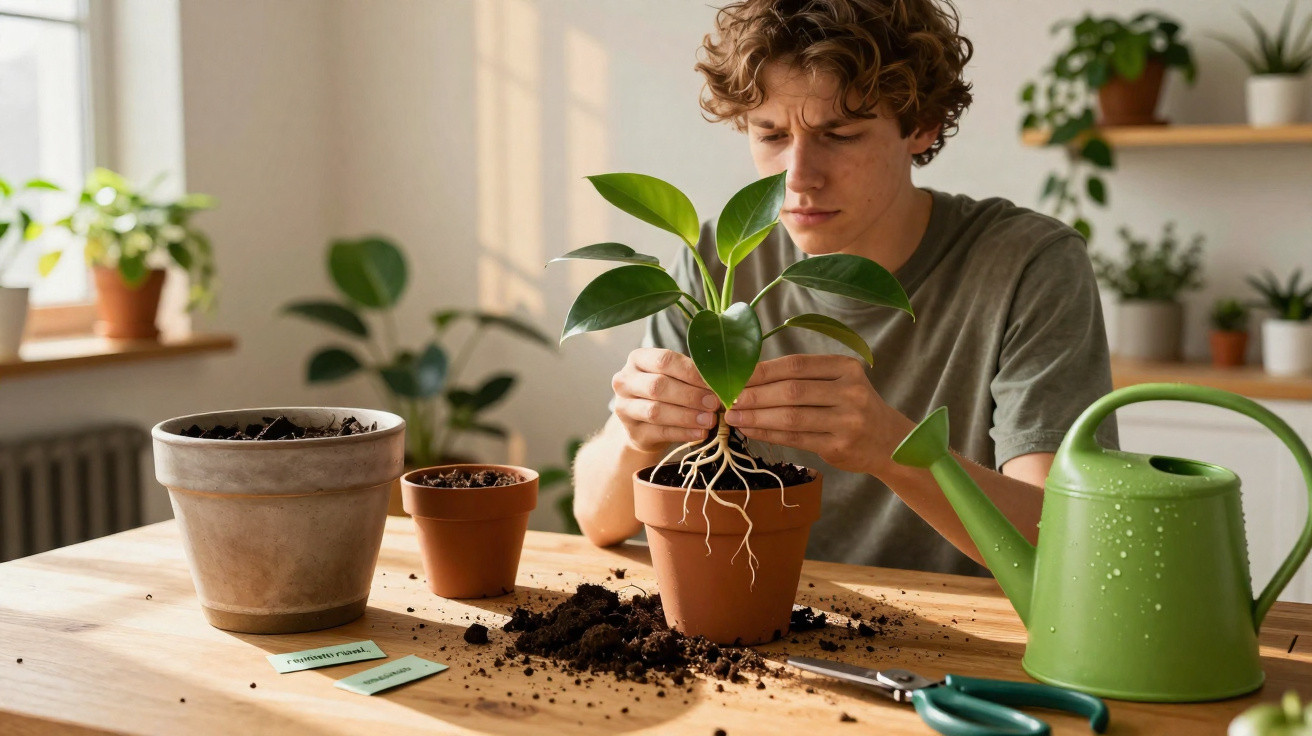
Soil beneath your fingernails, the scent of fresh potting compost across the kitchen table, a half-finished mug of coffee beside the watering can: repotting can feel like a small ritual of renewal. You tip the old pot, turn the plant, give it a slight tug and murmur, “Come on, then” – and suddenly the root ball is sitting in your hand. For a few seconds, you are literally holding that plant’s life between your fingers. It sounds dramatic, and in a way it is. Many mistakes that later cause yellow leaves, drooping stems or hidden root death happen at precisely this point. Quietly, unnoticed and with the very best intentions. You only spot the consequences weeks later, when the plant starts playing up “for no reason”. That is where things become interesting.
Why repotting so often goes wrong, even when you mean well
We all know the moment: the plant looks “a bit unhappy”, so into a bigger pot it goes. More room, more compost, more love – what could possibly go wrong? The scene is always much the same: an oversized, attractive cachepot, a bag of compost from the garden centre, the plant briefly turned upside down, a little squeezing, then into its new home and job done. On Instagram, it looks like self-care. In reality, this is often where a quiet drama begins around the roots. Repotting is less of a decorating task and more of a surgical procedure. Hardly anyone talks about it in those terms.
A reader once told me about the Monstera she had “saved”. Its leaves were pale, it was barely growing and it seemed miserable. So she bought the largest pot she could find – “so I would not have to do it again too soon”. Two months later, it was a casualty on the windowsill. The problem was not too little love, but too much freedom. In the enormous pot, the compost stayed wet for ages, the roots could not get enough air and rot spread without a sound. According to a survey by a major garden centre, more than 60 per cent of amateur gardeners say they repot their plants “generously”. It sounds kind. For many plants, it means pure stress.
Here is the plain truth that few people want to hear: when being repotted, plants primarily need stability, not extra size. A houseplant’s root ball is a delicate network adapted to the shape of its current pot. If the move to the next pot is too drastic, that balance is disrupted. Moisture is distributed differently, oxygen shortages arise and nutrients remain unused in the lower layers. We think we are giving the plant “more”, when in fact we are taking away what it needs most: a manageable environment that can breathe. Let us be honest: no one gets out a ruler and measures meticulously while repotting – and that is exactly where the trouble starts.
The quiet killers when repotting plants – and how to avoid them
The first step towards healthier repotting is unglamorous: choose a pot only one size larger, not three. One to two finger-widths of space around the root ball is enough. Put a thin layer of coarse material, such as clay pebbles, broken terracotta or coarse gravel, over the drainage hole rather than blocking it completely. Start by adding only a little compost to the new pot, then position the plant so that the old soil surface sits at roughly the same level as before. Fill compost around the sides and gently firm it with your fingers, but do not compress it as though you were laying cement. Finally, water thoroughly until water runs out at the bottom, then leave the plant alone for a while. No fertiliser, no repeated watering and no “I’ll just check it every hour”.
One especially common mistake is exposing the roots completely and making them “nice and clean”. It looks tidy and feels satisfying to the eye, but for many plants it is a shock. If you are faced with a tangled mass of roots, it is often enough to carefully loosen a few individual roots with your fingers or lightly scratch the outside of the root ball. Plenty of people boldly cut away large sections or even wash off all the compost – that only works for certain species, and even then it carries a risk. Another trap is “turbo compost”: heavy, nutrient-rich potting compost used for every plant, whether it is a cactus or a Calathea. One will drown while the other goes hungry. We treat plants as if they were all identical, even though their roots need very different worlds.
A gardener once said something to me that I have never forgotten:
“Most plants do not die because we forget them, but because we keep fiddling with them too much.”
- Less overdoing it – only repot when roots are genuinely growing out of the pot or the compost visibly looks “tired”.
- Breathing compost – use a suitable substrate for each plant type, rather than one all-purpose mix for everything.
- Patience after repotting – allow a few weeks to adjust, with no fertiliser, no constant changes of position and no panic watering.
What your repotting ritual reveals about your relationship with plants
The next time you are standing at the kitchen table with soil under your nails, take a moment to watch yourself. How quickly do you become impatient when the root ball does not slide straight out of the pot? How firmly do you squeeze, and how frantically do you reach for the scissors? Repotting is a small character test in fast-forward: are you someone who wants to “get it over with quickly”, or someone who can accept that it may need to be done carefully and slowly? Plants respond with ruthless honesty to our impatience. You see it only later, when leaves hang limp, new shoots fail to appear or the plant is technically “alive” but no longer really gets going. Sometimes a lopsided Ficus reflects more back at us than any mindfulness book.
Perhaps that is the real point: repotting is less about practical skill than caring for a relationship. You are making a plant leave its entire root home – something it would scarcely ever experience so abruptly in nature. No wonder it responds with signs of stress. Once we take that seriously, we stop talking about “quickly repotting” and instead treat it as a task that deserves preparation. The right compost, a suitable pot, a calm room and no time pressure. And yes, sometimes that means leaving a beautiful but far-too-large designer pot on the shelf. The sentence no one likes to admit is this: many plant problems are self-inflicted. Yet that also gives you power back – you can repot differently tomorrow.
You may share this text with that friend who “rescues” their plants every two weeks and wonders why they still die. Or perhaps you will look at your own pots and suddenly see patterns: containers that are far too large, soggy compost, the plant that loses three leaves after every repotting. Do not see it as failure, but as a small stocktake of your routines. Plants do not need perfection; they need consistency. A reasonably reliable rhythm. Let us be honest: nobody repots “by the book” every single time, with ideal substrates and pH charts. But a little more awareness next time can make the difference between a plant that merely survives and one that visibly thrives.
| Key point | Detail | Benefit for the reader |
|---|---|---|
| Increase pot size only moderately | Allow no more than one to two finger-widths around the root ball | Prevents waterlogging, stabilises growth and reduces root rot |
| Handle roots gently | Loosen or roughen them only slightly; do not cut radically or wash them out | Minimises repotting stress and lowers the risk of growth stopping |
| Aftercare instead of overdoing it | After repotting: water thoroughly once, then allow rest and use no fertiliser | Gives the plant time to adapt and supports long-term vitality |
FAQ:
- Question 1: How can I tell whether my plant genuinely needs repotting, rather than it simply being “nice” to do?
- Question 2: How should I deal with root balls that are completely tangled and hard as a sponge?
- Question 3: Can I use any standard potting compost, or do different plants need their own mixes?
- Question 4: What should I do if my plant looks limp or loses leaves after repotting?
- Question 5: Is there a particular time of day or season when repotting is especially useful, or does it not matter?
Comments
No comments yet. Be the first to comment!
Leave a Comment