
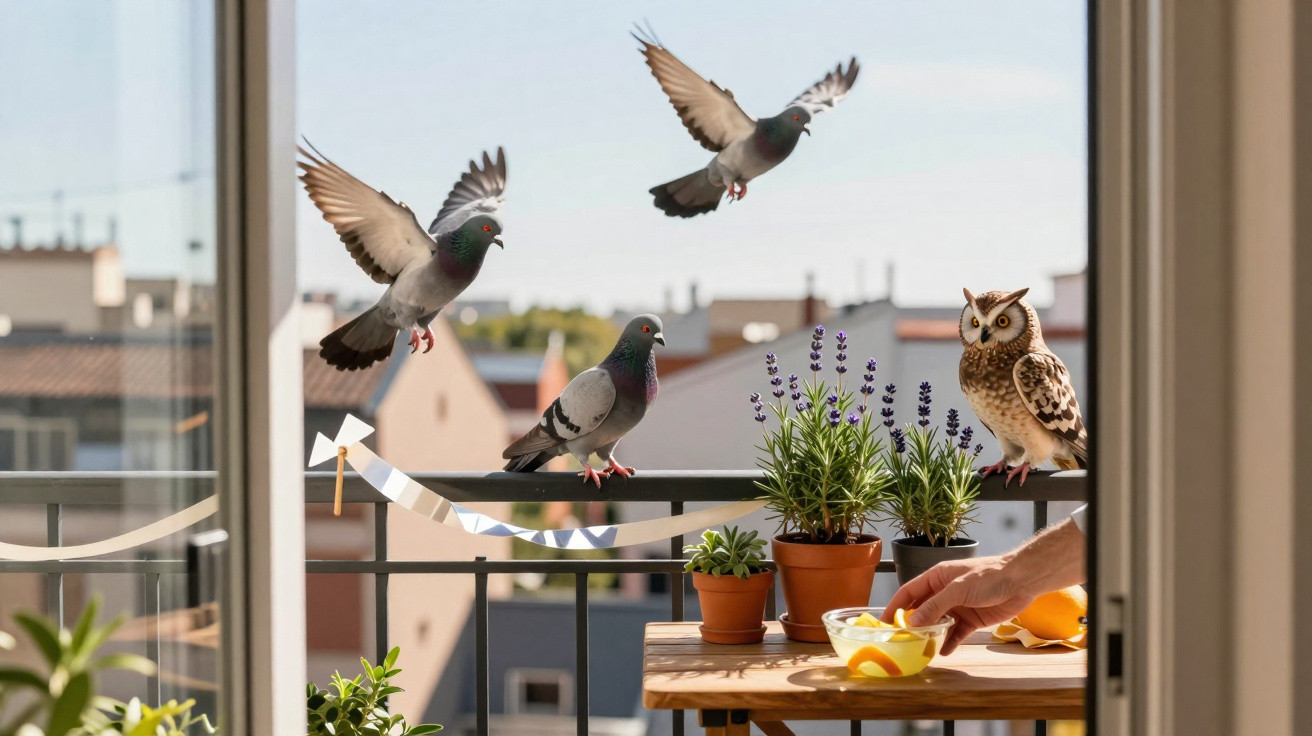
Weeks of wiping, scrubbing and swearing – yet every morning the balcony was covered in pigeon droppings again.
Then one simple trick changed everything.
Many city residents know the problem: you have only just painstakingly cleaned the balcony or terrace when the next flock of pigeons arrives. The birds are persistent, their droppings can damage stone, metal and wood, and they pose a genuine hygiene issue. The good news is that a smart mix of scents, surfaces and a few structural changes can keep pigeons away for good without harming them.
Why pigeons find your balcony so appealing
Before taking defensive measures, it helps to understand the reasons. Pigeons are not acting out of malice; they follow a very simple pattern: food, safe spots and peace.
- Food sources: Breakfast crumbs, dog food left in a bowl and seeds dropped from window boxes are an all-you-can-eat buffet for pigeons.
- Comfortable landing areas: Window sills, railings, ledges and roof edges offer ideal places to perch and sleep.
- Sheltered corners: They can nest comfortably beneath eaves, in corners or in inaccessible gaps.
“Anyone who understands why pigeons love a place can deliberately make it unattractive – entirely without violence or poison.”
First step: drastically reduce food and comfort
Remove food: your balcony is not a restaurant
The key rule is simple: do not leave anything edible behind. It may sound obvious, but in practice it makes a major difference.
- Clear away leftover food immediately, including small crumbs.
- Do not keep open rubbish bags or food-waste bins on the balcony or terrace.
- Offer bird food for tits and other small birds only in enclosed feeders that pigeons cannot access.
- Put food out for dogs or cats outdoors only while they are eating, then take it back inside.
Deliberately feeding pigeons is already prohibited in many towns and cities, and for good reason: the more they are fed, the faster they multiply.
Make surfaces uncomfortable: pigeons should not want to land at all
Pigeons favour stable, wide surfaces. Turning them into unsteady or unpleasant areas takes away their desire to use a regular spot.
- Bird-deterrent spikes: Narrow strips fitted with plastic or metal spikes can be installed on window sills, railings and ledges. They may not look attractive, but they work very well: the birds can no longer perch comfortably, without being injured.
- Tension wires and thin lines: Wires or cords stretched across railings and edges unsettle the birds and affect their balance. Even a difference of just a few millimetres in height can be enough.
- Smooth panels: Perspex or other highly smooth materials make landing and perching difficult. Pigeons may slip or feel insecure, eventually choosing another location.
The scent trick: natural remedies pigeons avoid
Vinegar, spices and herbs as an invisible barrier
Pigeons are sensitive to certain smells. This can be put to use, particularly in areas that are cleaned regularly anyway.
“A strongly diluted vinegar solution, sprayed regularly over a terrace or balcony, makes pigeons lose interest in their favourite spot.”
Practical options include:
- Vinegar solution: Fill a spray bottle with a mixture of roughly 50 per cent water and 50 per cent white vinegar. Spray railings, floor areas and favourite perching spots. The smell deters pigeons, while fading more quickly for people than it does for the birds.
- Spices: Lightly scatter pungent or strongly scented spices, such as pepper, curry powder or cinnamon, over window sills or window boxes. Moisture will gradually wash them away, so reapply them from time to time.
- Aromatic plants: Herbs including rosemary and mint, as well as certain geranium varieties, produce scents pigeons avoid. Planting them in railing boxes combines decoration with a protective function.
The benefit of these methods is that they are inexpensive, easy to use and do not alter the building structure.
Use light and movement against persistent pigeon visitors
Make use of reflective objects and wind
Pigeons are surprisingly easily startled by sudden flickering light and unpredictable movement. That makes simple everyday items effective aids.
- Old CDs or metal strips: Hung from string, they turn in the wind and cast irregular flashes of light. Many pigeons avoid these areas because they cannot assess the situation properly.
- Wind spinners: Colourful garden wind spinners or small wind chimes add movement and sound to a balcony. They can be pleasant for children to watch, but often give pigeons a reason to keep their distance.
Variety matters: if the objects remain unchanged in the same place for months, the birds will become used to them and no longer be wary.
Technology and structural solutions for pigeon problem hotspots
Ultrasonic and scare devices
Shops sell devices that emit high-frequency sounds. People can barely hear them, if at all, whereas birds perceive them as a disturbance. Some models combine ultrasound with flashing lights or motion sensors.
Before buying, consider two points:
- The device may also disturb other animals, including songbirds and pets.
- Its range should suit the balcony or roof area so that pointless gaps are not left uncovered.
Decoy predators: owls, falcons and balloons
Plastic figures shaped like birds of prey, or balloons with large “eyes”, signal danger. They can be positioned on a roof, along the edge of a balcony or in trees.
For them to work, two things are needed:
- Move or slightly turn the decoys regularly so they do not look like fixed decorations.
- Place them wherever pigeons would normally land, rather than somewhere in a corner.
Nets and barriers: when nothing else works
Pigeon netting is often the only permanently reliable option, particularly in courtyards, beneath eaves or on loggias. It completely prevents access without harming the birds.
Typical applications include:
- Open balconies with a severe pigeon problem
- Roof overhangs where nests regularly appear
- Courtyards where keeping the ground clean has become almost impossible
| Measure | Effect | Effort |
|---|---|---|
| Vinegar & spices | The scent disturbs pigeons and is easy to apply | Low; requires regular reapplication |
| Spikes & wires | Prevent landing and perching | Medium; installed once |
| Reflectors & wind spinners | Deter through light and movement | Low; reposition occasionally |
| Nets | Block access completely | High; professional installation is often advisable |
Legal rules and limits on pigeon deterrence
Many people do not realise that pigeons are classed as vertebrates and are protected by animal welfare laws. Cruel or lethal methods are forbidden. Poison, traps and adhesive coatings may not only be illegal, but can also affect other animals.
“Only measures that keep pigeons away are permitted – not those that injure or kill them.”
In many local authorities, feeding pigeons can result in fines. Anyone living in a block of flats should also check with the property management company before installing spikes, nets or conspicuous structures. Some landlords even require specific systems to maintain a consistent appearance across the building façade.
Why patience matters – and what works in the long term
Pigeons are creatures of habit. Once they have identified a location as safe and rewarding, they return again and again. Every measure therefore needs some time before it takes effect. Trying something for only a few days rarely produces a breakthrough.
A combination of several steps works best:
- consistent cleaning and no accessible food
- uncomfortable or blocked perching areas
- disruptive smells and visual stimuli
- structural screening with nets where necessary
Those who apply these measures consistently will usually see a clear result: the birds give up and look for alternative areas, often only a few houses away where they are not disturbed.
Ultimately, all these tricks are based on one simple principle: change the environment so that it no longer interests pigeons, without harming them. This effort is particularly worthwhile on frequently used balconies and terraces. Once the regular pigeons have moved on, moderate upkeep of the measures is usually enough to keep the outdoor area clean and usable in the long term.

Comments
No comments yet. Be the first to comment!
Leave a Comment