
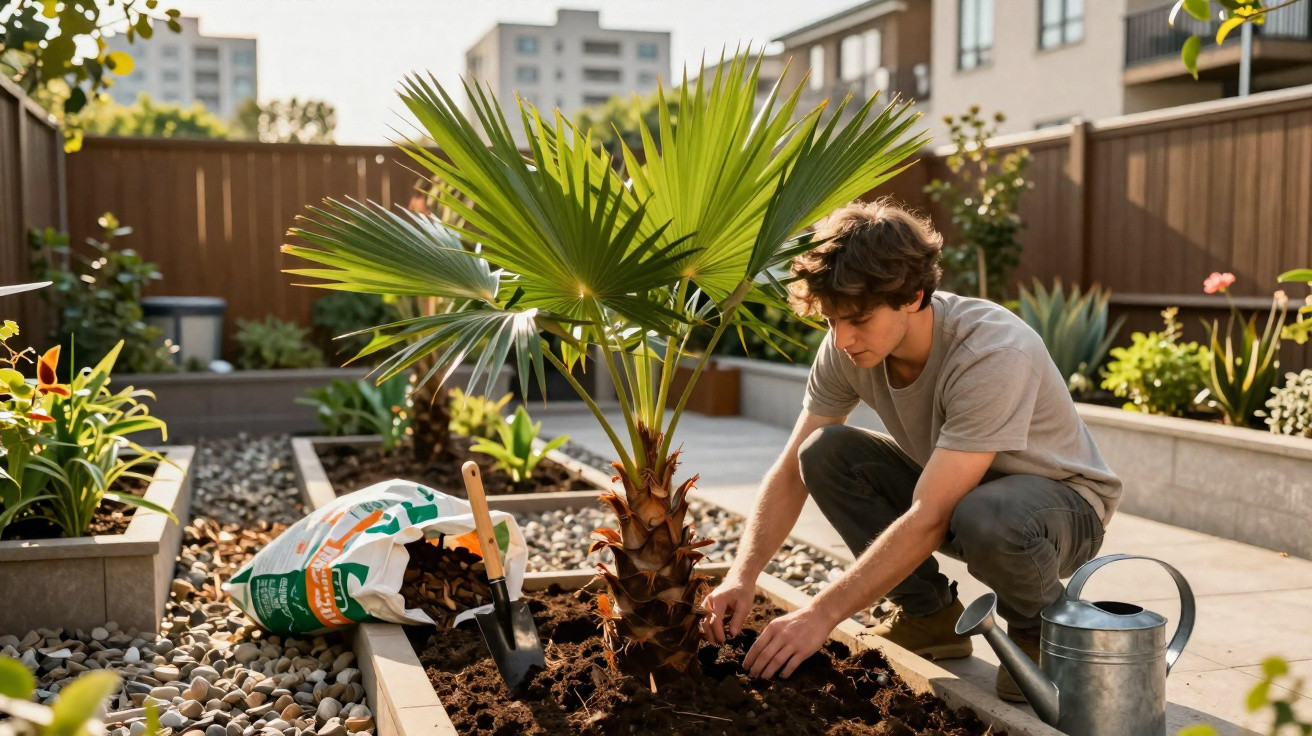
Many hobby gardeners quietly throw in the towel in late summer: borders finish flowering, the lawn looks tired, and the garden tools slowly make their way back to the shed. Yet this is exactly the moment that offers an often-missed opportunity. If you plant the right winter-hardy palm, you can instantly bring holiday atmosphere, structure and shade into the garden - without having to replant every year.
Why a winter-hardy fan palm makes sense right now
Exotic impact without a plane ticket
Trachycarpus fortunei - usually sold in garden centres as the hemp palm or “Ticino palm” - is a bit of a secret weapon for anyone who wants to lift their garden’s look up a level. Its slim trunk and large fan-shaped leaves create an immediate holiday vibe.
"A single, well-placed hemp palm trunk turns an ordinary terraced-house garden, visually, into a small holiday backdrop."
Those fan leaves cast a loose, dappled shade pattern across patios, lawns or gravel areas. The result is an instant shift in mood: the familiar “lawn plus thuja hedge” scene becomes a Mediterranean-leaning seating area or a calm corner with an almost Japanese feel.
The contrast is especially striking alongside classic garden plants:
- dark green hedges (yew, cherry laurel) gain a whole new sense of depth next to the palm’s silhouette
- pink or white roses look even brighter against an exotic backdrop
- beside gravel, timber decking or natural stone, the trunk looks like something brought back from a beach holiday
Frost-hardy, undemanding, suitable for town gardens
The key point is this: this palm isn’t a diva. Based on horticultural experience, Trachycarpus fortunei tolerates temperatures down to around −18 °C. For Central Europe that is a strong figure, especially compared with many other palm species.
Another advantage: once it is well established, it needs very little water. If you live somewhere with summer droughts - or you simply don’t want to water every day - that matters. Even when lawns and many perennials slump in high summer, the hemp palm tends to stay visually steady.
Typical advantages at a glance:
- frost-resistant down to about −18 °C
- moderate growth, so there is little pruning effort
- very well suited to front gardens, small urban gardens and roof terraces in large containers
- low maintenance once established
The right spot: half the success with one spadeful
Light, wind, sightlines - what matters
For the palm to make the impact you want, it pays to take a quick look at your garden’s layout. A position in full sun or bright partial shade is ideal. The plant is less keen on cold, funnelled winds; shelter from a wall, the house or a hedge usually leads to noticeably better growth.
Good locations include, for example:
- the south side of a patio, to add shade and structure
- the end of a straight lawn area, to bring depth and height into the view
- the start of a garden avenue as a distinctive “gatepost” feature
- a corner close to the seating area, where you can actually notice the leaves rustling in the breeze
It becomes particularly appealing when you play with perspective: if you can see the trunk and crown straight from the living-room window, you get that holiday feeling all year - even in January, with snow.
Plant pairings that genuinely work
A hemp palm rarely looks its best on its own. It has much more presence when framed by suitable companion planting. With straightforward combinations, you can create very different styles:
- Mediterranean look with minimal watering: with lavender, thyme, low rosemary, agaves, rockroses, sedum varieties and gravel areas.
- Zen-inspired calm zone: combined with ornamental grasses, bamboo (non-spreading varieties), pale gravel, stepping stones and a water bowl.
- Flowering family garden: with bed roses, catmint, hardy geraniums and looser perennials that soften the area around the trunk.
"The palm provides the framework; the other plants tell the garden’s story."
Planting time and soil preparation: do it now, enjoy it in winter
Why late summer and early autumn are ideal
From late August until around mid-October, the soil is usually still mild. That is perfect for forming new roots. At the same time, many regions begin to see the first wetter autumn spells - and nature takes over some of the watering.
If the palm goes in during this window, it has several weeks to build a stable root ball. That means it heads into winter much tougher. Planting late in autumn, or even in early winter, removes that head start and increases the risk of frost damage.
Step by step to the right planting hole
For healthy development, a well-prepared base matters. The soil should be free-draining; in the long run, waterlogging harms the palm more than short periods of dryness.
- Dig a planting hole at least 60 centimetres deep and 60 centimetres wide.
- Loosen heavy soil with coarse sand or fine chippings.
- Mix in a little well-rotted compost, but avoid fresh, “strong” fertiliser.
- Position the plant so the root collar sits just above the surrounding soil level.
- Firm the soil lightly and water thoroughly to close air pockets.
- Finish with a 5–10 centimetre mulch layer (bark humus, leaves, chipped material) around the trunk.
When planting, it is worth gently teasing open the root ball so roots can grow into the surrounding soil more quickly. Avoid tugging roughly; loosen and separate carefully instead.
Care through the year: little effort, big impact
Watering, mulching, protecting
In the first year after planting, the palm needs a bit more attention. During dry spells, water the root area regularly - but not every day - and do it thoroughly. It is better to water less often but deeply than to give a small amount daily.
The mulch layer does several jobs at once: it keeps the soil moist for longer, protects the roots from hard frosts, and slows weed growth. In autumn you can simply renew it or top it up.
In especially cold regions, or if extreme frosts are forecast, a light winter fleece around the crown can help. The trunk itself is usually robust enough. Container plants, of course, need more protection: wrap the pot and stand it on wooden feet or polystyrene so cold cannot creep in from below.
Diseases and pests - what’s realistic
Compared with many other ornamental shrubs, Trachycarpus fortunei is surprisingly trouble-free. Pests rarely appear in large numbers. However, a root zone that stays wet for too long can encourage rot; early warning signs include yellowing, limp leaves without an obvious cause.
Two simple routines help:
- once or twice a year, cut away old brown leaves cleanly at the trunk
- make sure there is no dense, permanently damp layer of rotting leaves around the base
"If you avoid waterlogging and pick up the secateurs once a year, you rarely have real problems with this palm."
Lighting and garden design with palm character
Use lighting to boost the “wow” factor
The hemp palm can look particularly impressive in the evening. A small ground uplighter or a warm-white LED spotlight at the base of the trunk makes the fan leaves glow. The shadows create graphic patterns on walls or the ground - the sort of effect you associate with southern holiday regions.
If you already have power in the garden, it only takes a few simple steps to create a true focal point. Especially in winter, when the rest of the garden can feel sparse, the evergreen character really comes into its own.
Replace lawn, save water, structure spaces
Many homeowners now feel how much work a perfect lawn takes - watering, feeding, scarifying. One or more hemp palms can help you rethink those areas. Instead of mowing everything short, you can create islands of gravel, herbs, stones and palms. That saves water, cuts maintenance and looks more contemporary.
This becomes particularly interesting on sloping plots or in small urban gardens. There, the palm adds height and structure without visually overpowering the space. In narrow front gardens, a single specimen can act like a green “exclamation mark” and upgrade the whole entrance.
If you are unsure whether your soil is suitable, you can start with one plant in a large container. If it grows well there over one or two years, that is a strong sign it can be planted out permanently - and the garden can be turned, long term, into a personal exotic corner.
Comments
No comments yet. Be the first to comment!
Leave a Comment