
The basil looked flawless at the garden centre: full, aromatic and covered in leaves. Twenty minutes later, on my small city balcony, it was already drooping as though it wished it had never come home with me. Like most people, I reached for an old pot, tipped in leftover compost, squeezed the roots in tightly and gave it a thorough watering.
For a week, it acted as if everything was fine. Then its leaves began to turn yellow. The stems went black near the base. One morning, I pressed the compost and found it felt... boggy. When I lifted the plant, it came away in my hand. Its roots had turned to mush.
That was when an experienced gardening friend gave me the advice that permanently changed the way I plant herbs.
“You drowned it before it ever had a chance.”
The one mistake gardeners beg you not to make
Ask a balcony or back-garden gardener what kills potted herbs most quickly and the answer is usually the same: still, trapped water. It is not missed watering sessions. It is not inexpensive compost. The true killer of herbs in pots is poor drainage.
Because we care about our plants, we tend to make them too cosy. We use heavy compost, choose containers with no hole or one tiny hole that becomes blocked, and leave saucers full of water for days. Everything may appear normal above the surface: green leaves, perhaps slightly limp. Below it, however, the roots are suffocating in a cold pool they never needed.
After watching rosemary die from root rot three times running, you do not forget it.
A Paris gardener I met on a rooftop once told me a memorable story. He was looking after more than fifty pots of herbs for a restaurant, including basil, thyme, chives, mint and coriander. They had the same sunlight, watering schedule and fertiliser. Yet a whole row of basil plants repeatedly collapsed.
Initially, he blamed the heat, then the wind, and then the basil variety. Eventually, frustrated, he pulled out one of the plants. Its roots were brown and slimy. The problem was that this row of pots had slightly concave bases, leaving the drainage hole sitting marginally higher. Water gathered beneath the root ball and remained there.
After drilling a second hole into every pot and standing them on small tiles, the next basil crop grew so rapidly that the chefs asked him to slow it down.
Drainage may sound technical and rather dull, but it is the unspoken rule behind every successful potted herb. These plants developed in soil that can breathe: rain falls, moisture drains away and air enters. Inside a pot, that natural process is interrupted. The small hole underneath is the only route out for surplus water, and what sits between the roots and that outlet can determine the plant's future.
When compost is too compacted, air spaces are absent or the hole is blocked, the pot becomes like a sealed jar. Roots require oxygen to work properly. Without it, they begin to rot, fungi take hold and the plant declines for seemingly mysterious reasons. We blame our gardening ability, the weather or even the moon.
The simple reality is this: if water cannot escape, your herb cannot survive.
How to plant herbs in pots the way gardeners actually do it
Gardeners who keep herbs healthy for years tend to follow the same routine. Before adding any compost, they inspect the pot as a plumber would. Where will the water drain? How quickly will it leave? What could obstruct it?
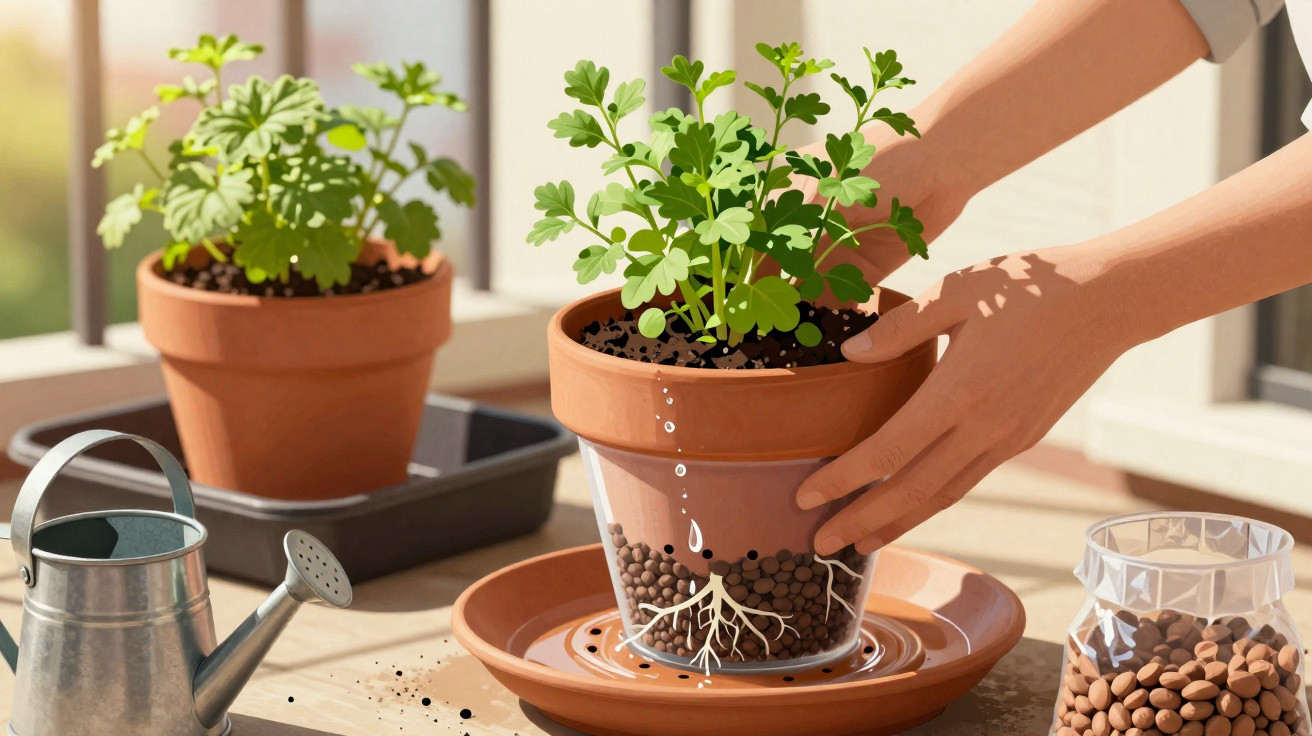
Begin with a pot containing at least one suitably large drainage hole. Next, make a base layer with a few clay pebbles, terracotta fragments or coarse gravel. It should not be deep; it only needs to prevent compost from blocking the hole.
Then add a light, airy growing medium. Choose compost labelled for container plants or herbs rather than dense garden soil. If it seems compact, mix in a handful of sand or perlite. The aim is straightforward: water should pass through, rather than remain there waiting to create problems.
If you are thinking, “I’ve definitely crammed basil into a decorative pot with no hole,” you are certainly not the only one. We have all had that moment when an attractive container matters more than a practical one. The herb looks wonderful on the windowsill... for roughly three weeks.
Then the familiar signs begin: leaves yellow from the bottom upwards, the compost smells sour and fungus gnats hover nearby. You water less, then more, then less again, attempting to correct a problem that is already established below the surface, out of sight.
In reality, nobody lifts every pot to inspect its underside every day. This is why gardeners urge you to deal with drainage while planting, rather than waiting until something starts to go wrong.
One balcony grower in Lyon described it plainly:
“People think they’re killing herbs by neglect. Most of the time, they’re killing them with kindness and no drainage. A pot without a hole is a vase, not a home.”
So, what do experienced gardeners do in practice? They usually work through a straightforward mental checklist:
- Select a pot with at least one proper drainage hole, rather than a decorative imitation.
- Place a thin layer of coarse material, such as pebbles or broken pot pieces, in the base.
- Use a light, free-draining potting mix, never garden soil on its own.
- Water once, allow all excess water to drain, then empty any saucer beneath the pot.
- Lift pots slightly with feet, tiles or wooden slats so that water can flow away freely.
Rethinking how we care for our potted herbs
Once you realise how much herb care depends on the “invisible” area beneath the compost, you begin to view your pots differently. That wilted mint may not need water. That unhappy thyme may not need fertiliser. Often, the real explanation lies at the container's base, where air, water and roots either work together or conflict.
There is something reassuring about accepting this. A dead basil plant does not mean you are hopeless with plants. Perhaps you gave it a bathtub rather than a bed that could breathe. The next time you plant, you may spend an extra minute checking the hole, adding a handful of pebbles and making the mix lighter.
Some gardeners even add extra holes to attractive ceramic pots, or place a plastic nursery pot with excellent drainage inside a decorative outer container. It is a minor change with a major effect.
You may find that, once drainage is sorted, advice to water “when the top inch is dry” suddenly becomes much more reliable. Friends may begin asking why your herbs are so healthy on the same small balcony. You will probably smile, remember that soggy basil from years ago and quietly turn their pot over to inspect the underside.
| Key point | Detail | Value for the reader |
|---|---|---|
| Good drainage is non-negotiable | Herbs in pots die fastest from trapped water and root rot | Helps avoid the most common cause of herb failure |
| Pot and soil choice matter | Use pots with real holes and light, airy mixes with sand or perlite | Gives herbs a root environment closer to natural conditions |
| Simple setup, long-term payoff | Thin layer of coarse material, raised pots, emptied saucers | Healthier plants, fewer “mystery” deaths, better harvests |
FAQ:
Question 1: Can I grow herbs in a pot without a drainage hole if I’m careful with watering? Technically, yes, but gardeners almost universally recommend against it. Even with careful watering, salts and excess moisture accumulate. A safer compromise is to use a nursery pot with holes inside a decorative outer pot.
Question 2: Do I really need gravel or pebbles at the bottom of the pot? A thin layer can help prevent compost from blocking the hole and support water flow. It does not “suck up” water, but it creates a small buffer that keeps roots away from any standing moisture.
Question 3: What kind of soil is best for potted herbs? Choose a good-quality potting mix labelled for containers, not dense garden soil. For Mediterranean herbs such as rosemary or thyme, add some sand or grit to make it drain even more freely.
Question 4: How can I tell if my herb is suffering from poor drainage? Watch for yellow lower leaves, slow growth, a musty odour or compost that remains wet for days. If you ease the plant out and the roots are brown and mushy rather than white and firm, poor drainage is probably responsible.
Question 5: Should I always use a saucer under my pots? Saucers are acceptable, particularly indoors, but they must not stay full. Allow the pot to drain after watering, then empty the saucer so the roots are not left in a permanent puddle.
Comments
No comments yet. Be the first to comment!
Leave a Comment