
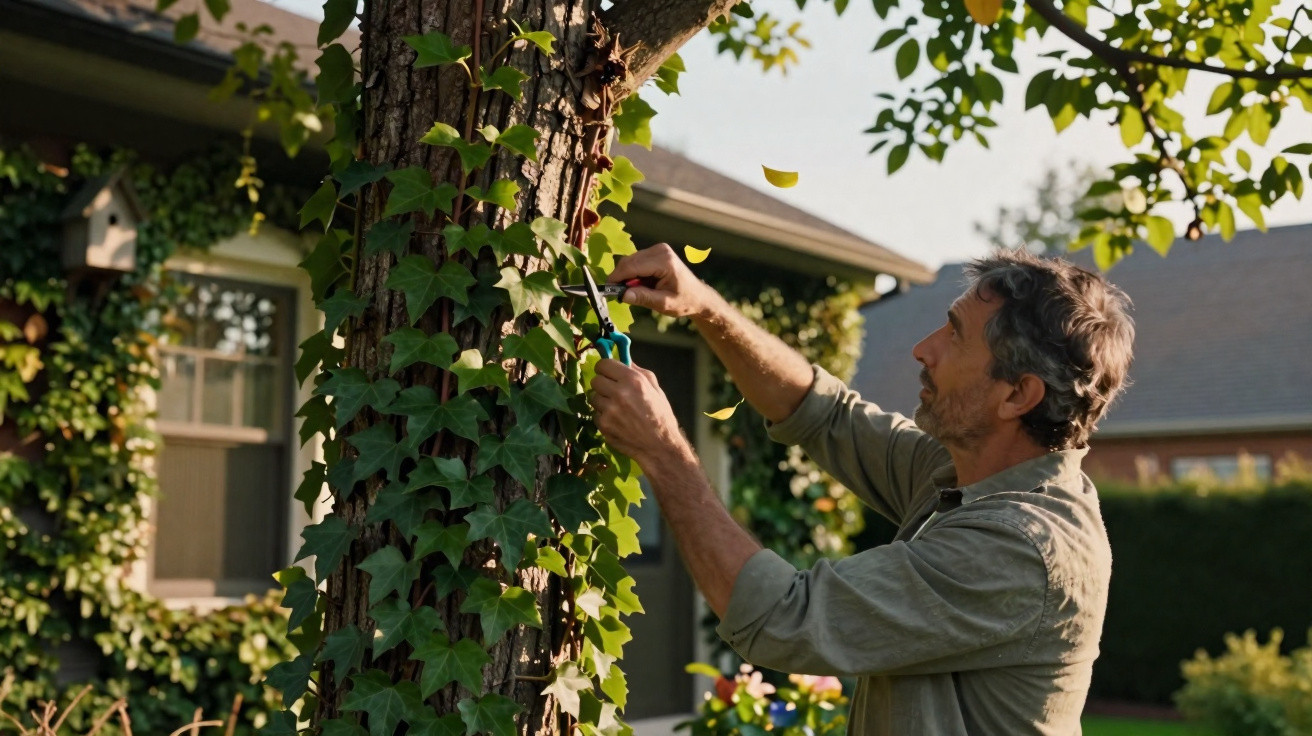
Many amateur gardeners pull ivy from trees and house walls – fearing it will cause damage.
Yet such drastic action can have precisely the opposite effect.
When people see an overgrown tree trunk or a green house façade, they often reach for the secateurs automatically. Ivy is widely regarded as a “nuisance”, a threat to walls and a supposed tree-killing plant. Experts now take a far more nuanced view – explaining when this climber is protective and when it can genuinely cause difficulties.
Ivy is not a parasite – and is often an overlooked ally
At first glance, ivy can seem threatening: dense foliage, thick stems and everything being covered over. Many people confuse it with genuine parasites such as mistletoe. Its biology, however, quickly corrects that assumption.
- Its roots remain in the soil, where they draw up water and nutrients.
- The aerial roots on a trunk or wall act solely as “hooks” for attachment.
- Ivy does not tap into a tree’s vascular system or take water from it.
For a healthy tree, ivy is therefore primarily additional growth rather than a drain on its resources. Experts observe that, provided the tree remains vigorous, ivy has little effect on its growth or lifespan.
“Ivy is not a secret tree killer, but a climber that uses the tree for support – not as a source of food.”
A protective cover rather than an enemy: ivy on tree trunks
On robust trunks, ivy acts like a natural coat. It creates a thick layer of leaves around the trunk, producing several effects that are noticeable in practice.
How ivy protects the trunk
The foliage forms an insulating cushion around the bark:
- Protection from heat: It screens out direct sunlight, so the bark warms up less.
- A buffer against frost: Cold does not reach the trunk as suddenly, making stress cracks in the bark less common.
- Protection from hail and heavy rain: The leaf layer absorbs part of the mechanical impact.
- Moisture regulation: Conditions around the bark remain somewhat more balanced.
At ground level, an ivy cover forms living mulch: it slows erosion, keeps moisture in the soil for longer and suppresses weeds. This can be particularly beneficial during dry summers.
Habitat for birds, insects and small mammals
Ivy is a biodiversity hotspot in the garden. Countless animals shelter among its leaves and shoots:
- Birds use the dense growth for nesting and roosting.
- Small mammals find hiding places from cats and birds of prey.
- Up to around 200 insect species benefit from its nectar, berries or shelter.
Removing ivy radically deprives this miniature ecosystem of its habitat overnight – often during the breeding season or in winter.
When ivy on a tree can genuinely become a problem
Ivy becomes a risk chiefly when a tree is already weakened or has not yet become properly established. In those circumstances, several hazards can combine.
Young and diseased trees are more vulnerable
The following are particularly sensitive:
- young trees with thin bark, such as newly planted fruit trees;
- old, severely damaged specimens with rotten branches;
- trees with visible areas of decay or a heavily thinned crown.
In these cases, dense ivy growth can cast heavy shade over the crown. It deprives young twigs of light, leaving the crown weaker. Its foliage can also conceal damage or fungal infection, meaning the gardener may notice problems only at a late stage.
Greater exposure to wind in storms
Weight and wind exposure are another consideration. If ivy completely envelops the crown, it creates a type of sail. During storms, substantially more pressure is exerted on the trunk and roots. Unstable trees are then more likely to topple or lose larger branches.
“It is not ivy itself that is problematic, but the combination of a weakened tree and dense growth extending into the crown.”
Ivy on a house façade: source of damage or natural shield?
The usual assumption about walls is also that green growth must be removed, otherwise “the render will come away” and “the bricks will crumble”. This concern is only partly justified and depends greatly on the condition of the façade.
When ivy protects the façade
On an undamaged, solid wall, ivy can have surprisingly positive effects:
- The leaves provide a screen against driving rain, so the wall absorbs less water.
- Surface temperatures fluctuate less sharply, which benefits the masonry.
- In summer, the façade heats up less, leaving the rooms behind it slightly cooler.
- In winter, less heat escapes directly through the bare wall surface.
- Fine dust and dirt particles are caught in the foliage, creating a slight local air-cleaning effect.
In this situation, the aerial roots sit only on the surface. They do not pull away sound render, provided it is firmly bonded and not already crumbly.
When ivy genuinely damages walls
Problems arise when the wall is already damaged:
- crumbling mortar joints in the masonry;
- hairline cracks in the render;
- loose bricks or old external walls that have never been renovated.
The aerial roots can grow into these weak points and gradually widen the cracks. Wind movement and moisture increase the strain, allowing water to penetrate more deeply. Over time, this can result in damp damage, loose bricks or blocked gutters if ivy climbs into the rainwater gutter.
“An intact façade usually tolerates ivy surprisingly well – but render that is already damaged does not.”
How gardeners can decide when ivy may stay
Anyone wishing to act according to clear criteria rather than instinct can use a simple checklist.
Checklist for trees
| Situation | Recommendation |
|---|---|
| Strong, deeply rooted tree with a healthy crown | Leave the ivy in place; restrict it every 2–3 years so that it does not grow throughout the crown |
| Old or already compromised tree with rotten branches | Cut back the ivy substantially, especially around the crown, and have its stability assessed |
| Young tree or fruit tree | Keep ivy away where possible, leave the base of the trunk clear and ensure the crown receives sufficient light |
Checklist for façades
- Smooth wall, no cracks, sound render: Ivy may remain; inspect it regularly and keep it away from windows, gutters and ventilation openings.
- Cracks, hollow areas, crumbling mortar joints: Cut the ivy at its base, allow the shoots to die back, then repair the masonry.
- Very old houses that have never been renovated: Check the structural condition first, then decide specifically where planting is suitable.
Pruning ivy properly – without creating garden chaos
If ivy needs to be restricted, proceed gradually. A drastic clear-out destroys nesting sites and suddenly exposes the façade to the weather.
- First cut through the main shoots at ground level that supply the façade.
- Leave the drying stems in place for several weeks so they are easier to remove.
- Identify nests and shelters and, where possible, take them into account when planning the pruning.
- Do not thin out crown areas on trees in the middle of bird breeding season.
This makes it possible to reduce the growth selectively without destroying an ecosystem that has developed over years in one go.
Why a “wild” garden is often more resilient
Ivy represents a wider question: how tidy does a garden really need to be? Closely mown lawns, bare beds and “clean” walls may look neat, but ecologically they are often poorer and more vulnerable to extreme weather.
Features such as ivy-covered walls, hedges, piles of leaves and dead wood create buffer zones against heat, heavy rain and wind. Animals gain places to retreat, while beneficial creatures help control pests. Leaving ivy in place deliberately and intervening only where structural or building-related concerns require it strengthens this natural resilience.
Ultimately, the decision is not about treating ivy as universally good or bad. A more useful approach is to assess each case: how healthy is the tree? What condition is the façade in? Are there alternatives, such as trellises or climbing frames, if the wall is too vulnerable? Asking these questions avoids a great deal of unnecessary work – while also making the garden more resilient and alive.
Comments
No comments yet. Be the first to comment!
Leave a Comment