
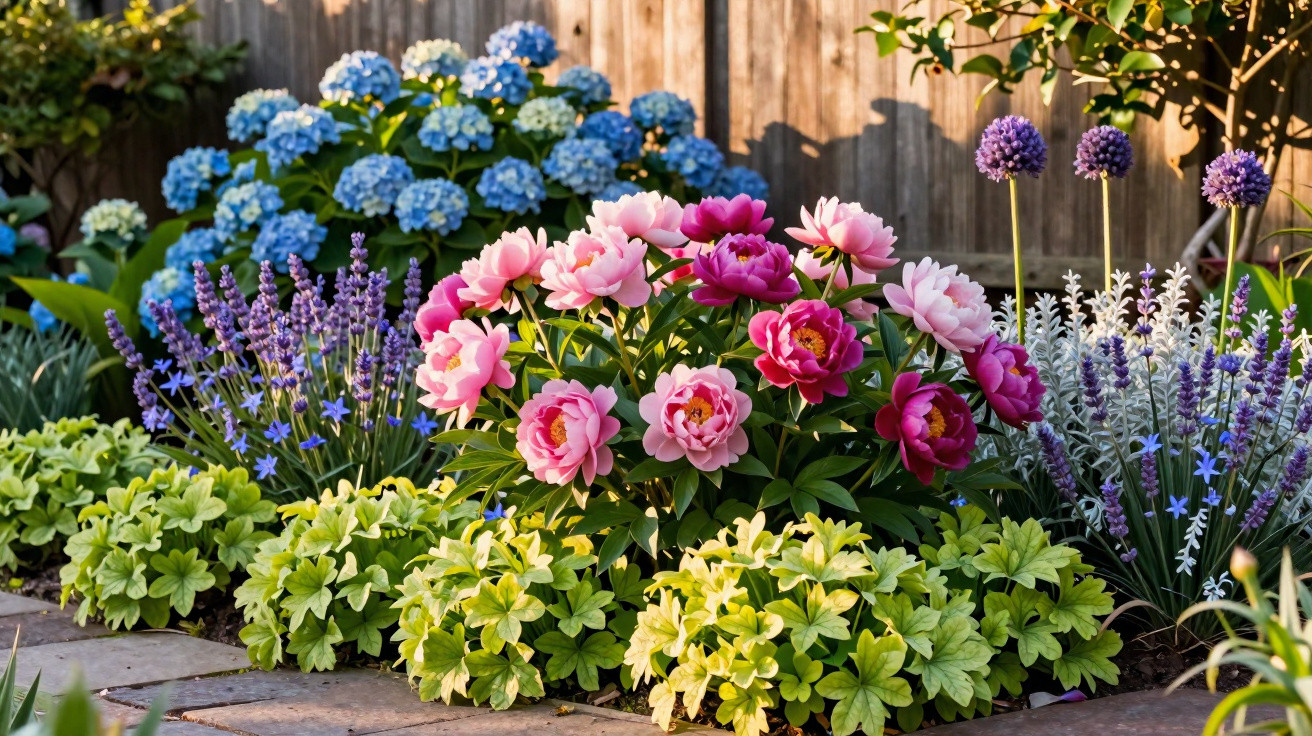
Many garden owners put peonies anywhere in a border, then wonder why the flowers look attractive rather than truly spectacular. The secret often lies not with the peony itself, but with the plants immediately surrounding it: paired with the right perennials, shrubs and scented plants, the border can suddenly resemble a professionally designed show garden.
What peonies need before choosing their companions
To combine peonies successfully, it is important to understand their requirements first. Although these perennials appear tough, they have definite preferences.
- Position: full sun to light partial shade
- Soil: deep, humus-rich and free-draining
- In winter: no waterlogging; the soil must not become saturated
- Spacing: room for air around each plant, without overcrowding
Peonies dislike having to compete around their roots. Vigorous neighbouring plants that take their nutrients and water can restrict their growth. If the perennials are planted too closely together, moisture remains on the foliage for too long. Fungal diseases such as grey mould can then spread easily, while flowers may stick together or rot.
“Peonies flower most beautifully when they have sunshine, space and leaves that dry after rain.”
When planting the border, these three simple rules help to create those conditions:
- Choose only plants with similar light and soil needs.
- Do not place substantially taller perennials immediately in front of a peony.
- Leave a small “air ring” around every plant instead of packing the area with dense planting.
Perennials that make peonies stand out
Alchemilla: a delicate veil for large blooms
Lady’s mantle (Alchemilla) is a classic companion for peonies. It forms low, dense mounds of rounded foliage, with clouds of pale green flowers floating above from early summer onwards. This precise contrast makes the large peony blooms appear even more luminous.
Pastel cultivars, including pink or cream peonies, look notably more intense against lady’s mantle’s almost neon-green flowers. The two perennials barely compete with one another: lady’s mantle stays comparatively low, so it does not deprive the peony of either light or space.
Bellflowers for airy touches of colour
Many varieties of bellflower remain compact, making them well suited to the front of a border. Their bell-shaped flowers extend the flowering period and introduce blue or violet shades, which work exceptionally well alongside pink and white peonies.
Some bellflower species are more prone to attracting aphids and other pests. That need not rule them out, provided they are paired with fragrant “watchdog” plants – more on that later.
Hydrangeas as a calm backdrop
Hydrangeas positioned at the back of the border add structure. Their large, rounded flowerheads echo the shape of peony blooms and enhance the effect of a lavish sea of flowers. The key point is to plant hydrangeas behind the peonies with sufficient space between them, rather than directly alongside them.
When placed correctly, they provide light, localised shade in hot summers without depriving the perennials of all their sunlight. The result is a layered arrangement: rounded peony flowers at the front, hydrangea heads behind them, and loose filler perennials in between.
Flowering succession: keeping the border in bloom from spring to late summer
A peony border has the greatest impact when there is always something happening around it, both before and after the main flowering period. A well-planned succession of blooms ensures there are no empty gaps.
Bulbs and perennials for before and after the peony display
- Bearded iris: usually flowers shortly before peonies, opening the season.
- Ornamental alliums (Allium): produce spherical blooms, often at the same time as peonies or immediately afterwards.
- Daylilies (Hemerocallis): take over in high summer and provide the second major burst of colour.
By mixing these plants thoughtfully, you can create a kind of “wave of flowers”: irises first, followed by peonies, then alliums and finally daylilies. This keeps the border attractive from April to August without the need to keep adding new plants.
“The aim: no bare spell in the border – every plant takes the leading role in its own time.”
Lavender and other protective plants for natural defence
As well as appearance, protecting peonies plays an important part. Some plants act as a natural barrier against pests and browsing wildlife.
Lavender as a fragrant protective wall
Lavender is ideal along the sunny edge of a peony border. It thrives in well-drained soil, needs little maintenance and prefers conditions on the dry side. Particularly interesting is the fact that its essential fragrance deters many unwelcome visitors.
These include:
- Mosquitoes
- Flies
- Fleas and moths
- Some sap-sucking insects
- Wildlife such as deer, which often avoid the scent
Planted in a row along the edge of the border, lavender creates a sort of scented barrier around the peonies. Its blue-violet colouring also harmonises beautifully with pink, white and red blooms.
Ornamental alliums: decorative and useful at once
Ornamental alliums do more than bring graphic, spherical flowers to the border; they also release a faint onion scent. Many insects and some rodents dislike this smell. That gives Allium a dual purpose: an ornamental plant as well as a guard.
Combined with lavender, it creates an unusually effective protective belt – especially where the border includes more sensitive plants such as bellflowers, which can attract pests.
Common mistakes when selecting plants around peonies
Anyone who simply plants “something pretty” beside peonies is often in for a surprise. Some plants are poorly matched to them by nature.
Overpowering grasses and thirsty plants
Very vigorous ornamental grasses can simply overrun peonies over the years. They develop dense root systems, occupy valuable space and draw heavily on water. As a result, the peony may struggle, flower less well or flop over more quickly after rain.
Perennials that require permanently wet soil are equally unsuitable. They encourage a damp microclimate in which fungal diseases spread more readily. In these conditions, peonies are left almost constantly with “wet feet”, something they strongly dislike.
A crowded border without air circulation
A densely planted border may look wonderful in its first year, but it often causes problems later on. When foliage cannot dry after rain, fungal issues become considerably more common. Peonies in particular, with their large flowerheads, need enough room for air to move through the plants.
| Good companions | Challenging companions |
|---|---|
| Lady’s mantle | Vigorous giant grasses |
| Bellflowers (compact varieties) | Perennials for constantly wet soils |
| Hydrangeas set back with space behind | Shallow-rooted plants that crowd everything out |
| Ornamental alliums, bearded irises, daylilies | Densely planted, tall perennials immediately in front |
| Lavender as edging | Thirsty summer-flowering plants that ignore dry spells |
Practical example: what an ideal peony border could look like
Here is a simple layout for a border beside a sunny house wall or along the edge of a patio:
- At the very back: a loose row of hydrangeas to form a calm backdrop.
- In front: two or three groups of peonies arranged in a slightly staggered line.
- Between them: islands of lady’s mantle and bellflowers for fullness and colour transitions.
- In front of and among the perennials: several ornamental allium bulbs and bearded irises for the early season.
- Right at the front edge: an uninterrupted row of lavender as a fragrant, protective border.
This creates a border that remains lively from spring until late summer, attracts fewer pests and naturally directs the eye towards the peonies.
Why this combination with peonies works so well
Peonies naturally bring scale, shape and presence. They are the “leading actors” in the border. Many other perennials, by contrast, serve more as supporting plants or background features. Using this distribution of roles deliberately produces a harmonious garden design.
The major benefit is that peonies are long-lived, improve with age and require little care when the position suits them. Anyone who gives proper thought to their neighbouring plants at planting time can enjoy a border that almost looks after itself for many years.
Those new to the idea can begin on a small scale: a group of peonies, lavender along the edge, lady’s mantle in front and a few allium bulbs. Even this straightforward combination demonstrates how strongly the right companions can enhance the floral splendour of peonies.
Comments
No comments yet. Be the first to comment!
Leave a Comment