
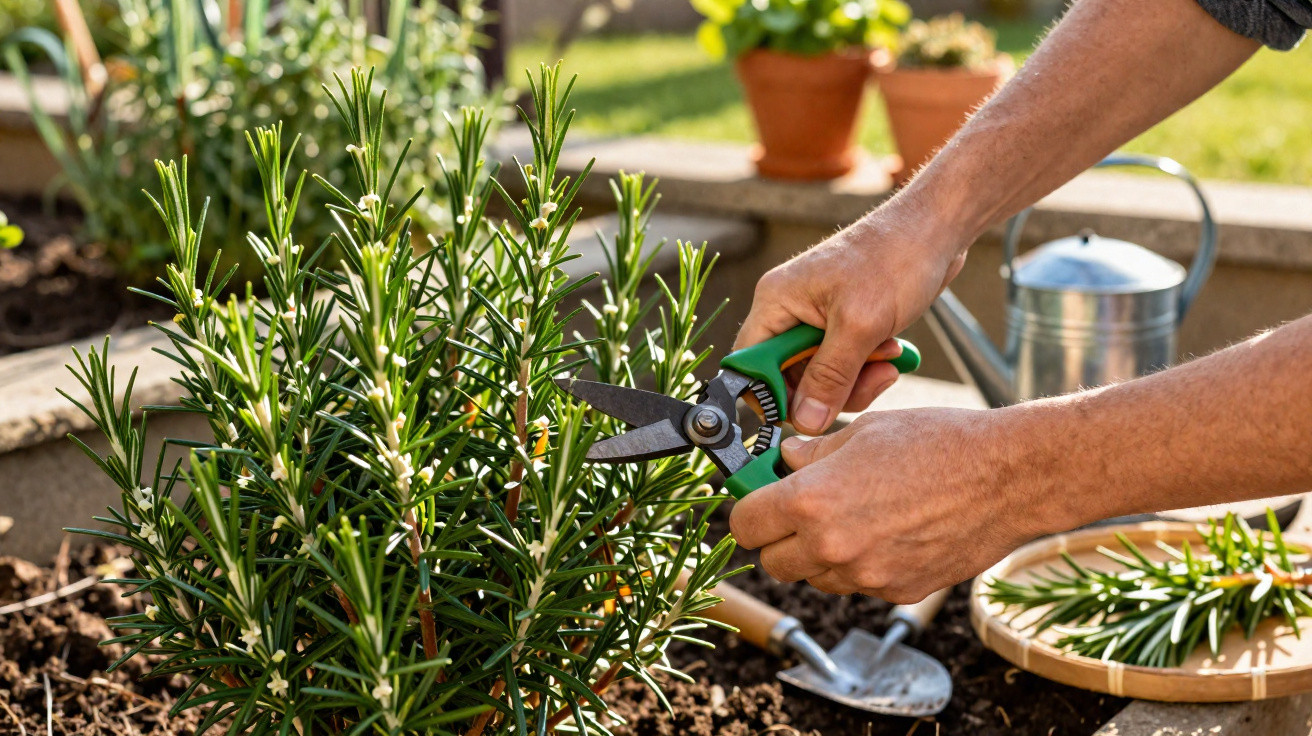
Many amateur gardeners are surprised in spring by a tall, woody rosemary plant that is bare at the bottom and has only a few timid flowers at the top. The good news is that a carefully targeted prune in March can turn the shrub back into a dense, fragrant and abundantly flowering feature. Not only the timing matters: the cutting height is crucial above all.
Why March determines your rosemary’s flowering
Rosemary begins growing again in early spring. From March to April, it produces fresh, soft shoots and closes pruning wounds quickly. At this stage, the plant responds particularly vigorously to cutting. Each cut encourages fresh branching, and most of the later flowers will appear on these young shoots.
If you let March pass without pruning, you risk uneven growth. The shrub will mainly produce long, hard stems that become sparse at the base. Flowering then gathers in the upper section. The lower part of the rosemary looks thin, the overall appearance becomes tired, and insects also find less appealing nectar at eye level.
Pruning in March ensures that rosemary produces flowers not only at the top, but across the plant’s entire height.
In colder areas, check the forecast first: if severe night frosts are still expected, postpone the cut until the second half of March or early April. The plant should not freeze immediately after being pruned.
The ideal cutting height: how far back to prune rosemary in March
The key guide is the so-called one-third rule. It prevents rosemary from being overtaxed and helps to ensure reliable flowering.
Never cut back more than one third of the plant’s current height at one time.
If your rosemary is around 60 centimetres tall, removing roughly 20 centimetres in one session is a sensible guide. Cutting significantly more places too great a demand on the plant’s reserves. The shrub will then take a long time to recover and may flower noticeably less during the current year.
Different rosemary types need different cutting heights
Depending on its age and location, a rosemary shrub needs different treatment. This overview will help you assess it:
- Young rosemary in a border or pot: Trim only 5–10 centimetres from the soft, green tips. The aim is a dense, branched shrub rather than a few long, thin stems.
- Mature garden rosemary (80–100 cm tall): Cut 10–15 centimetres from the still-leafy ends. This keeps the plant stable at roughly this height, encourages plenty of flowers and prevents it from becoming bare.
- Rosemary in a container: Keep it somewhat shorter overall than plants growing in a border. Root space is limited, and wind affects pots more strongly. Compact, relatively broad growth helps protect it from toppling over and drought stress.
- Very old, heavily woody rosemary: Cut only within the green area, where leaves and young, flexible stems are still present. Do not cut into the brown, bare old wood, as it will almost never produce new growth.
If you have a veteran plant in the garden that has completely lost its shape, it is better to work in stages. Spread the corrections over two or three years instead of cutting everything back at once. This keeps the plant vigorous and allows it to produce fresher growth gradually.
The essential steps for a perfect March prune
A little preparation before removing the first shoot tip is worthwhile. It reduces stress for the plant and avoids frustration for you.
- Prune only in dry weather that is not too cold.
- Sharpen and disinfect secateurs or pruning shears beforehand.
- First, judge and visually mark the desired final height on the shrub.
- Always cut just above a small side shoot or bud point.
This allows every cut point to develop into a small cluster of new shoots. Gradually, the plant becomes denser, its crown takes on a rounder shape, and flowering is spread more evenly.
Shaping rosemary into a small dome lets light reach the centre while also slowing the thinning of the base.
Start with the outer growth. The sides can be cut back very slightly lower than the central section. This lets more light reach the interior later and prevents the plant from remaining green only around the outside. Keep checking the overall shape as you work rather than pruning blindly from one shoot to the next.
Where to stop cutting: old wood, frost and other pitfalls
The greatest risk remains cutting into old, brown wood. Where a stem is hard, cracked and leafless, it will usually not produce new shoots. A shrub that is severely bare can then be difficult to save. Therefore, always remain clearly within the green growth, even if the rosemary has become very misshapen.
Timing is another key issue. Do not prune during a frosty spell. Fresh cut surfaces are sensitive, and young shoots can be killed by frost. The ideal day is lightly sunny and dry, with temperatures above freezing – preferably even in double figures.
Very late autumn is also unsuitable. Rosemary should not be strongly encouraged to make new growth just before winter. Fresh, tender shoots would have little time to mature and would be highly vulnerable to frost.
What correct pruning does for flowers, flavour and insects
Well-pruned rosemary rewards the effort in several ways. Numerous new side shoots create more buds, making the flowering display denser. Flowers appear not only at the top of the shrub but also around the middle. This looks more balanced and extends the flowering effect in the border.
Its flavour improves at the same time. Young shoots and fresh foliage contain particularly high levels of essential oils. Regular harvesting and pruning continually encourage these young, aromatic parts of the plant. As a result, a March prune helps ensure that the kitchen benefits from strongly flavoured rosemary in summer and autumn.
Correct pruning also has ecological benefits. More flowering shoots mean more nectar sources for bees, solitary bees and butterflies. Especially in smaller gardens or on balconies, even one healthy rosemary shrub can make a noticeable difference.
Practical example: what a successful March prune looks like
Take a typical rosemary plant in a garden border, about one metre high. It is visibly bare at the bottom, dense at the top and has grown somewhat untidily in places. The aim is a compact shrub around 80 centimetres high, well ventilated and free-flowering.
Proceed step by step:
- Check the height: The current top is at around 100 centimetres. One third of that is roughly 33 centimetres.
- Set the planned cutting height: Aim for 80–85 centimetres. This keeps you comfortably within the one-third rule.
- Shorten the upper shoot ends evenly: Do not cut every tip individually; instead, work across connected sections to retain a clearly rounded form.
- Cut the sides back a little more: This prevents a later “mushroom shape” and creates a gently oval dome instead.
- Finally, remove dead or crossing shoots from the centre, if present: This lets air circulate between the branches and makes fungal disease less likely.
Over the following weeks, new side shoots will form at almost every cut point. After a few months, the rosemary will look noticeably younger, its base will fill out and its flowering will appear more compact and abundant.
How to recognise healthy wood and what “woody” really means
Many gardening beginners are unsure where “green” wood ends and “old” wood begins. A simple test helps: bend the stem gently. If it feels flexible, springs back and carries leaves, it belongs to the area that can still be cut. Brown, hard wood snaps or barely moves and often carries no leaves at all.
Rosemary becomes woody from the base upwards as it ages. This is natural and helps support the plant. It becomes problematic when almost nothing but woody, bare growth remains and the green tips sit only like a ring at the top. In that situation, a careful restorative prune spread over several years is sensible, and sometimes replacing the plant is the more honest solution.
Further care tips to complement March pruning
A neatly pruned rosemary plant responds well to a little support. Straight after pruning, you can apply a light organic feed, such as a thin layer of mature compost around the plant. For a pot-grown plant, a small amount of Mediterranean herb fertiliser is enough. Too many nutrients may encourage green growth, but can partly reduce the flavour.
If you harvest heavily, use smaller corrective cuts during summer instead. Remove only the current shoot tips; this amounts to continuous, gentle shape maintenance. It keeps the major intervention needed the following spring smaller and ensures the shrub remains attractive over time.
There is another interesting benefit: regular pruning also allows rosemary to be shaped deliberately. Low balls, small hedges along a path or geometric forms in pots are not created by one major cut, but by repeated small corrections built on the March prune.




Comments
No comments yet. Be the first to comment!
Leave a Comment