
Many people have no idea what this reveals about their garden.
Anyone who spots a hoopoe in their own garden is unlikely to forget it. With its striking erectile crest, this bird looks as though it has flown in from a distant savannah. Its presence is not accidental: it says a great deal about soil quality and the way the plot is designed, while also carrying a powerful symbolism of renewal and inner guidance in many cultures for centuries.
An exotic visitor in the front garden: how to identify a hoopoe
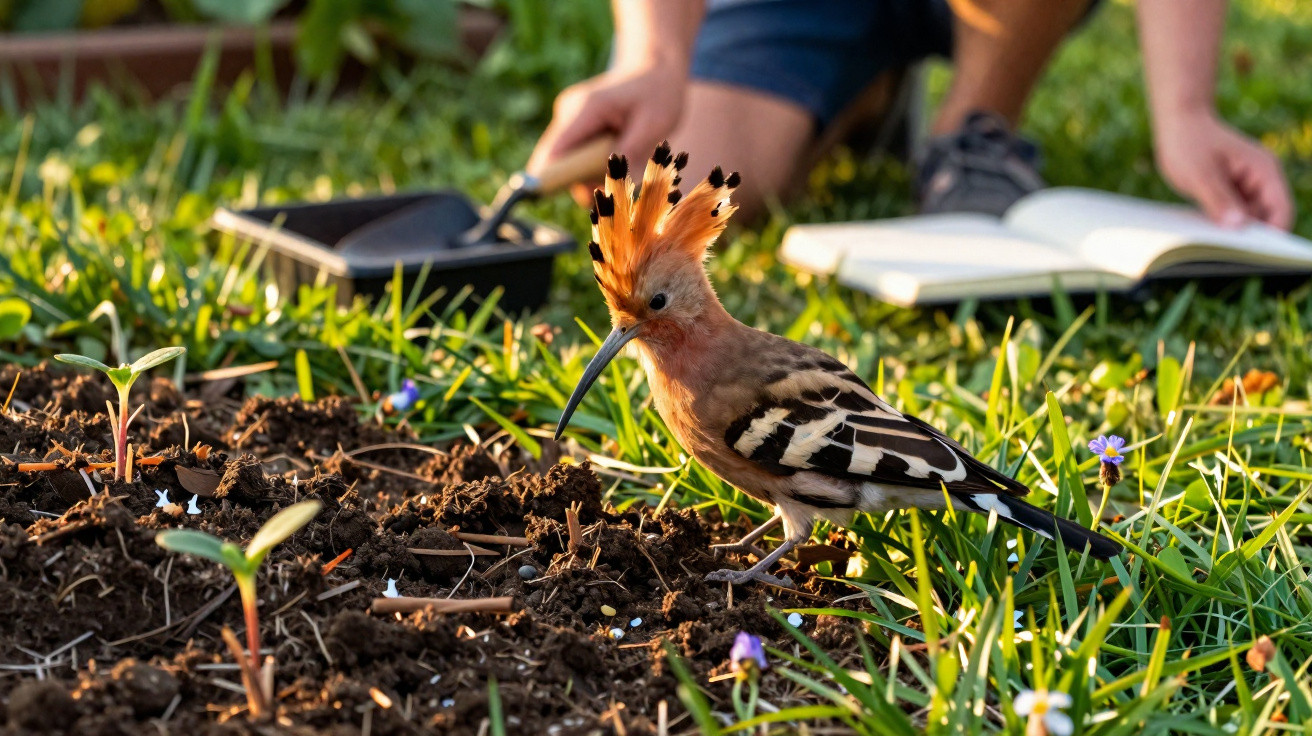
The hoopoe (Upupa epops) is one of those birds that even beginners can identify instantly. Roughly the size of a starling, it is sandy to orange-brown in colour and has a distinctive feather crest on its head, which it can raise like a crown. Its broad wings are boldly striped in black and white; in flight, the pattern can look almost like a fluttering zebra.
Its call is equally characteristic: a three-syllable “hup-hup-hup” that may carry across meadows and gardens on warm spring days. If you hear this call and then see a bird probing the soil with a long, slightly curved bill, you are very likely looking at a hoopoe.
“A hoopoe in the garden is not a decorative highlight, but a clear signal: something is right with the soil here.”
What a hoopoe reveals about your soil
Biologically, the hoopoe is a highly specialised insect-eater. It feeds almost entirely on creatures found in, or directly on, the ground. These include:
- Cockchafers’ grubs and larvae
- Mole crickets
- Larger beetles and their larvae
- Caterpillars and other larvae living in the soil
- Crickets and other large insects
To find enough food, it needs areas where the soil is teeming with life. This is where its importance for amateur gardeners begins: if a hoopoe stays for several consecutive days or returns every year, it strongly suggests healthy, living soil with a plentiful insect population. Such soil is generally:
- not contaminated with harsh chemical products
- rich in structure and loose enough for the bird to probe with its bill
- partly bare, rather than completely overgrown
The bird therefore acts as a natural bioindicator. Where it is able to hunt, there is often a garden that is not constantly sprayed, where fallen leaves are allowed to remain and where a little intentional “untidiness” is accepted.
Why your garden may be attractive to a hoopoe
The hoopoe is a devoted sun-lover. It avoids dense woodland and favours open, warm landscapes, such as traditional orchards, vineyards and extensively managed grassland, as well as gardens arranged in a similar way. It is especially drawn to:
- closely mown lawns beside patches of open soil
- sunny spots without permanent shade from tall trees
- quiet corners with little traffic noise and limited visitor activity
- old trees, gaps in walls or nest boxes with larger entrance holes
A garden that looks partly tidy while deliberately retaining a few wilder areas can quickly become highly appealing to this bird. In tightly designed plots that are fully planted and continually maintained by robotic mowers, it is seen far less often.
A migratory bird with a purpose: why its arrival is not random
The European hoopoe spends winter mainly south of the Sahara. In spring, it migrates northwards and reaches German-speaking regions between around March and April, depending on the area. It usually remains until late summer or early autumn.
It is particularly common in warm regions with traditional agriculture, including Mediterranean-style valleys, wine-growing areas and sunny rolling landscapes. In more northern or heavily urbanised locations, every sighting is almost a small event. If a hoopoe chooses your garden, this points to:
- a favourable microclimate: warm, sheltered from wind and sunny
- enough food in the soil
- relatively little disturbance, especially in the morning and evening
Experts have observed that, following pronounced declines during the 1990s, the species has slowly begun to increase again. Changes in farming, reduced use of insecticides in some regions and rising temperatures in Europe all play a part. Even so, the hoopoe remains locally rare, so its visit is still something of a quality mark for your garden.
An ally in the fight against pests
For amateur gardeners, this bird is not merely an intriguing guest but also a quiet helper. It preferentially eats larvae that might otherwise gnaw at roots or strip vegetable beds bare. These include, for example:
- grubs that damage grass roots
- processionary moth caterpillars, which can themselves be problematic for people and animals
- various beetle larvae that may harm planted beds
“Supporting the hoopoe reduces the need for chemical pest control – almost like having a free biological service provider.”
It is therefore regarded as a “regulator” in ecological gardening. It helps maintain balance by limiting population explosions of certain insects without wiping them out altogether.
The hoopoe’s role in ancient myths
Long before biologists described it as a bioindicator, the hoopoe had acquired a powerful symbolic role. In ancient stories from the Middle East, it is portrayed as a guide in the search for truth and inner clarity. Its eye-catching crest and distinctive call made it an ideal “messenger between worlds”.
It also appears in written symbols from ancient Egypt, often associated with gratitude and family bonds. In some regions, it was given the nickname “king bird”, as its raised crest resembles a small crown.
Many people still interpret its visit as a positive sign: an indication of renewal, a change in their own lives or a setting where natural processes are once again able to unfold. Whether or not one believes this, simply recognising that the bird appears only under certain conditions often changes how people view their own garden.
How to make your garden hoopoe-friendly
Anyone wishing to improve the chance of a visit, or encourage a bird that is already present to stay, can make a significant difference with a few focused measures:
- Avoid pesticides. Broad-spectrum chemicals kill not only “pests” but also the hoopoe’s prey. A poison-free garden is the essential starting point.
- Allow patches of bare soil. Not every area needs dense planting. Small, sunny areas of earth make it easier for the bird to find food.
- Leave some corners undisturbed. Nest cavities in old trees, cracks in walls or sheds can provide potential breeding sites. Do not cut everything down or seal every gap.
- Put up nest boxes. Large cavity nest boxes with wide openings may be accepted if they are hung in a quiet, sun-exposed position.
- Limit noise and disturbance. Particularly during the breeding season from April to June, peaceful mornings and evenings can help the bird remain.
A small warning for sensitive noses: hoopoes can “perfume” their nest site with a pungent-smelling secretion to deter enemies. People are unlikely to find this scent especially pleasant. Anyone hoping to support the bird should be aware of, and tolerate, this trait.
What a hoopoe visit means in practical terms for garden owners
Seeing a hoopoe in the garden can prompt people to reconsider their gardening routine. Chemical measures against grubs or caterpillars suddenly seem counterproductive once you see that a rare bird feeds precisely on these animals. Many amateur gardeners then begin to work more with nature rather than against it.
A useful approach is to combine well-kept areas where people enjoy spending time with wilder zones consciously “left to nature”. In these areas, insects can complete their life cycles, which is essential if a hoopoe is to find anything to eat at all.
For those with children, a hoopoe in the garden provides an ideal starting point for conversations about biodiversity, migratory birds and climate change. The bird makes visible what normally happens out of sight beneath the soil: a dense network of relationships between plants, insects, birds and people.
Why looking at the soil suddenly becomes more exciting
Healthy garden soil has a mildly earthy smell, crumbles in the hand and contains earthworms, beetles and larvae. At first, none of this may appear remarkable, yet it is the key to a visit from a bird that feels like an exotic guest of honour. Understanding the hoopoe naturally makes people pay closer attention to ground cover, mulch, humus-building and the deliberate avoidance of chemicals.
The garden is transformed from a “green stage” into a genuine ecosystem. A single bird becomes a visible sign that complex life is taking place beneath the turf, and that every gardening decision has direct consequences. That interaction is exactly what makes it so special when an orange-brown shadow suddenly darts over the lawn, raises its crest and announces the start of a new gardening season with a quiet “hup-hup-hup”.
Comments
No comments yet. Be the first to comment!
Leave a Comment