
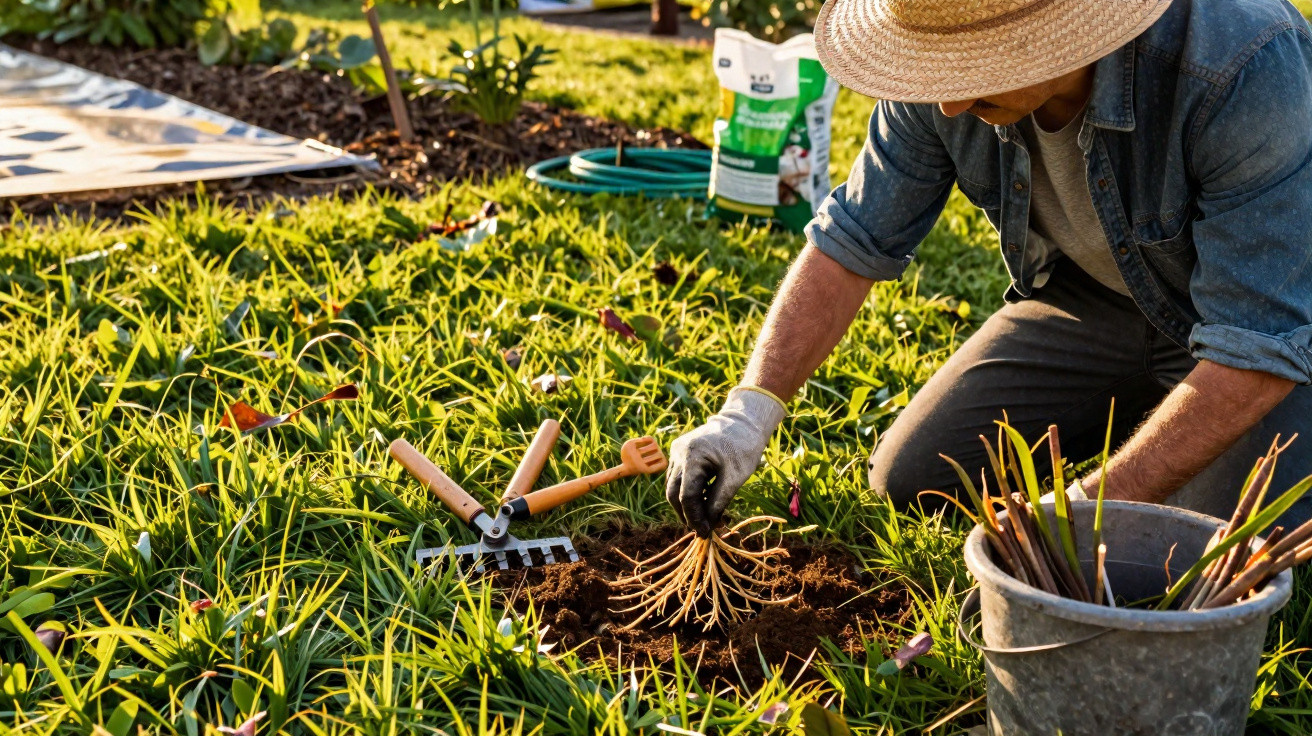
Many amateur gardeners end up at their wits’ end with this unassuming yet highly aggressive weed. Once Nutgrass (Cyperus rotundus) gets into your lawn or flower bed, you quickly learn one thing: simply pulling it out barely helps, because it keeps coming back. With the right approach, however, you can push this nuisance back step by step - and in many cases remove it entirely.
What makes Nutgrass so hard to deal with
Botanically speaking, Nutgrass is not a true grass at all, but a sedge. That’s precisely why it is so persistent. Underground, it develops a dense network of rhizomes and small tubers. New shoots can emerge from each of those tubers - even from tiny remnants.
"The real problem isn’t above ground, but up to 30 centimetres below the surface."
Unlike many other weeds, Nutgrass can thrive in a wide range of conditions:
- in wet, poorly drained lawn areas
- in dry, sandy corners
- in vegetable beds and perennial borders
- along transitions between lawn edges and paths
To control Nutgrass successfully, you need patience, a plan, and several methods that work together.
Identifying Nutgrass reliably: what the nuisance looks like
The first step is always correct identification. Nutgrass is often mistaken for ordinary lawn grass or clover. A few features make it unmistakable.
Typical signs in a lawn
- Stems: triangular rather than round - when rolled between your fingers they feel angular
- Leaves: usually grow in groups of three from the base of the stem
- Colour: often slightly darker and glossier than the surrounding turf
- Growth: shoots noticeably taller than the rest of the lawn just a few days after mowing
In mid-summer, Nutgrass shows another tell-tale feature: yellowish-brown flower heads form at the stem tips, clearly different from normal grass seed heads.
Below ground it is even more distinctive. The plants are connected by chains of rhizomes with small tubers. Each individual tuber can produce multiple new shoots - even if the visible growth has already been removed.
Manual methods: tackling Nutgrass with elbow grease
If you want to avoid chemicals, or you only have small patches in the garden, mechanical control is a sensible starting point. It takes effort, but it can work if you stay consistent.
Proper digging out instead of quick pulling
Yanking at the blades until they snap is pointless. The root system remains in the soil and often regrows faster than before. A structured approach is far more effective:
- Water the area thoroughly the day before so the soil softens.
- Use a weed knife or digging fork to loosen the soil around the plant.
- Grip the plant low at the base and pull upwards slowly and steadily.
- Open the soil with your hand or fork and collect as many nearby tubers as possible.
- Dispose of everything in a sealed bag - do not put it on the compost.
- Check the spot weekly over the next few weeks and dig out any fresh shoots immediately.
The earlier the infestation, the better these techniques perform. Acting quickly can save you years of ongoing effort.
Rotavating - risky, but sometimes necessary
A powered mower or garden rotavator can sound tempting: one pass and the job is done. With Nutgrass, that’s dangerous. Every chopped-up tuber can become a new plant. If you rotavate without understanding the risk, you often spread it across the entire garden.
Repeated rotavating can make sense when you plan to completely rebuild a heavily infested area. If you go down that route:
- Work only the affected section, not the whole garden.
- Rotavate several times at intervals of about two weeks.
- Let shoots appear in between so the tubers are forced to use up energy.
The principle is simple: make the plant sprout repeatedly and destroy it again and again until the tubers’ reserves are depleted.
Solarisation: using the sun as an ally
In beds you intend to redesign anyway, a more drastic option can be worth it: solarisation. The area is essentially “cooked” under plastic sheeting for several weeks.
- Water the area thoroughly so heat penetrates deeper into the soil.
- Stretch clear plastic tightly over the ground and weigh down the edges with soil or stones.
- Leave it in place for four to six weeks during the hottest part of the year.
Under the plastic, soil temperatures rise significantly - in very hot summers often above 60 degrees Celsius. That can damage many tubers so severely that they fail to resprout later.
"Solarisation takes patience, but in return it delivers a relatively chemical-free ‘deep clean’ of entire bed areas."
Chemical options: when they help - and when they don’t
On larger areas or where Nutgrass has been established for years, mechanical methods alone are often no longer enough. Many people then turn to herbicides. The key is choosing the right product and applying it at the right time.
| Herbicide type | Active ingredient | Suitable timing | Typical interval before next application |
|---|---|---|---|
| Selective against Nutgrass in lawns | Halosulfuron-methyl | Growth phase, 3–5 leaves per shoot | 6–8 weeks |
| Non-selective, for whole areas | Glyphosate | Strong growth before dormancy | usually one application |
| Pre-emergent treatment | Sulfentrazone | Early spring before sprouting | about once per year |
Selective products: Nutgrass out, lawn stays
Products containing Halosulfuron-methyl are widely regarded as a targeted tool against Nutgrass without wiping out the entire lawn. They act through the leaves, are transported into the tubers, and weaken the plant from within.
For good results, the following points matter:
- Plants must be actively growing (late spring to early autumn).
- Each shoot should have at least three to five leaves.
- Avoid watering for a few hours after application and don’t apply when rain is likely.
One treatment is often not enough. After six to eight weeks, check whether new shoots appear and treat again if needed.
Glyphosate: a reset for severe problem areas
If an area is so badly infested that there is hardly any lawn left, starting over can be the most practical option. In that situation, total herbicides containing glyphosate may be considered. They kill not only Nutgrass, but all green plants in the treated area.
A common process in these cases is:
- Wait for a nutrient-rich growth period and allow Nutgrass to grow.
- Apply the product across the whole area during strong growth.
- Let plants die back completely - don’t mow too early.
- Remove dead growth, loosen the soil, and wait at least two weeks.
- Then sow new grass seed or lay turf.
Before taking this step, be aware that glyphosate is publicly debated and must always be used according to the manufacturer’s instructions and the relevant regulations.
Preventative products: blocking germination
Active ingredients such as Sulfentrazone form a kind of chemical barrier in the top layer of soil. Germinating plants are disrupted before they become visible above ground. These products mainly target new seedlings rather than established tubers. They can be useful alongside selective treatments to reduce new establishment.
Prevention: creating conditions where Nutgrass has little chance
The strongest strategy against Nutgrass begins long before you see the first blade. A dense, healthy lawn leaves little space for this invader. The more resilient your garden ecosystem, the less room there is for problem weeds.
Mowing and watering correctly
- Never remove more than one third of the blade height in a single cut.
- Mow slightly higher - longer grass shades the soil and suppresses seedlings.
- Water deeply but less often instead of light daily watering; this encourages deeper rooting and tougher turf.
- Prevent waterlogging consistently, for example with aeration or drainage.
Nutgrass favours persistently wet or compacted spots. Fixing these weak points removes its preferred habitat.
Test the soil and fertilise with intent
Healthy soil helps your lawn compete more effectively against weeds. A soil test every few years provides guidance on pH and nutrient levels, allowing you to adjust feeding accordingly:
- Don’t apply high nitrogen “just in case”; feed according to need.
- Reseed bare patches quickly after scarifying.
- For heavily compacted soils, improve structure with sand or compost.
Mulch and coverings in beds
In perennial borders and vegetable beds, a thick mulch layer can help against Nutgrass. A 3 to 4 centimetre layer of bark mulch, woodchips, or straw reduces light at the soil surface. In stubborn problem beds, add a weed membrane under the mulch.
"If you check beds regularly and remove isolated finds early, you stop entire tuber networks from spreading."
What many people don’t know: background and risks
In some parts of the world, Nutgrass is considered among the most economically damaging weeds because it causes major yield losses in agricultural crops. Those same traits make it so aggravating in private gardens: rapid spread, strong adaptability, and a tough root system.
The plant is not poisonous to people, and in some cultures it is traditionally regarded as a medicinal plant. In ornamental and productive gardens, however, it still creates problems because it crowds out other plants, draws nutrients, and spoils the tidy look of an area.
Practical combinations for everyday gardening
In real gardens, a single method rarely solves the issue on its own. Many amateur gardeners get the best results from combining approaches:
- Dig out early patches by hand and follow up consistently.
- On larger areas, use selective herbicides while improving overall lawn care.
- Solarise beds in summer when you’re planning to replant them.
- Build a tougher, denser lawn over time through sensible feeding, watering, and mowing height.
If you accept that Nutgrass control is not a one-weekend job but a process across multiple seasons, frustration tends to drop. Every shoot you suppress and every tuber you remove weakens the colony. With well-chosen methods and a bit of perseverance, this “grass imitator” can be pushed back more and more each year.


Comments
No comments yet. Be the first to comment!
Leave a Comment