
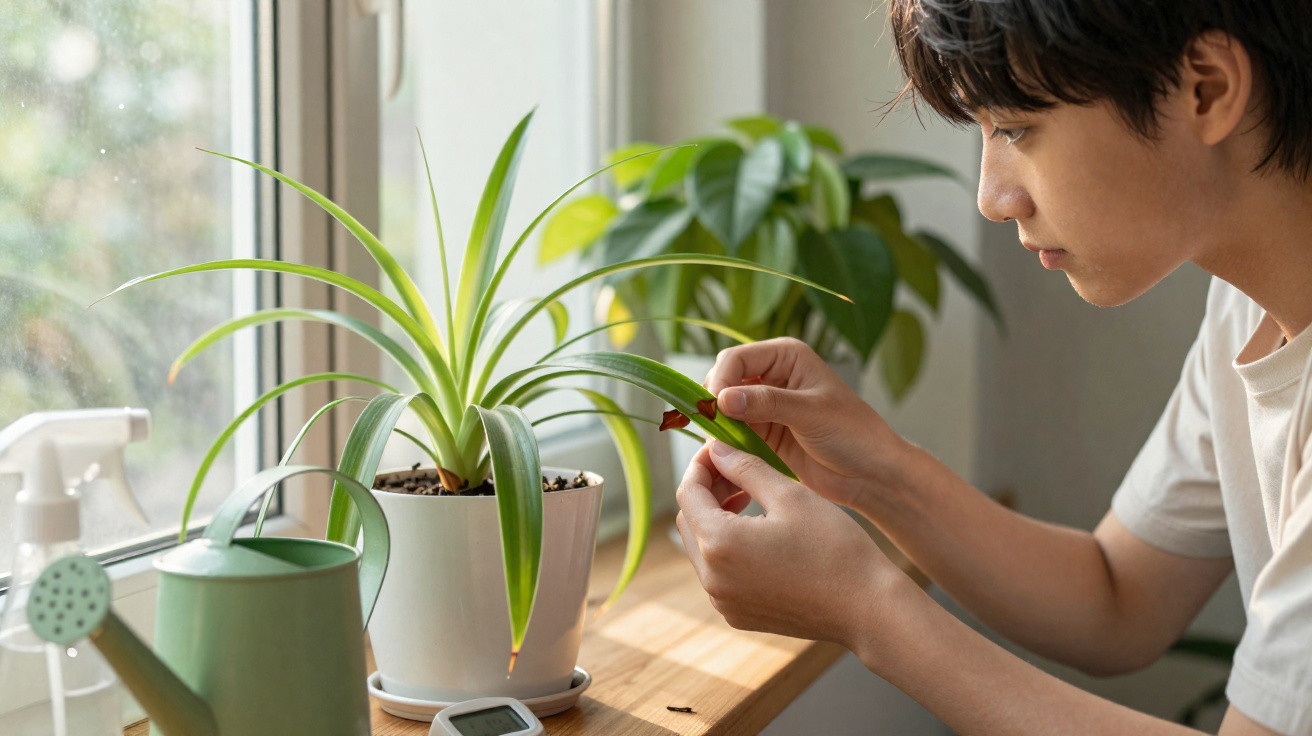
Many owners only realise something is wrong with their spider plant when they spot snapped leaves or blades that have folded into odd angles. The watering can is ready, the position seems fine - yet the foliage looks more stressed than decorative. In most cases, that kind of damage points to more than an unlucky knock as you walk past.
What healthy spider plant leaves should look like
A typical spider plant forms a thick fountain of long, narrow leaves. They are a bright green; many varieties are striped green and white. The leaves arch down in a soft curve - like a small indoor leaf fountain.
A healthy plant is usually characterised by:
- leaves that feel springy and flexible
- no hard creases or sharp angles
- a midrib that follows the curve evenly
- no mushy, translucent or completely dried-out patches
So a strongly arched leaf on its own is not a warning sign. It becomes a concern when there is a distinct kink - as if the leaf has been sharply folded over once. If you can feel a definite crease at that point and the tissue turns yellow or brown, or becomes paper-thin, the internal transport channels have already been damaged.
"A true ‘kinked leaf’ can hardly do any work for the plant - it moves water and nutrients less effectively and can no longer handle light properly."
Why leaves snap: the most important causes at a glance
Not every broken leaf is a big deal. When the same problem keeps appearing, though, it is usually linked to care.
Pure “accident damage”: mechanical stress
If the pot sits somewhere busy, small mishaps are often enough:
- a leaf gets trapped while dusting or vacuuming
- the pot is knocked off a windowsill
- children’s hands or cat paws acting as “gardeners”
- leaves caught between the pot and the saucer
If it is only a few isolated kinks and the rest of the plant looks normal, it is usually sufficient to remove the affected leaves cleanly and make the spot more secure.
Too much water: slow-building stress in the pot
One of the most common reasons for kinked, soft leaves is waterlogging. The roots are starved of oxygen, begin to rot and can no longer take up water properly - which is paradoxical given there is plenty of moisture in the pot.
Typical signs include:
- leaves become soft, look “tired” and bend more easily
- discolouration towards yellow and brown
- compost stays wet for longer than two or three days
- heavy, compact compost that barely dries out
Rule of thumb: only water when the top 5 cm of the compost has dried out. If you are unsure, test with a finger or use a simple moisture meter.
Too little water: when leaves snap like dry straw
Most people recognise the other extreme when watering gets delayed: the compost pulls away from the edge of the pot, feels dust-dry, and water runs straight through when you finally water.
In this situation you often see:
- brittle, rustling leaves
- brown tips and edges
- pronounced creasing; leaves roll inwards along the sides
"With drought stress, the leaf tends to break in a brittle way - less of a soft bend and more of a proper snap."
A quick “sip from the top” will not solve it. The pot needs soaking thoroughly, ideally by standing it in a bowl of water until no more air bubbles rise. Then let it drain well.
Root damage, light levels and dry air from central heating
When several factors overlap, the overall look can deteriorate quickly.
- Roots starting to rot: the plant feels soft overall, leaves droop, and some kink right at the base. When you lift the root ball out, you may notice brown, mushy roots, often with an unpleasant smell.
- Too little light: the spider plant leans noticeably towards the window; new leaves come in thinner and longer, and they kink more easily in the upper third.
- Very dry air: especially in winter above a radiator: the tips dry out, turn brown and become brittle, and the whole plant can look scruffy.
What to do with kinked and broken leaves
A leaf with a severe kink will not straighten again. Damaged transport tissue does not repair itself like a broken bone.
Best approach:
- use a clean, sharp knife or pair of scissors
- cut the affected leaf off right at the base
- allow the cut to dry briefly; do not soak the plant immediately afterwards
"Spider plants are among the tougher houseplants. If you remove damaged leaves and adjust the care, they usually push out fresh, healthy growth quite quickly."
Emergency plan if you suspect root rot
If the leaves remain limp even after more cautious watering, it is worth checking inside the pot:
- gently remove the plant from the pot
- cut away black, slimy, foul-smelling roots generously
- keep only firm, lighter-coloured roots
- repot into fresh, well-draining compost, ideally with a little sand or expanded clay
- choose a pot with a drainage hole and always empty the saucer
After this kind of intervention, a spider plant needs a few quiet weeks - but it must not be allowed to dry out completely. The compost should be lightly moist, not wet.
How to prevent new leaf problems effectively
The right watering rhythm
A simple routine offers the best protection:
- always check before watering - finger test or a meter
- water less often but more thoroughly, rather than constant little splashes
- tip away standing water in the outer pot consistently
Position, humidity and nutrients
Spider plants like bright light, but not harsh midday sun. A spot near an east- or west-facing window works well. In very dark corners they grow weak and leggy, and leaves then kink far more easily.
The air should not stay extremely dry for long periods. If you do not want to use any equipment, place the pot on a tray with pebbles and water - without the root ball sitting directly in the water. Wiping the leaves regularly removes dust and supports photosynthesis.
A moderate dose of green plant feed once a month during the growing season is enough. Overfeeding leads to salt build-up in the compost, which stresses roots just as much as repeated drought or constant wetness.
What the leaves can tell you about the care mistake
| Leaf appearance | Possible cause |
|---|---|
| soft, kinked, yellowish, compost constantly wet | too much water, risk of root rot |
| brittle, breaks easily, compost dust-dry | too little water, drought stress |
| long, thin leaves, leaning towards the window | lack of light |
| brown tips, rest of plant healthy | dry air or slightly inconsistent care |
Why spider plants forgive so much - yet still send clear signals
Spider plants are often seen as a “beginner’s plant”. That is exactly why they are frequently left to tick along in the background with very little attention. They cope with a surprising number of mistakes, draw on their reserves and still produce new leaves - until, at some point, the warnings become harder to miss.
Kinked, broken or badly deformed leaves are one of those clear messages. If you take that warning seriously, adjust your watering habits and reassess the position, you can usually enjoy a dense, fresh “indoor fountain” for a long time. And if an older plant really cannot be saved: healthy plantlets can quickly be potted up into a new plant - this time with a closer eye on compost, water and light.



Comments
No comments yet. Be the first to comment!
Leave a Comment