
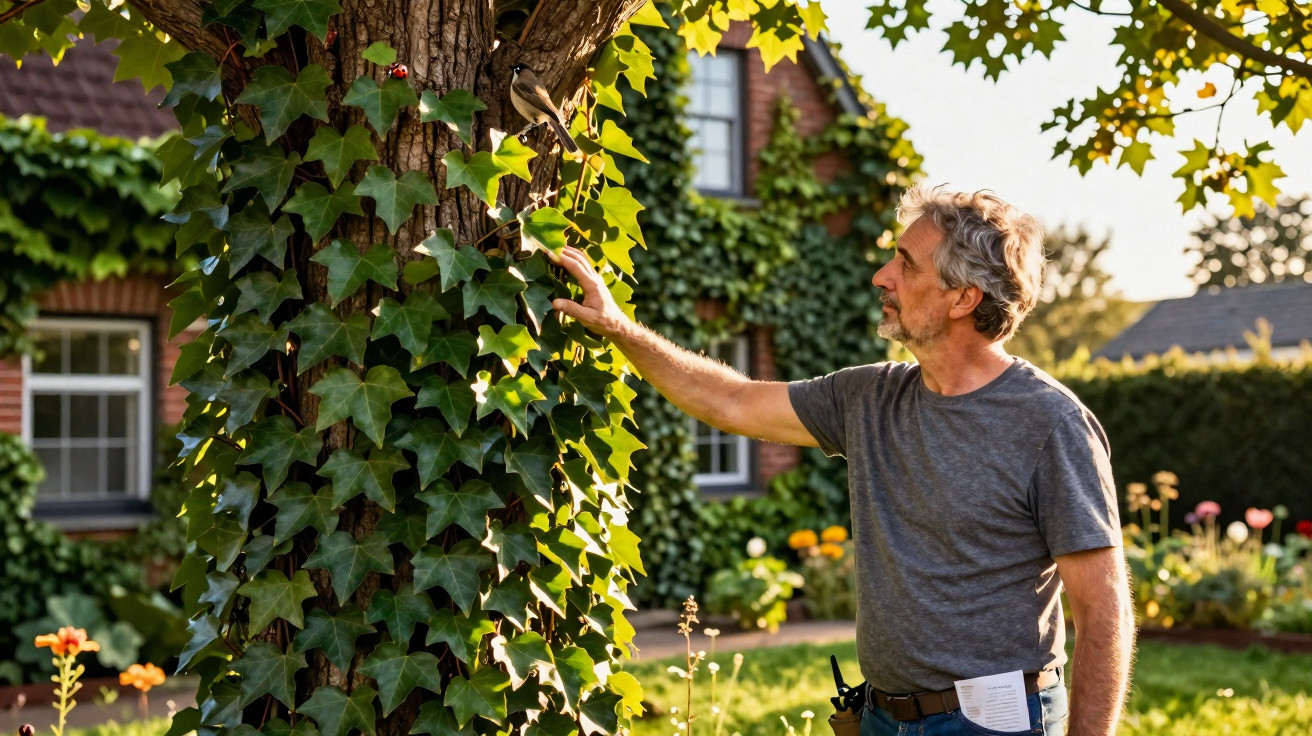
Radically cutting everything back can easily achieve the opposite of what you intended.
When people see an overgrown tree trunk or a house façade covered in green, they often reach for the secateurs on instinct. Ivy is widely labelled a “nuisance”, blamed for damaging walls and even accused of killing trees. Specialists now take a much more nuanced view-and explain when this climber is beneficial and when it genuinely causes problems.
Ivy is not a parasite – and often an underrated helper
At first glance, ivy can look intimidating: thick foliage, hefty stems, and a surface that seems to disappear under growth. Many people mistake it for true parasites such as mistletoe. A look at the plant’s biology clears up the misunderstanding.
- The roots stay in the soil, where the plant takes up water and nutrients.
- The clinging roots on a trunk or wall function only as “hooks” for support.
- Ivy does not tap into a tree’s vascular tissue and does not steal the tree’s water supply.
For a healthy tree, ivy is therefore mainly an additional layer of growth rather than a leech. Experts observe that as long as the tree remains vigorous, ivy tends to have little effect on overall growth or lifespan.
“Ivy isn’t a secret tree killer; it’s a climber that uses the tree as support-not as a food source.”
Protective cloak rather than enemy: ivy on tree trunks
On robust trunks, ivy can act like a natural coat. It forms a dense layer of leaves around the stem-and that can have several practical effects.
How ivy protects the trunk
The foliage works like insulating padding around the bark:
- Heat protection: It shades the trunk from direct sunlight so the bark heats up less.
- Frost buffer: Cold reaches the trunk less abruptly, so tension cracks in the bark occur less often.
- Protection from hail and heavy rain: The leaf layer absorbs part of the mechanical impact.
- Moisture regulation: Conditions right around the bark are a little more stable, creating a more even microclimate.
At ground level, an ivy mat functions as living mulch: it slows erosion, helps the soil retain moisture for longer, and suppresses weeds. In dry summers, that can be a real advantage.
Habitat for birds, insects and small mammals
Ivy can be a biodiversity hotspot in the garden. Countless animals shelter among the leaves and shoots:
- Birds use the dense growth for nesting and as a night-time roost.
- Small mammals gain hiding places from cats and birds of prey.
- Up to around 200 insect species benefit from nectar, berries, or refuge.
If ivy is removed abruptly, this mini-ecosystem can lose its habitat overnight-often right in the middle of the breeding season or during winter.
When ivy on a tree can genuinely become a problem
Ivy becomes risky mainly where the tree is already weakened or not yet firmly established. In those situations, several hazards can overlap.
Young and diseased trees are more vulnerable
Particularly sensitive are:
- young trees with thin bark, such as newly planted fruit trees,
- old, badly damaged specimens with rotten branches,
- trees with visible decay patches or a heavily thinned canopy.
In these cases, dense growth can shade the crown significantly. Ivy can take light from young shoots, leaving the crown weaker. Leaves may also conceal damage or fungal infection, meaning the garden owner notices problems later.
More surface area in storms
Another factor is weight and wind load. When ivy envelopes the crown completely, it creates a sail-like effect. In strong winds, far more force acts on the trunk and roots. Unstable trees are then more likely to topple or to shed large limbs.
“The issue isn’t ivy itself, but the combination of a weakened tree and dense growth reaching right into the crown.”
Ivy on the house façade: source of damage or natural shield?
With walls, the common assumption is similar: green growth must go, otherwise “the render will blow” and “the bricks will crumble”. That fear is only partly justified-and depends heavily on the condition of the façade.
When ivy protects the façade
On a sound, solid wall, ivy can have surprisingly positive effects:
- The leaves act as a screen against driving rain, so the wall absorbs less water.
- The surface temperature fluctuates less-helpful for masonry.
- In summer the façade warms up less, and rooms behind it stay a little cooler.
- In winter, less heat escapes directly through a bare wall surface.
- Fine dust and dirt particles are trapped in the leaf mass, providing a small, local air-cleaning effect.
In this scenario, the clinging roots sit only on the surface. They do not tear off healthy render as long as it is well bonded and not already friable.
When ivy truly damages walls
It becomes problematic when the wall already has defects:
- crumbling mortar joints,
- hairline cracks in the render,
- loose stones or very old exterior walls that have never been repaired.
Clinging roots can work their way into these weak points and gradually widen cracks. With wind movement and moisture, the strain increases and water penetrates deeper. Over time this can lead to damp damage, loosened masonry, or blocked gutters if ivy climbs into the guttering.
“A sound façade usually tolerates ivy remarkably well-but already damaged render does not.”
How garden owners can judge when ivy can stay
Anyone who wants to act on clear criteria rather than gut feeling can rely on a simple checklist.
Checklist for trees
| Situation | Recommendation |
|---|---|
| Strong, deep-rooted tree, healthy crown | Leave ivy in place; limit it every 2–3 years so it does not spread fully into the crown |
| Old or already affected tree with rotten branches | Cut ivy back significantly, especially in the crown area; have stability checked |
| Young tree or fruit tree | Keep ivy away where possible; leave the base of the trunk clear and maintain a well-lit crown |
Checklist for façades
- Wall smooth, no cracks, firm render: Ivy can remain; inspect regularly and keep it away from windows, gutters and ventilation openings.
- Cracks, hollow-sounding areas, crumbling joints: Cut the ivy at the base, allow shoots to die back, then repair the masonry.
- Very old, never-renovated houses: Check the building fabric first, then decide in a targeted way where greening makes sense.
Pruning ivy correctly – without chaos in the garden
If ivy needs to be controlled, it is best done in stages. A drastic strip-back destroys nesting sites and suddenly exposes the façade to the weather.
- Start by cutting through the main stems at ground level that feed the growth on the wall.
- Leave the drying stems hanging for a few weeks so they loosen more easily.
- Look out for nests and hiding places and, where possible, factor them into the cutting plan.
- Do not thin crown areas on trees in the middle of the bird breeding season.
This approach lets you reduce growth in a controlled way without wiping out a long-established ecosystem in one go.
Why a “wilder” garden is often more resilient
Ivy also represents a broader question: how tidy does a garden really need to be? Closely mown lawns, bare borders and “clean” walls may look neat, but ecologically they are often poorer and more vulnerable to extreme weather.
Features such as ivy-covered walls, hedges, leaf piles or deadwood create buffer zones against heat, heavy rain and wind. Wildlife gains shelter, and beneficial species help keep pests in check. If you leave ivy deliberately and intervene only where stability or building fabric demands it, you support this natural resilience.
Ultimately, the decision is not about labelling ivy as universally good or bad. A more sensible approach is to look carefully: how healthy is the tree? What condition is the façade in? Are there alternatives-such as trained supports or trellises-if the wall is too delicate? Asking these questions can save a great deal of unnecessary work while making your garden tougher and more alive.



Comments
No comments yet. Be the first to comment!
Leave a Comment