
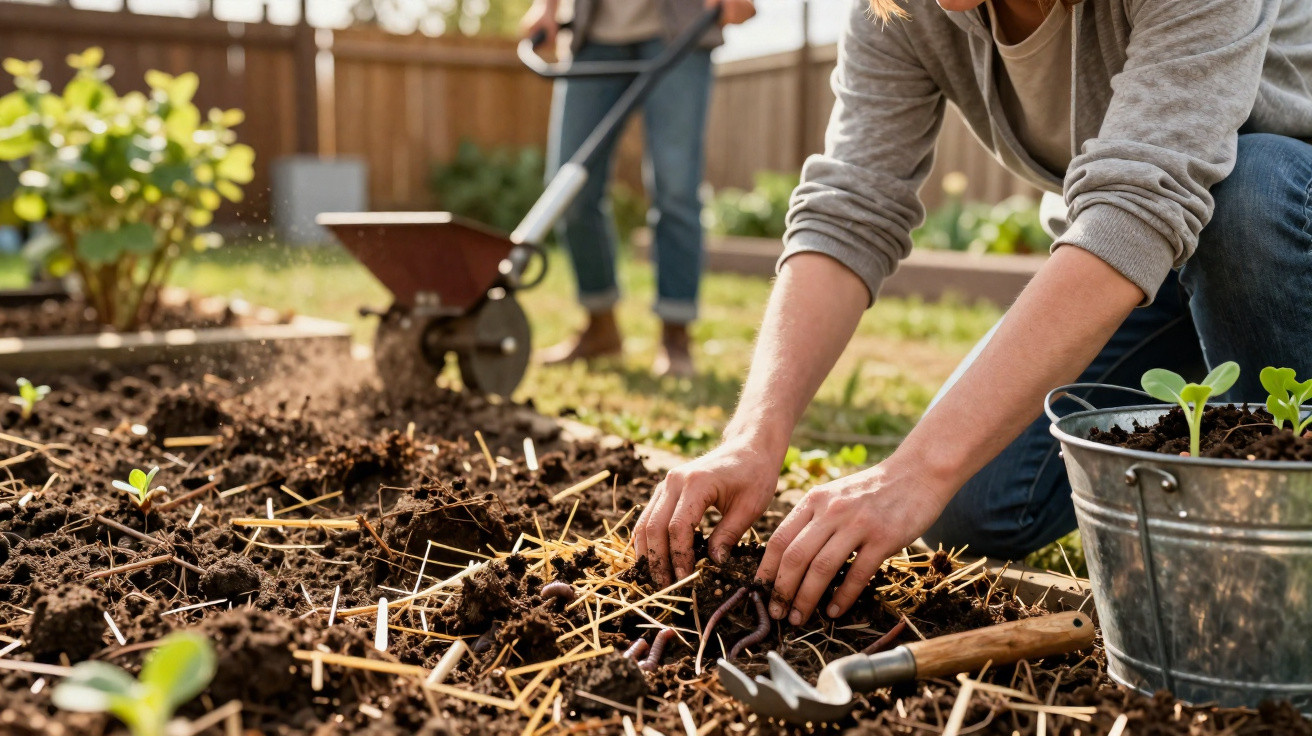
The first mild Saturday of spring rouses the neighbourhood like a disturbed anthill. In gardens everywhere, the same soundtrack begins: rakes scraping, spades striking the earth and rototillers whining as they tear through the ground. Gardeners shrug off their coats, narrow their eyes against the sunshine and head outside carrying that familiar blend of optimism and guilt. Still moist and slightly chilly, the soil is dug, turned and loosened to within an inch of its life.
From the pavement, the activity appears impressively productive. Beneath our boots, however, a very different story is unfolding in the microscopic world below. That is exactly where the trouble starts.
The spring habit that quietly drains life from your soil
Each year, the moment spring seems “safe enough”, thousands of gardeners follow the same pattern: deep digging and vigorous tilling. Every lump is broken apart, every clod overturned, and the ground is raked until its surface is flawlessly fine and level. It seems instinctively right, rather like brushing a child’s hair before school. The tidier and more “cleaned up” the soil appears, the more satisfied we tend to feel.
But soil is not a tidy desk. It is more like a living city - and that city is battered whenever we force our way through it.
Consider Lisa, a self-taught gardener from Ohio who proudly started up her rototiller every April for ten years. She adored the immediate result: dark, crumbly earth as light as cake, seemingly perfect for tomatoes. Her plants always made a vigorous start by June. Yet by August, the bed surfaces had formed a crust, while the soil beneath was as hard as a car park. Rather than soaking in, water ran away. Her harvests declined year after year, regardless of how much fertiliser she applied.
Then, one spring, her neighbour did not till at all and simply spread compost over the surface. By the end of summer, his soil resembled chocolate cake. Lisa’s resembled dried cement.
Lisa’s experience is all too widespread. Frequent deep tilling destroys the natural structure of soil: its fine aggregates, channels and pores, all of which roots and water depend upon. Fungi that create delicate threads between soil particles are repeatedly cut apart. Earthworms, responsible for making those useful little tunnels, are either chopped up or driven away.
What follows is a brief spell of “fluffiness”, then compaction and structural collapse. The soil loses its sponge-like character and its ability to hold nutrients. We think we’re helping our plants, but we’re really exhausting the invisible workforce that keeps the ground alive.
A gentler spring routine that actually strengthens your soil
There is a different way to begin the growing season, one that does not involve battling the ground. Rather than digging deeply, work only the upper few centimetres and nourish the soil from the top down. Clear away substantial debris, add a layer of mature compost, then allow earthworms to take on the heavy work. Their tunnels will extend deeper and more directly than those made by any fork or tiller.
Where compacted patches need loosening, push a garden fork straight down and gently rock it backwards and forwards without turning the soil. This opens air channels while leaving the layers undisturbed. After several seasons of this gentler treatment, soil often becomes darker, softer and much easier to cultivate.
Many gardeners fear that avoiding deep digging will allow weeds to dominate or cause the soil to “suffocate”. Over time, the reverse is often true. Tilling brings dormant weed seeds to the surface, where light triggers their germination. With less disturbance, fewer seeds receive that wake-up call. As for the sensation that soil is suffocating, this generally results from compaction rather than from allowing soil organisms to remain undisturbed.
In truth, despite the advice in old gardening manuals, hardly anyone double-digs an entire bed perfectly every year. Most of us are weary, short of time and trying to achieve what we can in a weekend. A low-disturbance method recognises that reality while still allowing the soil to flourish.
“Once I stopped attacking my soil every spring, everything changed,” says Mark, a market gardener who abandoned his tiller five years ago. “The first year felt strange, almost lazy. But then I saw more worms, better drainage, and plants that didn’t stall in midsummer. The soil stopped fighting me.”
To shift from being a “soil beater” to a “soil builder”, concentrate on several straightforward actions:
- Apply 2–5 cm of compost or well-rotted manure to the surface every spring.
- When planting, disturb only the surface with a hand tool rather than a machine.
- Cover the soil with mulch or living plants whenever possible.
- Do not walk on beds, particularly while they are wet.
- Rotate crops so that the same plant family does not deplete one area year after year.
Every one of these actions may seem modest, perhaps even overly simple. Together, though, they create a quiet revolution beneath your feet.
Rethinking what “good gardening” looks like each spring
This is where the idea becomes uncomfortably liberating. So many spring gardening traditions focus on effort we can see: immaculate rows, freshly turned earth and cleared beds made into a “blank slate”. Choosing not to till can feel as though you are not doing enough, especially if you grew up seeing parents or grandparents attack the garden with spades each April.
Yet soil health is not a performance; it is a relationship. Disturb it less, feed it carefully and tread on it more thoughtfully, and it will quietly reward you with resilience. There will be fewer waterlogged areas after heavy rain, fewer cracks during heatwaves, and plants that keep going when the weather becomes unusual, as it increasingly does.
You need not become a purist or discard every tool in the shed. Begin with one bed and abandon the old habit there. Keep the tiller in the garage, spread compost, plant into that living and undisturbed layer, then observe. Your soil’s real story will emerge across seasons rather than weekends, and that gradual transformation may become the most satisfying thing to discuss, compare and quietly boast about when neighbours start their noisy machines again next spring.
| Key point | Detail | Value for the reader |
|---|---|---|
| Limit deep tilling | Work only the top layer and do not overturn soil horizons | Retains structure, organisms and long-term fertility |
| Feed from above | Apply compost and organic mulch regularly to the surface | Creates humus, boosts water retention and lowers inputs |
| Protect living soil | Keep beds covered and prevent compaction caused by foot traffic | Encourages resilient soil that improves itself over the years |
FAQ:
- Question 1 Will my plants still grow well if I stop tilling in spring?
- Question 2 How do I deal with severely compacted soil without a rototiller?
- Question 3 What type of compost layer should I spread on top?
- Question 4 Will slugs and pests shelter beneath all that mulch?
- Question 5 Can I move gradually from traditional digging to a low-disturbance method?

Comments
No comments yet. Be the first to comment!
Leave a Comment