
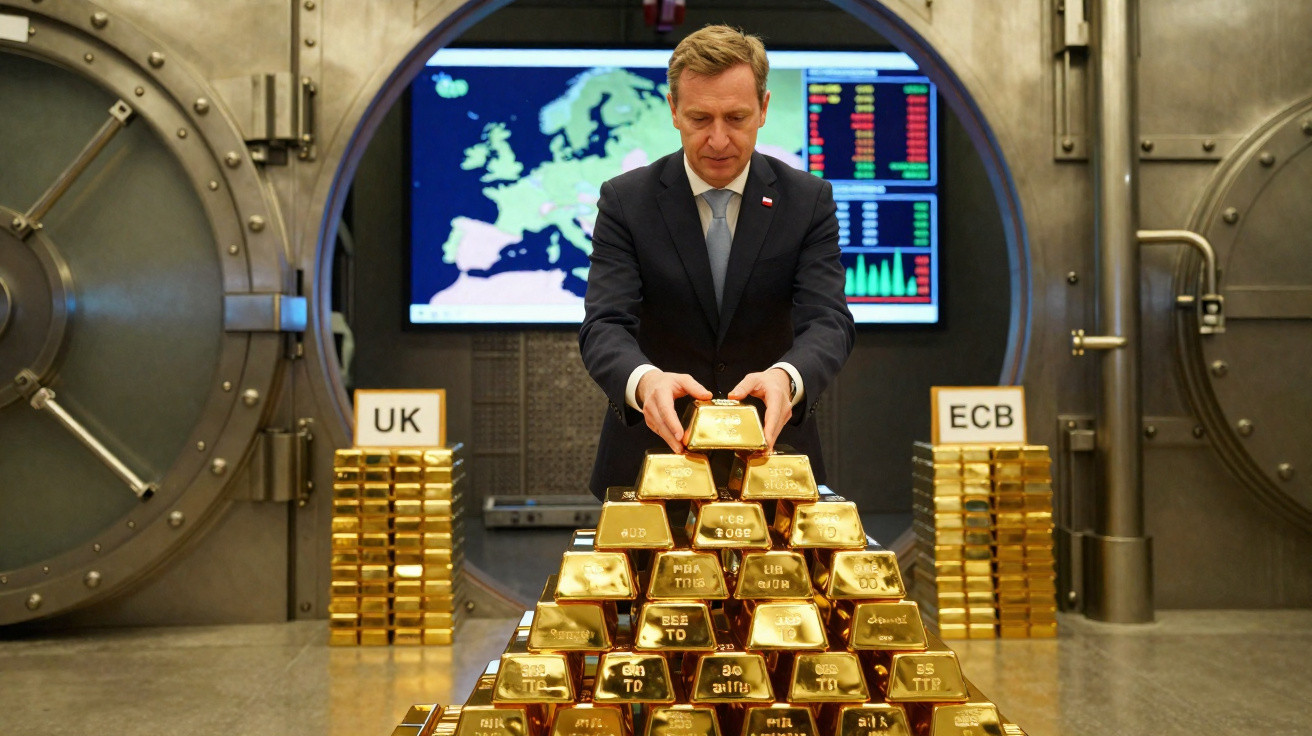
Poland’s central bank has been acquiring gold on a large scale for years. Its vaults now hold substantially larger gold reserves than those of the United Kingdom – and even more than the European Central Bank. A clear strategy underpins this approach: Warsaw intends to become more independent, cushion risks within the euro area and reinforce confidence in the zloty.
Poland quietly moves ahead of London and the ECB
Only a few years ago, Poland was more of a second-tier player when it came to gold reserves. It now ranks among Europe’s leading countries. Poland’s central bank has steadily expanded its holdings and communicates this policy very openly.
“Poland now holds almost twice as much gold as the United Kingdom and has overtaken the European Central Bank’s official gold reserves.”
This is also changing how Poland is viewed within the international financial system. Formerly regarded chiefly as a manufacturing location and recipient of EU funds, the country is now presenting itself as a state with a robust approach to currency and security.
Why is Poland relying so heavily on gold?
Gold is traditionally seen as protection during periods of crisis. This is precisely the objective behind the Polish central bank’s strategy, which responds to several developments that directly affect the country.
Lessons from the energy crisis, inflation and war
Poland is on NATO’s eastern flank, bordering Ukraine and located close to Russia and Belarus. The energy crisis, the surge in inflation and the war in Ukraine have significantly reshaped Warsaw’s view of security.
- Political risk in the east: A regional conflict can unsettle capital flows and place currencies under pressure.
- Inflation and currency risk: Rising prices have demonstrated how quickly cash assets can lose purchasing power.
- Dependence on the West: Although Poland has a seat at the EU table, it does not want to rely solely on Brussels or Washington.
Gold fits this picture. It exists physically, cannot be created without limit and is not directly dependent on the political decisions of other countries. Every additional bar held in the vaults also increases Poland’s negotiating power in Europe.
Gold as a weapon in the currency battle
Major central banks have used gold reserves as a quiet source of influence for decades. Large holdings convey stability and act as insurance against currency upheaval, debt crises or a loss of trust in paper money.
Poland is therefore following countries that have long relied on this instrument, including Germany, Italy and the United States. Warsaw’s central bank regularly stresses that gold enhances the credibility of its own monetary policy and protects the financial system against extreme events.
“Those who hold more gold can, in case of doubt, endure for longer when bond markets become nervous or their own public finances come under strain.”
At a time of high government debt in many EU countries, gold serves as a counterweight: it is not a claim against another debtor, but an asset in its own right.
A signal to Brussels and the markets
The decision to maintain substantial gold reserves also has a political dimension. Poland is sending several messages at once:
- Independence: Warsaw is showing that it does not depend exclusively on collective arrangements such as the EU budget or European Central Bank funds.
- Confidence in its own currency: Gold reserves are intended to make the zloty more attractive and make capital flight harder during crises.
- A stronger negotiating position: Countries with substantial reserves can take a more confident stance in European financial debates.
The development also influences international investors. When a state visibly makes provisions, many market participants see this as reducing the risk of a sudden default or currency crisis.
Comparison: Poland, the United Kingdom and the ECB – who holds what?
Exact figures vary according to the date and source, but the trend is clear: Poland has significantly increased its holdings, while other players have made little or no increase. The structural comparison is particularly revealing.
| Actor | Role | Direction of gold strategy |
|---|---|---|
| Poland | National central bank | Active expansion, clear political communication |
| United Kingdom | National central bank | Relatively stable holdings for years |
| European Central Bank | Shared central bank for the euro area | Gold plays a role, but bonds and monetary policy remain the focus |
For Berlin, Paris and other euro-area capitals, this raises the question of whether their own approach is still appropriate. When a country outside the euro catches up so quickly, it demonstrates how strongly the desire for tangible safeguards has grown.
What does this mean for Germany and savers?
Germany remains in a comfortable position thanks to its enormous gold reserves. However, Poland’s strategy brings an issue into sharper focus that already concerns many people: how safe is money in a world marked by wars, tensions between major powers and high debt?
Savers are asking whether they should place more emphasis on tangible assets – alongside gold, this could include property, shares or broadly diversified funds. Central banks operate on a far larger scale, but the underlying logic is similar: those who rely only on paper claims are more likely to face difficulties in a crisis.
“Gold is not a return-generating machine, but insurance against scenarios in which other safeguards become unstable at the same time.”
In Germany in particular, where confidence in monetary stability is historically sensitive, many investors are watching these developments in Poland closely. Some see Warsaw’s purchases as confirmation that part of their own wealth should be structured to withstand crises more effectively.
Risks and limits of the gold strategy
Despite its advantages, a focus on gold also brings drawbacks. Gold generates no regular income, incurs storage and insurance costs, and its price can fluctuate considerably. A central bank can pledge or sell gold, but cannot use it as flexibly as government bonds issued by major industrialised countries.
Poland also faces a political consideration: the more the country distances itself from Brussels on financial issues, the greater the suspicion among some partners. Gold reserves may strengthen independence, but they can also reinforce the impression that Poland is preparing for tougher disputes over budgets, debt rules or EU reforms.
What gold reserves really indicate
Gold holdings are more than a figure in a statistical table. They reveal something about a country’s history and fears. Germany maintains substantial reserves partly as a consequence of the currency crises of the 20th century. Italy and France have traditionally used gold as a political signal. Poland is now writing its own gold story.
Three aspects stand out:
- Need for security: Wars and tensions in eastern Europe are shaping financial policy.
- Distrust of debt-based models: As global debt rises, tangible assets appear increasingly attractive.
- Identity and pride: Political communication often uses gold as a symbol of national strength.
Investors and those interested in politics would do well to look closely: gold reserves alone do not determine the future of an economy. However, they offer clues about how strongly governments believe in long-term stability and which scenarios they are considering.
When Poland, long seen as a catching-up latecomer, overtakes European heavyweights in gold holdings, it marks more than a changed ranking. It shows how profoundly the tectonic plates of Europe’s financial and security order are shifting – and how states are seeking protection against the unpredictable.






Comments
No comments yet. Be the first to comment!
Leave a Comment