
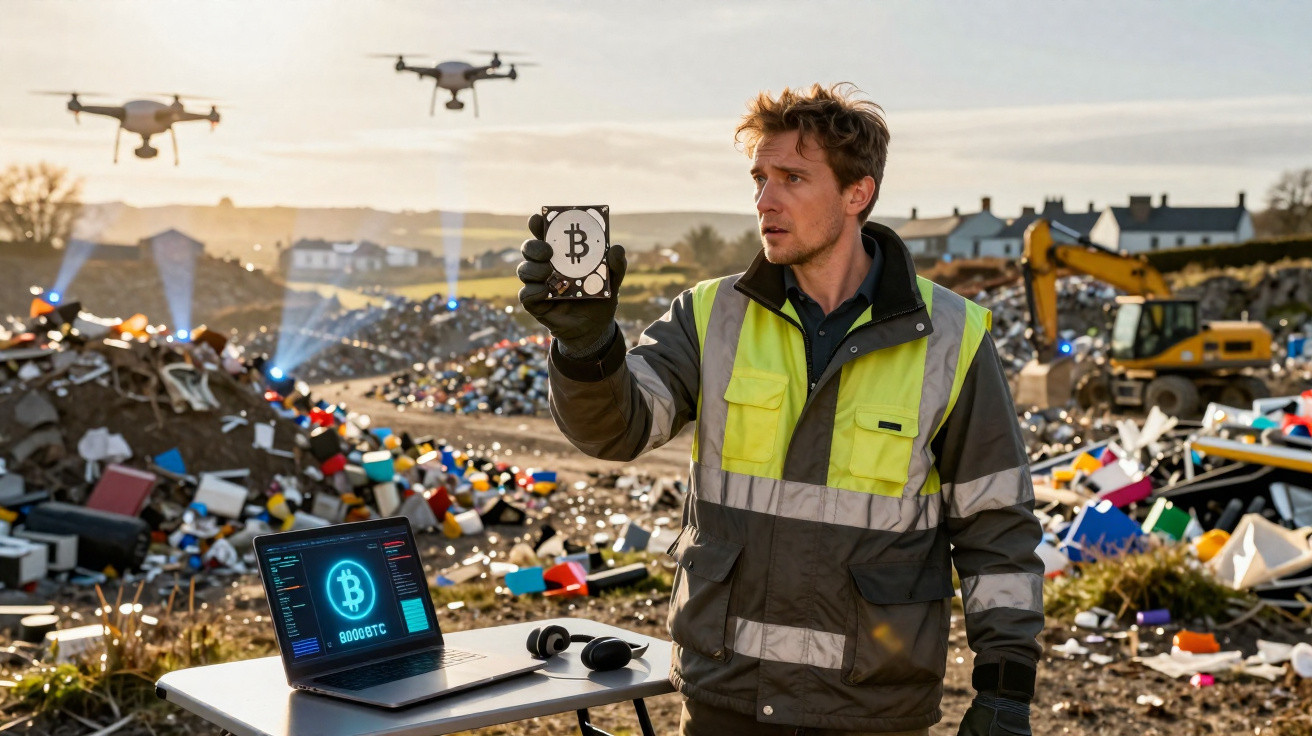
A routine office clear-out, one mistaken decision involving the wrong hard drive - and an IT technician from Wales suddenly finds himself at the heart of one of cryptocurrency’s most extraordinary stories. What starts as a minor tidying mishap turns into a nightmare involving hundreds of millions of dollars, a prolonged quest across a landfill site and, ultimately, an international documentary series.
How a clear-out mistake became a multi-million-dollar disaster
In 2013, James Howells, an IT technician from Newport, Wales, was clearing out his home office. While sorting through old hard drives, he disposed of one that contained the private keys to around 8,000 Bitcoin. Even then, this represented a substantial amount - approximately eight million dollars. Yet that figure seems almost modest compared with what followed.
Over the years that followed, Bitcoin’s price at times climbed above 90,000 dollars per coin. A relatively small digital holding became, on paper, a vast fortune. Current estimates put the value locked in the lost wallet at around 649 million dollars. Howells believes that fortune is buried beneath mountains of household waste at an ordinary municipal landfill in Newport.
A single wrongly discarded hard drive can make a man a multimillionaire in theory - while leaving him powerless in reality.
The hard drive is thought to have ended up at Newport’s municipal landfill. Waste has been compacted, layered and covered there for decades. For Howells, this marked the beginning of a search that grew increasingly technical, expensive and desperate.
High technology against waste mountains: his landfill plan
Howells has refused to give up. Rather than accepting the loss, he developed detailed proposals for recovering the hard drive from the sea of rubbish - ideally without excavating the entire landfill.
Futuristic technology for one hard drive
His plans sound like something from a science-fiction script. Among the measures he wants to use are:
- AI-equipped drones to survey the surface and deeper layers
- Robots for targeted excavation in locations calculated in advance
- Monitoring equipment to identify toxic gases and other emissions
- Dedicated safety and containment systems for hazardous materials in the waste
Howells has offered to cover every cost himself, including the technology, staff and protective measures. This would make the operation financially risk-free for Newport Council, at least. Nevertheless, the council has repeatedly refused permission.
Why Newport Council says no
The council’s case is that the landfill is a sensitive ecosystem. Large-scale digging and drilling could create serious environmental issues. Official assessments warn of:
| Risk | Potential consequences |
|---|---|
| Toxic gases | Release of landfill gas, posing a risk to workers and local residents |
| Groundwater contamination | Pollutants leaching into the surrounding area |
| Unstable ground | Landslides, collapses and accident risks at the landfill |
There is also a legal obstacle: in the United Kingdom, items thrown away at landfill sites become the property of the landfill operator. Formally, the hard drive no longer belongs to Howells but to the operator of the facility. That makes any authorised excavation even more difficult - even if the potential prize is approaching half a billion euros.
Court ruling: the chances are zero
Howells pursued the matter through lawyers, applications and negotiations. He sought access to the site and, at minimum, a restricted area in which to search. However, in 2024, a British court brought the matter to a firm end.
The judges reached a devastating conclusion: the likelihood of locating the hard drive and extracting usable data from it is effectively zero.
More than ten years in wet, compacted rubbish: experts consider it extremely unlikely that an ordinary hard drive could survive in such conditions.
Expert witnesses explained to the court why this was the case. Conventional magnetic storage devices deteriorate much faster in a landfill environment than they would in normal storage conditions. Moisture, chemical reactions with the surrounding waste and the immense pressure from layers above would severely damage the delicate internal components of a hard drive. Even if the device were physically recovered, the odds of its data still being readable would be poor.
Following the ruling, Howells had to officially accept what many had long suspected: the Bitcoin are, in practical terms, lost. His personal recovery mission failed before it could properly begin. What remains is a story that has fascinated - and unsettled - the global crypto community.
From landfill to screen: his story becomes a series
After the legal rejection of the excavation plans, the story could simply have faded away. Instead, a new chapter began. A US production company secured exclusive rights to Howells’ life story and is planning a multi-part documentary series.
Its working title describes a documentary about the “buried Bitcoin treasure” and the real-life search of a man unwilling to let go. The project is due to be completed by the end of 2025 and will retrace the entire journey - from the fateful clear-out, through the technical proposals, to the heated disputes with authorities and courts.
More than a crypto anecdote
The series is intended to go beyond the quirky “man searches landfill for millions” headline. It is also expected to cover:
- The technical concepts behind the proposed search
- The role of environmental regulations and landfill law
- The psychological strain of twelve years of hope and disappointment
- The disputes with politicians and public administrators
Howells sees the project as an opportunity to present his own perspective. In interviews, he has stressed that attention has largely focused on the headline amount - 649 million dollars. Far less known, he says, is how thoroughly his plans were developed and how much time, energy and money he has already committed.
What this case shows every Bitcoin investor
James Howells’ story is more than an unusual footnote. In an extreme form, it demonstrates what is at stake with cryptocurrencies when people fail to protect their access credentials professionally.
With Bitcoin, one piece of information - the private key - determines whether a fortune is real or merely a sequence of numbers in old price charts.
Millions of people now buy Bitcoin and other coins, often through smartphone apps. Many depend on exchanges, online wallets or screenshots of recovery words. The Newport case makes the risks of that approach painfully clear.
Common cryptocurrency storage mistakes
Frequent pitfalls include:
- Keeping a wallet on only one device without a backup
- Losing or destroying the recovery phrase
- Storing sensitive information unencrypted in cloud services
- Relying on exchanges that may be hacked or become insolvent
At its core, the issue is always the same: anyone who loses their private key loses access permanently. There is no “Forgot password?” button, no helpline and no bank branch that can help. The technology is deliberately designed that way.
Money versus the environment: the conflict behind the landfill
The dispute in Newport also exposes a broader conflict: how much risk to nature and public health is an enormous sum of money worth? The landfill is subject to strict safeguards. It produces gases, liquids and chemical reactions that must be managed. Any intervention could upset that balance.
Howells points to promised jobs, a potential tax benefit and technological innovation. The council has chosen the cautious route. This tension is likely to arise more frequently as crypto wealth grows: buried hardware wallets, forgotten USB sticks, lost backup notes - and the question of what societies are prepared to accept in order to recover them.
Lessons from the “landfill Bitcoin” legend
Anyone investing in Bitcoin or other digital assets can draw several lessons from this story. A multi-layered security approach substantially reduces the risk. Experienced investors often use a combination of:
- A hardware wallet to separate keys from the internet
- Multiple physically separate backups of the recovery phrase
- Clear instructions for relatives in case something happens
- Regular checks that backups still exist and remain legible
Each of these steps may appear excessive in everyday life. Once the amount that could be at risk is considered, they suddenly seem entirely rational. Unlike cash, gold or property, crypto wealth exists only as information. If that information disappears, there is no physical asset left to retrieve from a safe or a landfill.
James Howells is exceedingly unlikely ever to see his 8,000 Bitcoin again. His story, however, may continue to circulate for a long time - as a warning to anyone careless with private keys and as material for a documentary series showing how narrow the line between wealth and total loss can be in the crypto world.






Comments
No comments yet. Be the first to comment!
Leave a Comment