
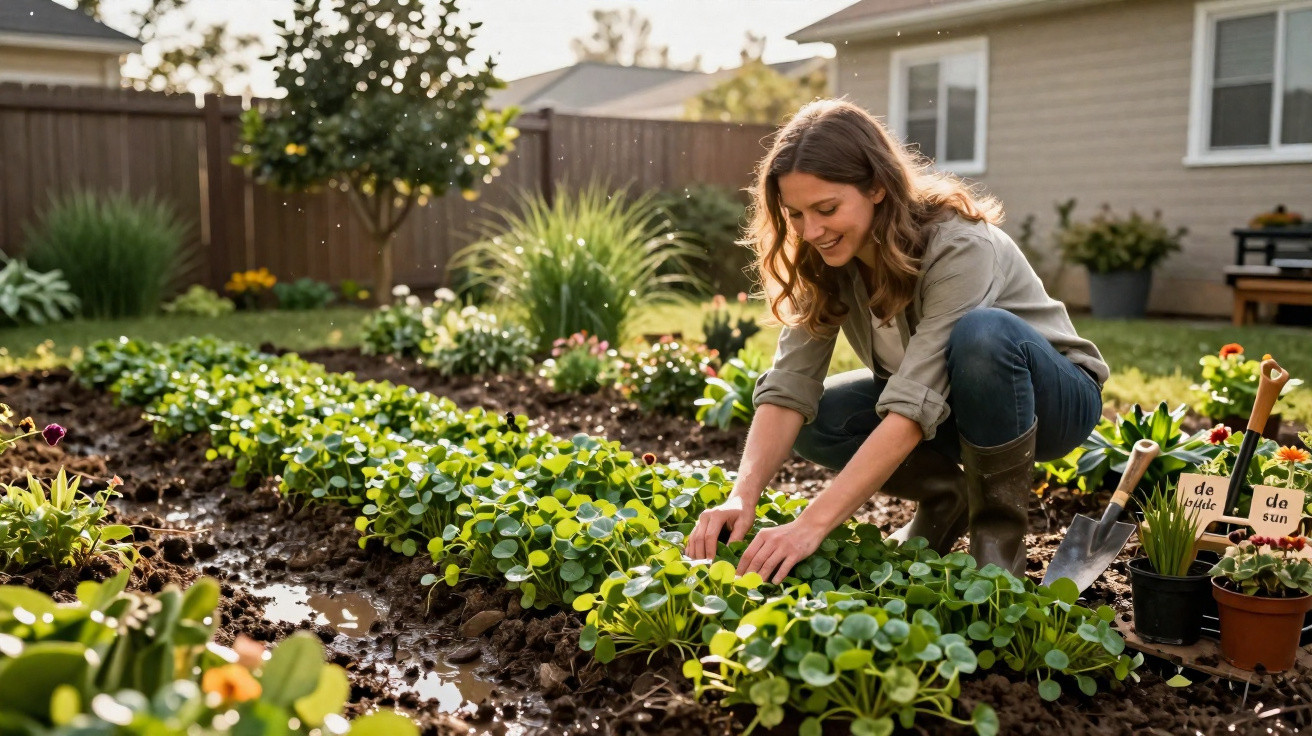
After every downpour, do you end up with mud instead of a lawn?
With the right ground cover plants, even a difficult garden can be improved step by step.
When parts of the garden stay wet and slippery, many amateur gardeners immediately assume they’ll need costly drainage. Yet often there’s a far simpler first move: planting the right things. Some plants don’t merely tolerate waterlogged soil - they actually thrive in it, helping turn a muddy patch into something you can walk on again.
Why your garden turns into a mud track after rain
The most common culprit is heavy soil with a high clay content. It compacts quickly, rainwater barely soaks in, and instead sits on the surface. Puddles form, shoes slide, and every footstep makes the ground softer still.
Other issues often make it worse:
- a high water table or natural seepage areas
- rainwater from guttering that dumps directly onto one spot
- bare soil with no roots to hold it together
- frequent walking that compacts the ground further
Where roots aren’t doing any work, you lose the natural processes that spread moisture, open up the soil and slow erosion. That’s exactly the gap that well-chosen ground cover can fill.
How ground cover plants change a muddy garden
Moisture-loving ground cover helps on several fronts at once. They won’t magically remove every puddle, but they can firm up the surface so it becomes far more usable.
Fine roots loosen the soil, the leaf canopy softens the impact of rain, and the mud loses its sting.
Their roots weave through the top layer of soil, binding it and creating tiny air pockets. As a result, water is more likely to infiltrate, rather than running off or pooling. Above ground, dense foliage intercepts raindrops, spreading the water more gently and protecting the surface from sealing over.
Over time, a true “living carpet” replaces bare earth. That means fewer slippery patches, less chance of every rainy spell becoming a bog, and more greenery and structure in the garden at the same time.
Eleven strong ground cover plants for wet and muddy soils
All of the following species share one key trait: they cope remarkably well with permanently damp, often clay-heavy soil, and they’ll spread happily where many other plants would quickly give up.
Ground cover for shady, cool corners
- Ostrich fern (Onoclea struthiopteris)
Forms impressive, robust clumps and prefers fresh to wet ground. A great choice for shaded stretches along fences or walls. The fronds can reach up to 90 centimetres and give the garden a slightly wild, woodland feel. - Canadian wild ginger (Asarum canadense)
A low ground cover with heart-shaped leaves. It knits into dense mats and holds soil reliably. Attractive to look at, but because it contains harmful substances it’s for viewing only - not for tasting. - Woodland phlox (Phlox divaricata)
Lightens the area with delicate spring flowers and draws in insects. It suits semi-shade with moist soil and gradually develops into lovely flowering carpets. - Foamflower (Tiarella cordifolia)
Stays low, grows densely, and sends up airy flower spikes in spring. Perfect for damp, shady beds beneath shrubs where grass has long since failed. - Bugle (Ajuga reptans)
One of the toughest options for semi-shaded, wet areas. It forms firm mats, tolerates some foot traffic, and adds colour with purple flower spikes in spring.
Plants for sunny, permanently damp spots
- Palm sedge (Carex muskingumensis)
A grass-like perennial that performs brilliantly in wet, sunny positions. It can replace a conventional lawn where water regularly sits on the surface. - American sweet flag (Acorus americanus)
Happy in clay-rich, very wet soil and will even cope with a few centimetres of standing water. Ideal for pond margins or soggy dips in the garden.
For true boggy patches and pond edges
- Marsh marigold (Caltha palustris)
A vivid yellow spring bloomer that genuinely enjoys mire-like ground. Excellent for ditches, pond edges and places that flood repeatedly. Raw, the plant is poisonous and does not belong on the plate. - Creeping jenny / moneywort (Lysimachia nummularia)
A robust trailer that makes dense mats and can handle light foot traffic around stepping stones. It loves wet soil and can turn greasy path edges into usable ground.
Lawn alternatives for difficult areas
- Blue star creeper (Isotoma fluviatilis, often sold as “blue star creeper”)
An extremely low, fine-textured ground cover with small blue flowers. Works as an alternative to grass in wet areas, but spreads very quickly. Many parts of the plant are considered poisonous - something to factor in when planning. - Lesser periwinkle (Vinca minor)
A classic, low-maintenance ground cover. It quickly blankets slopes and damp areas, though in some regions it can become overly vigorous and push out native species.
How to plant ground cover properly in a wet garden
Simply pushing young plants into mud rarely ends well. A little preparation makes a big difference.
- Loosen the soil only lightly
On heavy clay, gently break up the surface and avoid stamping or working it when it’s wet - otherwise compaction gets worse. - Work in compost
Well-rotted compost improves structure and nutrients. A thin layer is enough to help roots establish more quickly. - Add sand beneath the root balls
A handful of coarse sand directly under each root ball helps prevent water sitting around the roots and reduces waterlogging. - Plant closely
Set ground cover in groups rather than scattering individual plants. Small clusters join up into a continuous carpet much faster. - Mulch lightly
Spread a thin mulch layer between young plants. It helps prevent surface sealing and also guards against drying during dry spells.
Well-placed ground cover plants can even take the pressure off awkward spots such as gutter outlets, outdoor taps or ditch edges - without diggers and drainage pipes.
What to watch for with poisonous or invasive species
Some of the plants listed come with drawbacks. If children, dogs or cats use the garden, it’s worth being especially careful.
- Canadian wild ginger: contains carcinogenic substances; not edible, despite its pleasantly spicy scent.
- Marsh marigold: poisonous when raw; keep it out of salads and away from compost that animals can reach.
- Blue star creeper: many parts are considered toxic; less suitable for play lawns with very young children.
- Lesser periwinkle: classed as invasive in some areas because it can displace native plants; avoid planting in sensitive, wildlife-rich sites.
If you’re unsure, it’s safer to use clearly defined beds for the more problematic options, or choose harmless alternatives.
Typical garden problem areas - and which plant suits them
| Problem area | Suitable ground cover plants |
|---|---|
| Area beneath a gutter outlet | Bugle, creeping jenny, palm sedge |
| Damp shady corner behind the garage | Ostrich fern, foamflower, Canadian wild ginger |
| Edge of a pond or ditch | Marsh marigold, American sweet flag, creeping jenny |
| Clay dip that constantly forms puddles | Palm sedge, American sweet flag, blue star creeper (with caution) |
| Steep, damp slope | Lesser periwinkle, bugle, woodland phlox |
Practical tips for day-to-day use and care
After planting, patience matters. A very wet garden doesn’t change overnight. Most ground cover plants take two to three years to knit together properly. During that time it helps to top up with extra plants, fill gaps and keep a close eye on areas that are heavily weeded.
A common mistake is constant walking - or using heavy equipment - on newly planted ground. If you need a route through, it’s better to lay sturdy paving slabs or stones and plant creeping species such as creeping jenny between them. That way the path stays practical without compacting the soil again.
In the long run, it’s not just your footwear that benefits - wildlife does too. Damp, planted areas provide habitat for amphibians, insects and birds. The garden doesn’t have to look dry and perfectly clipped after every shower. What matters is being able to step outside after rain without needing wellies - and the right ground cover plants can achieve that surprisingly well.

Comments
No comments yet. Be the first to comment!
Leave a Comment