
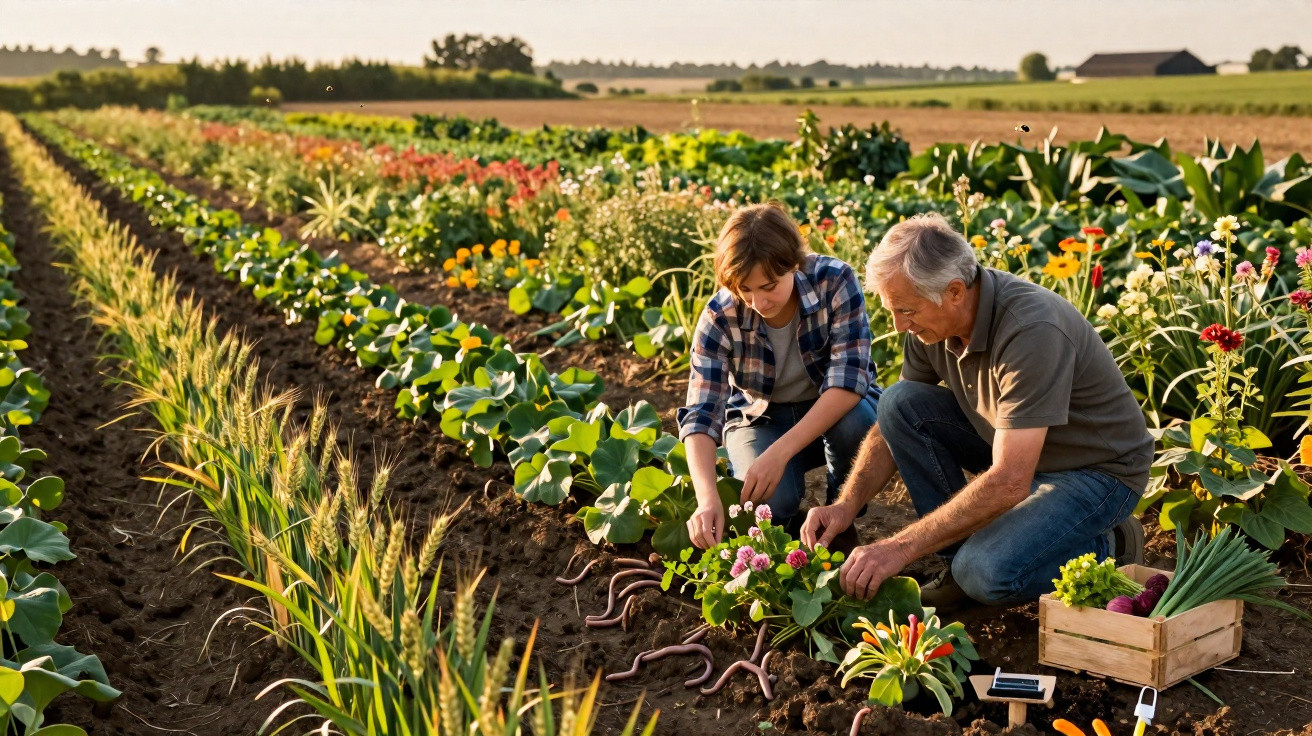
Soil as hard as concrete, a handful of yellowing maize stems, and little else. Three consecutive drought seasons had cut his harvests to virtually nothing, while his son had begun discussing a move to town.
Today, that very plot seems to belong to another world. The soil is dark. Beans wind their way up the maize, while squash leaves fan out like green parasols. Walking between the rows feels cooler, and boots press gently into the earth rather than knocking against a baked hardpan.
He has not spent more on fertiliser or put in irrigation. Instead, he is relying on a farming practice older than his grandfather, one that is discreetly increasing his yields by as much as 40%.
The ancient technique in plain sight
The approach sounds almost laughably straightforward: plant several crops together rather than a single crop in tidy, bare rows. Agronomists refer to it as “polyculture” or “intercropping”, although many grandmothers would simply call it “the old way”.
Here, maize, beans and squash share one bed. In other places, the combination could be millet and cowpeas, or coffee trees growing beneath bananas. The crops may vary, but the idea does not: different plants occupy the same soil and sunlight, each contributing something small to the others.
From the roadside, it may appear untidy, yet beneath the surface it is carrying out quiet calculations. There are more roots, more microbes and more biomass. That is often where the additional 30–40% in yield comes from.
In Mexico, researchers followed the renowned “Three Sisters” system - maize, beans and squash cultivated together - over several seasons. Maize-only fields saw yields level off or decline as soils became exhausted. In contrast, mixed plots produced substantially more food per square metre, with some trials exceeding the 40% threshold.
One farmer in southern Malawi told me that his one-acre plot once produced five bags of maize. Following three years of maize–pigeon pea intercropping, he was harvesting seven bags of maize as well as a worthwhile pigeon pea crop. The land was unchanged. So was the rainfall. What changed was the system.
This is not magic; it is thoughtful design. Maize raises its foliage high to catch the sun. Beans bind nitrogen and use the maize stems for support rather than requiring poles. Squash spreads over the surface, shading the ground and reducing moisture loss through evaporation. Individually, each crop performs slightly less well, but together they are astonishingly efficient.
Meanwhile, the soil ecosystem is transformed. Root exudates nourish fungi and bacteria, organic matter accumulates, and rainwater soaks in rather than washing away. Yield charts begin to rise as fertiliser costs fall.
Using intercropping without creating field chaos
The key principle is to combine at least two crops that are not competing for precisely the same space. Choose one tall crop, one medium-height crop and one low-growing crop. Where possible, include a legume to provide nitrogen. It is much like stacking flats rather than building bungalows alone.
In temperate gardens, that could mean sweetcorn with climbing beans and courgettes. In drier areas, sorghum can be grown alongside groundnuts. Coffee and cocoa growers can use shade trees such as banana or gliricidia, which can provide fruit or fodder while also creating a better microclimate.
Spacing is the control mechanism. Rows should be slightly wider than in a monocrop, with companion plants placed between them or set out in alternating strips. The aim is not to pack everything in, but to allow roots and leaves to interweave without smothering one another.
The most common early error is planting too densely, too quickly. That is when harvests fall and the system, rather than the layout, receives the blame. Begin modestly: use a few beds or a single corner of a field. Trial one combination, then observe where the light falls at 9 am, noon and 4 pm. That changing pattern of shade matters more than the information printed on a seed packet.
Most of us have gone through a phase of scrolling through abundant permaculture images and wanting an instant jungle on the first day. The reality is less polished. Slugs turn up. One variety takes over. Another struggles. Let’s be honest: nobody really manages this every day in a perfect way.
Be patient with yourself. If the beans overwhelm the maize, adjust the spacing the following year. If the ground cover uses too much water, replace it with another species. Sustainable systems are ongoing living experiments, not rigid formulas.
Another mistake is to regard an ancient practice as a cure-all. Polyculture alone will not resolve severe compaction or persistent flooding. It is most effective alongside sound basics: keeping soil covered, reducing tillage, and returning organic material to the earth instead of hauling it away.
“My grandfather told me, ‘Don’t let the soil see the sun,’” a Kenyan farmer named Peter told me, standing in a field of maize laced with lablab beans. “When I went back to his mixed crops and left the residues on the ground, the land started to breathe again.”
This technique also brings a subtle emotional change. A bare monocrop field can leave you feeling vulnerable: each dry spell, hailstorm or disease outbreak strikes the single crop like a blow to the face. In a mixed planting, there is a sense of insurance. When maize performs badly, the beans may still rescue the season.
- Begin with one straightforward combination: a cereal and a legume you already understand.
- Allow at least three seasons before assessing the system.
- Record sowing dates, spacing, rainfall and yields in writing.
- Visit the field at several times of day to assess shade and air movement.
- Speak with older local farmers, as many recall the systems used by their parents.
Why this “old way” may be the future
Climate change is making agriculture feel increasingly like a gamble. One year brings excessive rain; the next delivers punishing heat. A field with a single crop is essentially one large wager. Intercropping spreads that risk quietly, without requiring an app or sensor.
Researchers in East Africa found that maize–bean–banana systems delivered more dependable food and income through drought and flood years than maize grown alone. The figure most often repeated is the 40% yield increase. Yet the more important finding lies in the pattern: mixed systems suffer less severe collapses when weather conditions become unpredictable.
The effects extend beyond the farm gate into food culture. Where three or four crops are harvested from the same land, diets naturally become more varied. Children eat beans and squash alongside maize porridge, rather than repeatedly eating only white starch.
There is also an under-discussed mental burden. Managing a modern farm can mean trying to balance spreadsheets, chemical labels, seed catalogues and weather apps while avoiding financial ruin. An old method based on plant relationships, rather than another product to buy, can offer a quiet sense of relief.
Urban growers are adopting it as well. Balcony gardeners place basil beneath tomatoes, while allotment gardeners tuck peas into sweetcorn beds. The scale is different, but the principle remains: plants are arranged in layers, sunlight is used in portions, and one species’ waste becomes another’s resource.
In a world facing fertiliser costs, soil erosion and climate shocks, this scruffy, “unmodern” technique now appears unexpectedly sophisticated. It is almost as if a long loop of technological progress has brought us back to our grandparents’ knowledge, this time accompanied by fresh data and tidy graphs.
It leaves an uncomfortable question: how many other supposedly “old” practices are dismissed as backward when they may quietly contain the blueprint for a more resilient food system?
| Key point | Detail | Why it matters to the reader |
|---|---|---|
| Ancient polyculture method | Growing complementary crops together on the same plot | Demonstrates how a low-tech approach can raise yields by up to 40% |
| Soil and climate resilience | Deeper roots, improved moisture retention, more dependable harvests | Provides a way to deal with drought, flooding and increasing fertiliser prices |
| Practical first steps | Simple crop pairings, small-scale trials, spacing adjustments | Makes it possible to experiment without putting an entire season or field at risk |
FAQ
- What exactly is this ancient farming technique? It is intercropping or polyculture: growing two or more different crops together so they share space, light and nutrients instead of raising one species in isolation.
- Can small home gardens really see a 40% yield increase? Not in every case, but mixed beds frequently produce noticeably more total food per square metre than monocrops, particularly after several seasons of improving soil health.
- Does intercropping work without fertiliser? It performs best when some organic matter is returned to the soil, but including legumes can reduce the need for synthetic nitrogen quite significantly.
- Isn’t it harder to weed and harvest a mixed field? It may be more complicated initially, but many farmers find that the denser canopy suppresses weeds, and they harvest each crop during its own window instead of all at once.
- How do I choose crop combinations that won’t compete too much? Seek out different plant heights, root depths and nutrient requirements: a tall cereal, a climbing or bush legume and a low ground-covering crop make a dependable starting trio.



Comments
No comments yet. Be the first to comment!
Leave a Comment