

Right at the back of the garden-where the grass seems to give up and the border takes over-something quietly defiant is going on.
A woman in mud-splattered clogs stands over a scruffy mix of stems and foliage. Sunflower canes tilt at odd angles, hollowed out and browned with age; last year’s coneflowers have become a spiky snarl; and the surface is peppered with crumpled leaves in every shade of beige.
Her neighbour leans across the fence and chuckles: “Did you forget to clean up?”
She pauses, then grins. “No. I stopped.”
The border looks part neglected, part reverent-exactly the sort of scene that makes your inner neat freak reach for a rake and a green waste bin.
And yet, beneath those dead stems, something is stirring.
Why “messy” beds are secretly alive
A border stripped to perfection can look like the definition of good gardening: bare dark soil, crisp edges, and not a leaf out of place. It’s satisfying, it feels efficient, and it photographs beautifully.
But linger for a moment. There’s no hum of wings, hardly any rustle, and almost nothing moving. What you’ve created is closer to a display room than a living space.
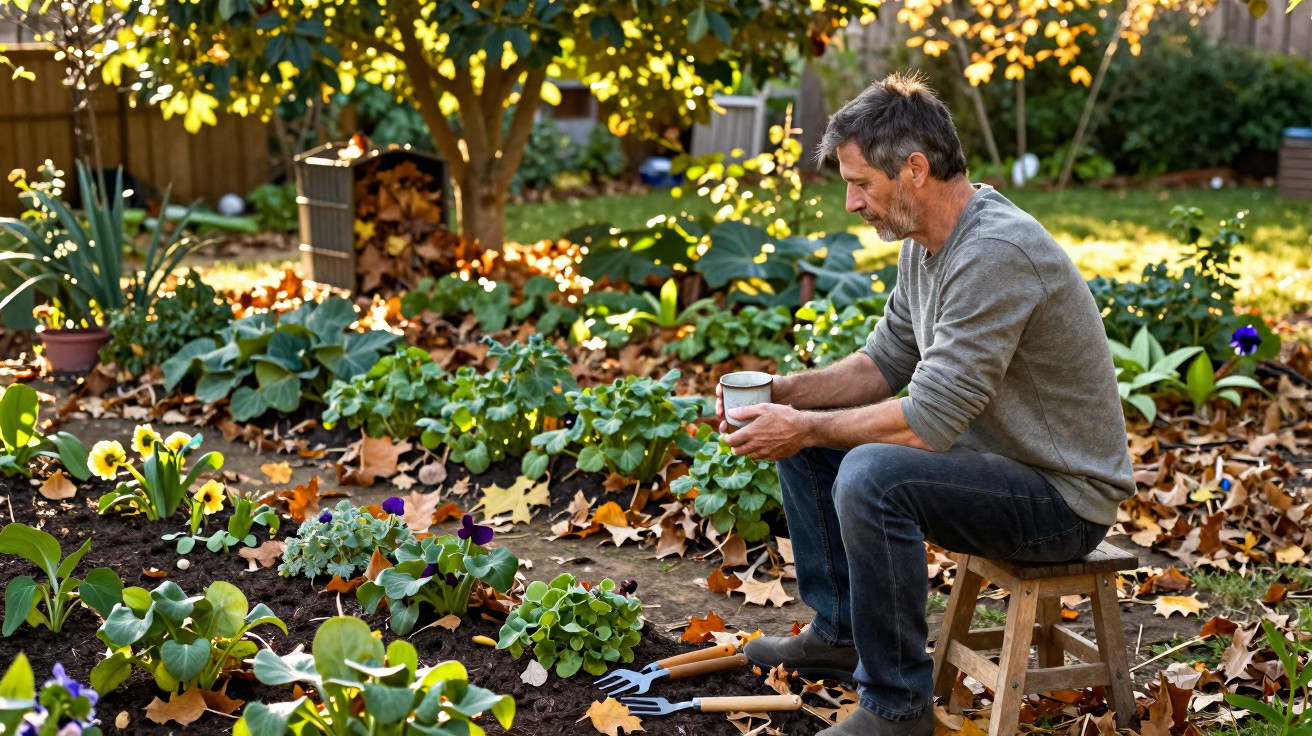
Now imagine the other kind of border-the one that’s allowed to be a bit untamed. Seed heads remain upright, leaves settle into soft drifts, and snapped stems stay where they landed. Birds hop in and out, turning over the debris. A ladybird emerges from a hollow stalk. It’s less polished, but unmistakably more alive.
In late autumn, you can spot this contrast in almost any community garden. One plot is scraped back to nothing, as if it’s been freshly mopped; the next is still covered in plant skeletons and crisping leaves.
I spoke to a volunteer gardener who used to be firmly on Team Clean. Each October she’d stuff ten garden-waste bags with cut stems and dead growth-“anything that looked tired,” as she put it. By spring, her soil had set hard and crusty. She saw fewer ladybirds, fewer bees, and more aphids.
Then one year she fell ill and missed the tidy-up. The beds stayed scruffy all winter, but the following season she noticed a shift: more pollinators, fewer pest flare-ups, and soil that broke apart in crumbs rather than sticking in clods. Without trying, she’d achieved more than all those “productive” weekends.
The mechanism is straightforward, and quietly radical. Fallen leaves and spent stems work like a winter duvet, buffering the soil against heavy rain, frost and sharp temperature swings. Under that cover, fungi and bacteria slowly process the plant material, building fertility and improving soil structure.
That so-called mess is also vital housing. Native bees use hollow stems and dry leaves for nesting and shelter. Lacewings and ladybirds tuck themselves into leaf litter for winter. Ground beetles-useful hunters of slugs-take refuge in plant debris. When we clear borders down to bare soil, we effectively evict a whole workforce of allies.
And let’s be realistic: almost nobody checks every border for overwintering insects before tidying. If the habit is to clean right “to the bone”, the harm is easy to miss-yet it compounds year after year.
How to clean less and help more
The simplest shift is to swap “thorough” for “light”. When plants collapse and start to rot, cut them back by half or two-thirds rather than right down to ground level. Keep the lower sections standing so insects still have sheltered places to use.
Clear leaves from paths and lawns, then slide them into your borders like a loose quilt. The aim isn’t a dense, airless mat; it’s a patchy cover-more like a woodland floor than a compost sack.
If a plant has disease, take off only the parts that are clearly affected and remove them from the garden. The rest can remain, gradually feeding the soil and supporting the life within it.
The real challenge is often in the mind. Many of us have been taught that “tidy” equals “good gardener”. A border that’s been stripped bare can feel virtuous; a border dotted with stems and leaves can spark guilt, or the worry that visitors will assume you’ve been lazy.
Most of us recognise that moment of reaching for the rake out of embarrassment rather than need. Yet that urge to over-tidy can remove exactly what helps a garden cope and balance itself.
Begin with one small area. Pick a single border as a year-long trial of gentler clearing. Pay attention to the soil texture, the insects, the birds. Curiosity has a way of loosening perfectionism.
A soil ecologist I interviewed summed it up in one plain sentence: “Every time you remove organic ‘mess’, you export food and housing for the organisms that keep your garden alive.”
- Leave some hollow stems 20–30 cm high for native bees and tiny predators.
- Maintain a loose layer of leaves over bare soil-more like a thin blanket than a suffocating mattress.
- Only remove plants that are clearly diseased or invasive, not merely “ugly.”
- Set aside one “wild zone” where you intervene as little as possible, then watch what arrives.
- Put off major clearing until late spring, when most overwintering insects have emerged.
- Shred or chop woody stems and drop them back onto the border instead of bagging them up.
- Look for birds, beetles and spiders working the debris; their activity is the most honest performance review.
The quiet satisfaction of gardening with what’s already there
Once you stop battling every fallen leaf, the whole garden feels altered. It becomes less like a project plan and more like a dialogue. Rather than imposing order, you start making room for the small lives sharing the space.
There’s a gentle relief in permitting a bit of disorder. That obstinate clump of dried stems turns into a winter feeding station for finches. The leaf pile by the fence becomes a nursery for beetles and centipedes. Your role shifts from cleaner to caretaker, from controller to collaborator.
The plain truth is that a slightly rough garden can be more resilient, more generous, and frankly more interesting than a perfectly polished one. You begin to catch the tiny sounds-the faint wingbeats, the soft rustles, the unseen work going on when you’re not paying attention.
And, little by little, the question stops being “How do I tidy this?” and becomes “Who lives here if I don’t?”
| Key point | Detail | Value for the reader |
|---|---|---|
| Gentle cleanup beats total cleanup | Cut plants back partially, keep some stems and leaves in place | Protects overwintering insects and soil life while still looking intentional |
| Leaves and debris are resources | Use fallen leaves as a light mulch rather than exporting them | Improves soil structure, moisture retention, and fertility at zero cost |
| Timing matters for wildlife | Delay heavy cleanup until late spring, after insects emerge | Supports pollinators and natural pest control, reducing chemical needs |
FAQ:
- Question 1: Will leaving dead plants in borders invite more pests?
- Question 2: How can I tell which stems to keep for beneficial insects?
- Question 3: If I stop cleaning so hard, can my garden still look neat?
- Question 4: If I leave stems and foliage on the soil, what about plant disease?
- Question 5: When is the right time to do a more thorough border tidy-up?


Comments
No comments yet. Be the first to comment!
Leave a Comment