
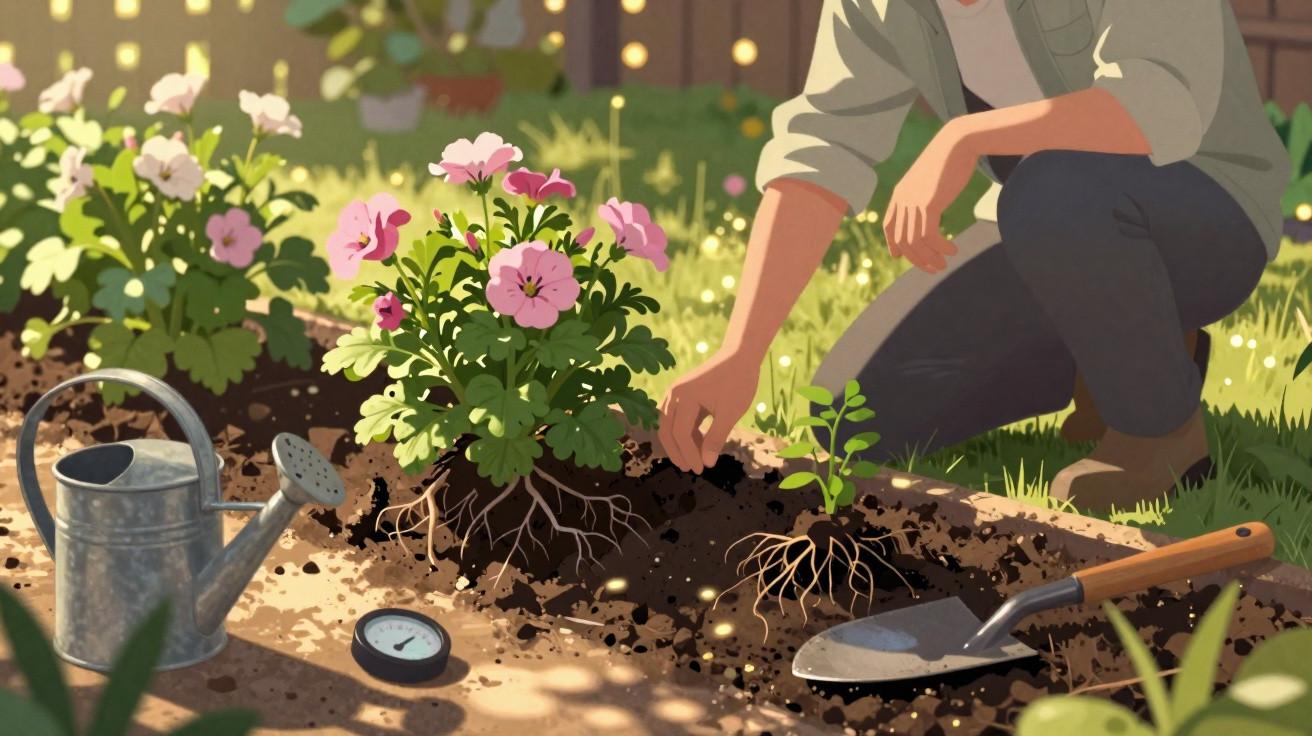
The first thing that catches your eye is the divide.
On the left-hand side of the border, the tulips look as if they’re mid-celebration: petals flung open, colours blazing. On the right, their twins seem as though they never got the message-stubby stems, buds clenched tight, and a weary green that never properly lifts. Same sunshine, same watering can, same bag of bulbs planted last autumn.
And still, one half is fit for Instagram, while the other is… signed off ill.
You hover there with a coffee, trying to work out whether you got the fertiliser wrong, or whether the weather has a personal grudge against that corner of the garden.
Then you crouch down, press your fingers into the soil, and meet something solid.
Thick roots-rope-like, hidden just beneath the surface.
Something underfoot is quietly taking the limelight.
When flowers fight underground, they bloom unevenly
Once you’ve noticed it, it’s impossible to ignore: uneven blooming often draws a neat boundary directly above a root system.
One side of the border appears full, bold and thriving; the other looks as if it’s moving in slow motion.
Most of us start by blaming what we can see.
Too little sun. The wrong cultivar. Perhaps the neighbour’s cat flattening the same patch every afternoon.
But beneath the petals, a tug-of-war is already underway.
Roots creep, clash, pull back, and loop around each other like earphones tangled in a pocket. Some plants take more than their share without fuss; others hang on by their fingertips-and the flowers reveal the outcome without saying a thing.
Picture a narrow bed running along a fence.
Nearest the pavement, a line of roses looks supercharged: shiny leaves, buds queued up like small promises. Tucked behind them, pressed against the fence, a weary row of dahlias struggles to reach knee height.
A gardener in Lyon told me she’d replanted those dahlias three times.
Fresh compost, different varieties, and the same let-down.
Eventually, she put a spade in at the back of the bed and dug deeper than she normally would.
She struck a dense mesh of roots from the neighbour’s maple-finger-thick and spread precisely beneath the failing dahlias. The roses, closer to the path, had their own pocket of looser soil.
Same watering routine, same gardener.
Completely different geography underground.
Once you accept the idea of uneven root competition, the pattern starts to make sense.
Plants aren’t merely “sharing a bed”; they’re living in very different districts of soil, with wildly unequal access to space and resources.
Tree and shrub roots behave like slow, determined explorers.
They slip under fences, snake around stones, bypass compacted ground, and settle exactly where your rich, watered flower border begins.
Shallow-rooted flowers such as tulips, dahlias and many annuals can end up squeezed into the last spare centimetres.
They might persist, but they’re living on rations. Meanwhile, the other side of the border-just a metre away-may be comparatively free of roots, offering water, oxygen and nutrients without constant competition.
What looks like a random patch of weak flowering can simply be the visible edge of an unseen land grab.
How to outsmart uneven blooming caused by root competition
A straightforward first move can change everything: chart the roots before you accuse the flowers.
Use a hand fork or a narrow spade and check several points across the “uneven” section.
Work carefully, as though you’re easing open a zip in the soil.
On the thriving side you may find crumbly, open earth with only a few fine roots. On the struggling side, you’ll often meet a mat of fibrous or woody roots within the first 10–15 cm.
Once you know where the pressure is highest, you can redesign how you plant.
Put tougher, deeper-rooted perennials nearer the competition, and reserve the clearer zones for more delicate annuals and bulbs. It’s the same garden, but approached with a new, almost architectural mindset.
When flowering looks weak, many gardeners reach for the same instinctive response: more fertiliser, more water, more attention.
It feels reasonable-comforting, even-like handing soup to someone who looks run down.
The problem is that the greedy roots get first sip.
That extra water you carry out may be drawn straight into the root system of a large ash tree ten metres away. The nutrients from your carefully chosen organic fertiliser can end up as an unexpected banquet for a hedge that’s already doing perfectly well.
Let’s be realistic: hardly anyone tests soil and sketches root maps every season.
We plant, we hope, we swear, we try again. So if one section of a bed is always lagging behind, the kindest thing you can do is suspect roots before you start questioning your gardening ability.
Sometimes the bravest gardening decision is to stop forcing a plant to win a battle it never chose.
- Raise the battlefield
Where competition is intense near trees or old hedges, use raised beds or large containers. Your flowers get their own soil “flat” above the chaos. - Create buffer zones
Place robust, competitive plants (geraniums, hostas, daylilies) right up against tree lines or fences. Behind them, keep a slimmer, freer strip for more delicate bloomers. - Rotate your stars
Move your most treasured bulbs or annuals each year to the best-looking positions-and, just as importantly, to the least-rooted pockets. This small yearly habit can change the whole feel of a border. - Loosen, don’t wound
If you uncover thick roots, avoid heavy cutting close to a trunk. Gently loosen the top 10–20 cm and accept that some areas will never suit thirsty prima donnas.
Seeing your garden as a living, uneven negotiation
Once you begin to read the garden as a series of hidden negotiations, uneven blooming starts to feel less like a failure and more like information.
The bright patch by the gate, the stubbornly weak strip beside the hedge, the pot that always outperforms on the terrace-they’re all parts of the same underground drama.
Perhaps the biggest change is an emotional one.
Most of us know that moment when a half-empty border feels like a verdict, as if the plants are quietly scoring your competence.
What if those patchy tulips or hesitant roses are simply telling you, very plainly: “There’s not enough room down here for what you’re asking us to do”?
From that point you have options: relocate them, lift them, grow them in containers, or swap out the cast for plants better suited to that spot.
Gardeners who treat root competition as part of the landscape often end up with calmer, less aggravating spaces.
They stop trying to make every corner perform like a firework display. Some zones become leafy, shady, root-packed “green walls”; other areas are turned into protected stages for heavy bloom.
You might speak to neighbours about shared trees, rethink that evergreen hedge, or decide a strip of groundcover is better than repeatedly losing annuals.
You may even start walking the garden differently-feeling where the soil is springy versus stubborn, noticing where plants lean, and where water vanishes fastest.
When you tune in to those small cues, the garden stops being a flat surface and turns into a living relief map.
That’s when you can start using contrast on purpose, rather than putting up with it by accident.
| Key point | Detail | Value for the reader |
|---|---|---|
| Uneven blooming often reflects hidden root competition | Stronger roots from trees, shrubs, or vigorous perennials quietly drain water and nutrients on one side of a bed | Helps readers stop blaming themselves and start diagnosing the real, underground cause |
| Simple soil “probing” reveals root pressure zones | Light digging at multiple points shows where root density changes sharply across a single border | Offers a concrete, low-tech method to understand why certain plants always underperform |
| Adapting plant choice and layout can rebalance the bed | Using raised beds, containers, buffer plants, and rotation turns problem zones into workable spaces | Gives practical strategies to recover stronger, more even flowering without endless trial and error |
FAQ:
- How do I know if tree roots are causing my flowers to bloom poorly?
Gently dig in the struggling area with a hand fork or small spade. If you hit a dense network of woody or fibrous roots just under the surface, especially coming from a nearby tree or hedge, that’s a strong sign of root competition affecting your blooms.- Can cutting big roots fix the problem for my flower bed?
Cutting major roots close to a tree or shrub can weaken or destabilise it, and the roots often grow back. It’s usually safer to adapt your planting (raised beds, containers, tougher plants) than to wage war on large structural roots.- Which flowers cope better with strong root competition?
Robust perennials like daylilies, hardy geraniums, ivy, some ornamental grasses, and hostas in moist shade tend to handle competition better than thirsty annuals or delicate bulbs such as tulips or dahlias.- Will watering more help my weak side of the border?
Extra water can give temporary relief, but a big share will still be captured by the dominant root system. Improving soil structure, adding organic matter, and changing plant selection usually has a longer-lasting effect than just increasing watering.- Is it worth moving underperforming plants to a new spot?
Yes, if you consistently see the same varieties thrive elsewhere and fail in one specific patch, moving them can be transformative. Replant them in an area with fewer competing roots or into containers and compare their performance over one season.

Comments
No comments yet. Be the first to comment!
Leave a Comment