
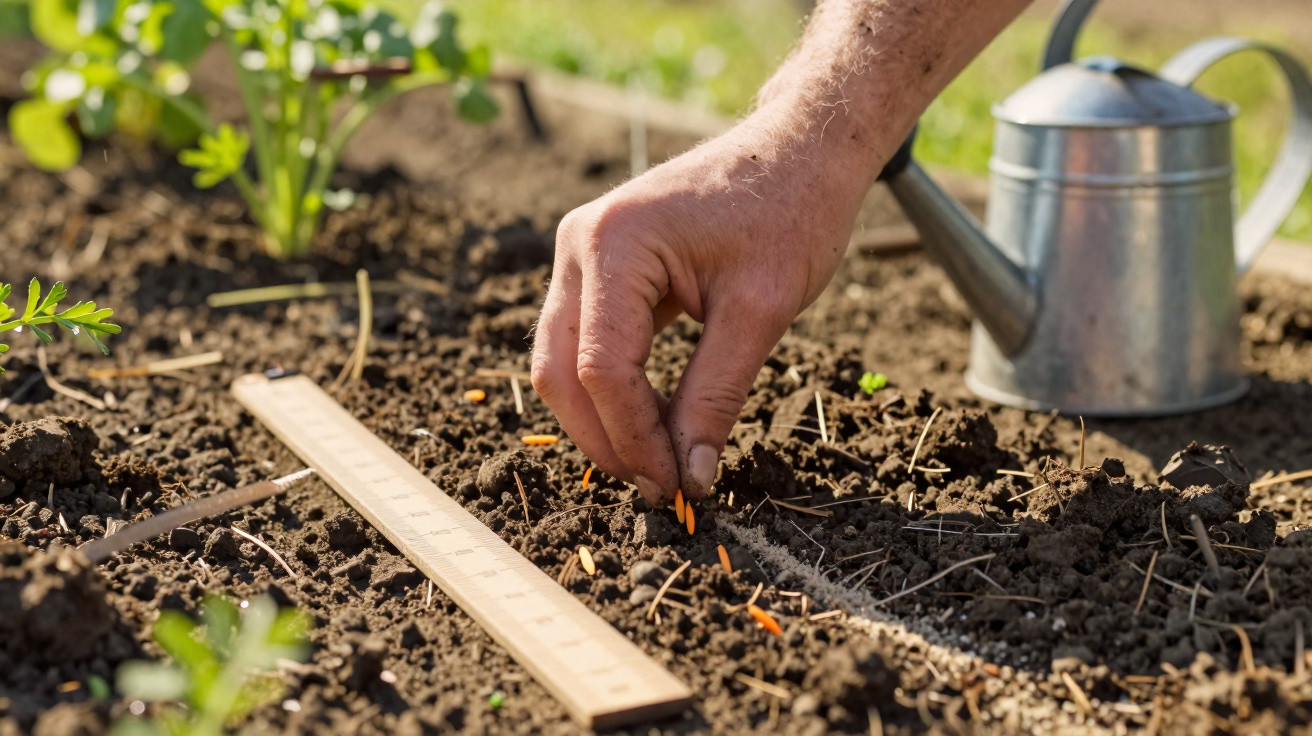
As winter draws to a close, your hands start itching to get back into the veg patch - yet an almost invisible detail still wrecks plenty of otherwise promising beds.
While seed catalogues pile up on the table and the cold begins to ease, thousands of gardeners make the same mistake year after year without noticing. The consequences only show up weeks later: gaps where a row should be, bare patches in the bed, and the feeling that the fault lies with the seed, the weather or even the moon. In reality, the trouble is usually created in just a few millimetres of soil.
The quiet drama of empty rows
Anyone who has waited nearly a month for a line of carrots that never appears will recognise the frustration. The bed is neatly prepared, the row is marked out with canes, the calendar says germination should have happened - and yet there is nothing. Not a single green thread.
The knee‑jerk response is to blame the seed packet, or to assume the late‑winter chill has finished everything off. But technicians and growers who produce carrots at commercial scale point to a different culprit: how the seed is placed in the soil - and, above all, the sowing depth.
"Carrots don’t usually fail through bad luck. They fail when they’re buried too deeply for the tiny energy store they carry."
Carrot seed is small, light and has very limited reserves. It can germinate in cool conditions if it is protected, but it cannot force its way through a thick layer of compacted earth. Before it ever reaches the light, it simply runs out of strength.
It’s not only the cold: the soil can kill too
In early February in Europe, the ground is still cold and damp. For many gardeners the conclusion seems obvious: “frozen ground, nothing grows”. Yet early varieties, when sown under a polytunnel, in a greenhouse, or even beneath simple fleece, can germinate at relatively low temperatures.
What tends to go wrong is the seed’s physical environment. Heavy, clay‑rich ground - especially when it is lumpy or poorly prepared - is, for carrots, like trying to push through a concrete lid.
As the embryonic root begins to grow and meets a compact barrier, progress stalls. Without quick access to the surface and to light, the seedling exhausts itself and dies unseen, right beneath a bed that looks perfect from above.
"The mistake starts with preparing the seedbed: rough soil, overworked with a hoe and not refined enough becomes a seed graveyard."
One centimetre that decides the harvest
Experienced growers repeat a simple rule that is often ignored: sowing depth matters.
The carrot’s ‘millimetre’ window
For carrots, technical guidance is to sow at 0.5 cm and no deeper than 1 cm. That level of precision is not fussiness; it is survival.
- If you sow at 2–3 cm: the seed may sprout, but it burns too much energy reaching the surface.
- If you leave it almost on the surface: wind and sun can dry it out before germination finishes.
- At 0.5–1 cm: the journey to light is short and moisture stays more stable.
Within this narrow range, the seed’s modest energy reserve is enough to push the seedling out of the soil, where photosynthesis can take over.
"One extra centimetre looks like nothing from above. For carrots, it’s the difference between life and death."
Cover without smothering: sand, not clods
Getting the depth right is not the whole story. How you cover the drill line can completely change the outcome.
On clay soils - common in many areas - late‑winter rain can leave the surface smooth and, once it dries, a hard crust forms. This “lid” can stop delicate seedlings from breaking through.
Why use sand or a fine sowing medium
A practice increasingly recommended by agronomists is to avoid covering carrot seed with the bed’s own coarse soil. Instead, use something lighter and finer, such as:
- washed river sand with fine grains;
- sieved vegetable compost or seed compost;
- a blend of sand and well‑rotted compost, with no chunks.
This creates a loose layer that does not set hard after rain and allows seedlings to pass through more easily. There is also a practical visual benefit: a strip of sand clearly marks the row and helps with weeding, reducing the risk of accidentally pulling up newly emerged carrots.
"Think of sand as a maternity ward: light, safe and obstacle‑free for a seed that starts out weak."
Watering done right: a fine sprinkle, not a deluge
After depth and covering comes the third key factor: how you water. A hard blast from a hose, or a watering can with a coarse rose, breaks up the drill, shifts seed, scours holes and buries what was sitting at the ideal depth.
Gentle watering and steady monitoring
For shallow sowings, the recommended approach includes:
- using a watering can with a very fine rose, held upwards so water falls softly;
- or using a hand sprayer for small areas to mimic a light mist;
- keeping the soil consistently moist, but not waterlogged, until seedlings emerge;
- avoiding long watering sessions that create puddles or erode the drill lines.
In late winter, with cold soil, carrot germination can take two to four weeks. That period demands discipline: don’t let the strip dry out, but don’t suffocate the seed in mud either.
What 1 cm says about your whole approach to sowing
The “one centimetre, no more” discussion goes beyond carrots. It highlights a common habit: gardeners often overestimate how deep many small seeds should go.
| Crop | Seed size | Recommended depth |
|---|---|---|
| Carrot | Very small | 0.5 to 1 cm |
| Lettuce | Very small | Surface to 0.5 cm |
| Radish | Small | 1 cm |
| Pea | Medium | 3 to 4 cm |
A useful horticultural rule of thumb is that larger seeds tolerate greater depth, while tiny seeds need very shallow covering - sometimes no more than a dusting of sieved medium.
When precision pays off in the bed
For hobby growers, talking about a few millimetres can sound like needless perfectionism. In practice, spending a couple of extra minutes judging drills with your finger - or even an old ruler - can save weeks of disappointment and wasted seed packets.
A familiar pattern goes like this: a gardener opens deep drills “so they won’t dry out”, covers them with the bed’s heavy soil, then waters hard “to firm it in”. Three weeks later, only a handful of plants appear, widely spaced, and the seed gets blamed again. If the same bed were set up with a maximum depth of 1 cm, a light sand cover and mist‑like watering, the row would look almost professional.
Risks, benefits and lessons that carry over to other vegetables
Changing sowing depth involves clear trade‑offs:
- too deep: germination failures and wasted space;
- too shallow: rapid drying, especially on sandy, exposed and windy sites;
- poor covering: crusting, erosion and seed being displaced.
The upside of getting this right is substantial. Fuller rows make it easier to plan space, reduce the need for resowing and lead to more even harvests. In professional systems that means yield; in home gardens it becomes motivation to keep caring for the bed with more attention.
The same logic applies to radishes and lettuces - classic companions for carrots in spring beds. All of these species respond directly to seedbed quality and to the thickness of the layer they must push through. Fixing this detail once can change your sowing habits for the entire season.
"A successful veg patch doesn’t depend on fancy tricks, but on small decisions repeated consistently - and a few millimetres are part of that routine."
For beginners, a useful exercise is to create two test drills side by side: one following the temptation to bury seeds “a bit deeper”, and the other sticking to the 1 cm limit with a light covering. A few weeks later, the comparison is often more persuasive than any gardening manual.
Comments
No comments yet. Be the first to comment!
Leave a Comment