
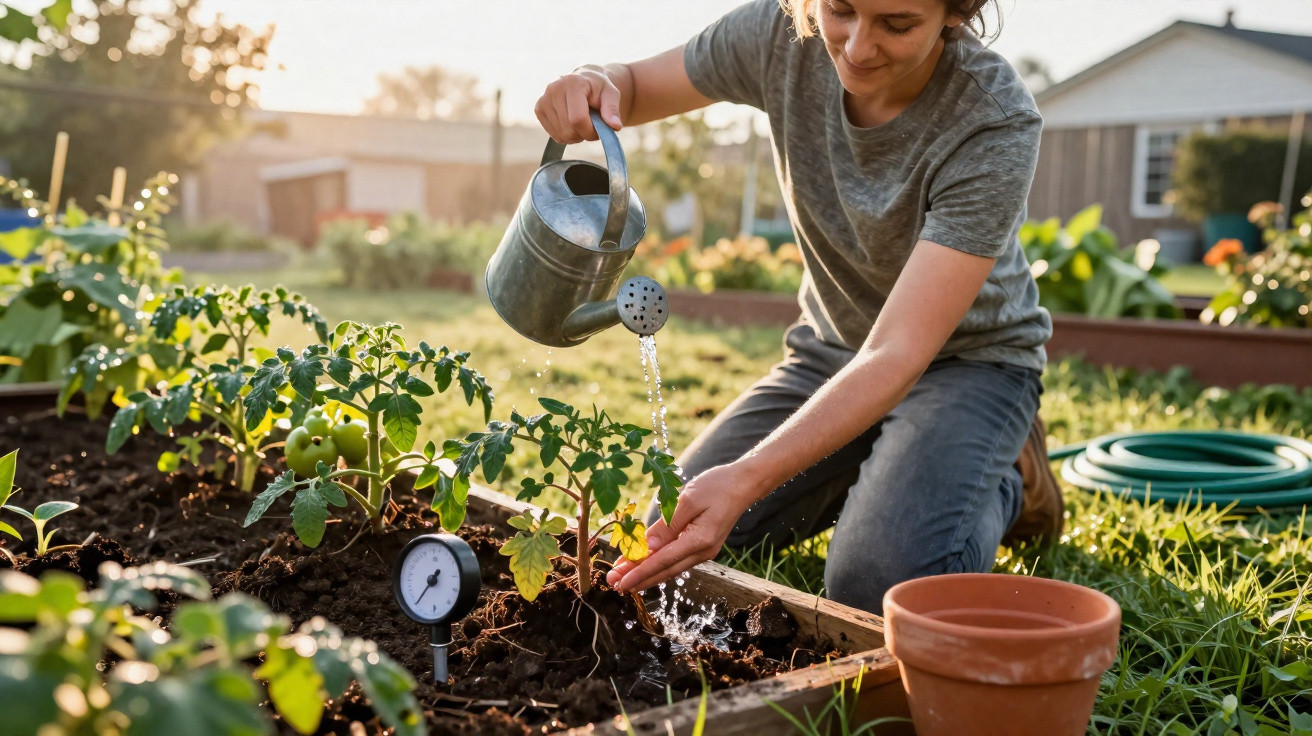
The hose felt warm in my hand the moment I lifted it.
Not hot, exactly-more that tepid warmth that tells you the sun has spent the afternoon turning your water bill into steam. Out on the patio, the terracotta pots looked exhausted: leaves slightly limp, compost split on top like an overbaked sponge. Over the fence, an elderly neighbour in a straw hat was already winding his hose up, finished for the day. “Too late now,” he shouted across. “You’re just watering the sky.” I grinned, watered anyway, and watched the fine spray drift upwards and disappear in the glare. That night, it turned out he was right. And that professional gardeners have a surprisingly exact answer to a simple question: when you water can matter more than how much.
The secret hour gardeners swear by
Ask three gardeners about watering times and you’ll spark a proper argument-but the same conclusion keeps resurfacing. Most professionals quietly settle on one window: the cool early morning, roughly between 5 a.m. and 8 a.m. It’s when the air sits still, the soil is ready to accept moisture, and the sun hasn’t begun charging its daily evaporation tax.
In that brief part of the day, water doesn’t immediately turn into vapour and vanish. It penetrates. Gradually. Further down. Roots can take a proper drink before the heat ramps up, and any damp leaves have plenty of daylight to dry before night returns. It’s like enjoying a coffee in peace rather than trying to neck it while sprinting for the bus.
Some landscapers describe this “golden watering hour” the same way runners talk about perfect morning light. In a small British survey of professional gardeners, several said they saved 20 to 30% simply by moving clients’ irrigation timers to early morning. Same gardens, same hoses, same plants-less water. One head gardener on a large private estate put it plainly: they changed nothing except the clock, and the drop in monthly water use was enough to pay for new flower beds.
It’s easy to picture what’s happening. A sprinkler system that used to run at 2 p.m., flinging glittering arcs into the hottest air of the day. Many droplets never reach the soil at all-carried off by wind or lost to instant evaporation. After switching the schedule, the very same system runs before sunrise. No scorching sun, barely any wind, calm air. Those droplets that were once wasted now end up where they’re needed: down at the roots.
The explanation behind that 30% saving is almost dull in its simplicity, which is exactly why so many home gardeners overlook it. Warm air can hold more moisture than cool air. Under midday sun, water sitting on soil or leaves heats quickly and evaporates before plants can make use of it. You walk away thinking you’ve watered “deeply”, yet an hour later the roots are still short of what they need.
In the early morning, the ground is cooler and the air tends to be slightly more humid after the night. Water lingers on the surface long enough to soak in rather than flashing off into the atmosphere. You get less run-off and less waste. And when leaves do get splashed, they’ve got hours of daylight to dry, which also reduces disease risk. All that, achieved with nothing more sophisticated than an alarm… or a timer.
How to water in the morning like a pro
There isn’t one miraculous minute-it’s more a gentle window. Professionals usually try to begin just before sunrise and wrap up soon after. That could be 5:30 a.m. in July, or 7 a.m. in September. The principle is straightforward: take advantage of the coolest, stillest part of the day, then stop before the sun climbs too high.
If you’ve got an irrigation system, it’s an easy win. Programme it to run between 5 a.m. and 6:30 a.m., using short cycles so moisture has time to sink in. If you’re watering by hand, treat it as a quiet routine: ten or fifteen minutes with a hose or watering can, directing water at the soil rather than the foliage. Keep the flow steady and gentle, not a harsh jet. You want the ground to absorb the water, not repel it.
If mornings are impossible, you can still work around the timing. Water in the early evening, once the day’s heat has eased but there’s still light and a bit of air movement. It’s not ideal, but it’s still far better than soaking everything at midday. Then, once or twice a week, set an early alarm just to feel how different the soil is underfoot. In a dry spell, this timing adjustment alone can help containers and beds cope through the worst of the heat.
Let’s be realistic: hardly anyone steps outside at dawn every day like a watering-can monk. People oversleep, children wake up, work calls multiply. That’s when automation proves its worth. A basic plug-in timer on an outdoor tap-or a simple smart controller-can handle the early shift while you’re asleep.
When professionals look at a thirsty garden, they don’t start with “how often”. They start with “how deeply”. Light daily sprinkles encourage roots to stay near the surface-exactly where heat and drought bite hardest. Deep watering in the morning, two or three times a week, encourages roots to grow down.
The same errors crop up repeatedly in their stories: watering the leaves instead of the soil; watering on breezy afternoons just because that’s when you’re home; forgetting that pots dry out faster than beds; leaving oscillating sprinklers running until half the water ends up on paving and fences. None of it makes anyone a “bad” gardener-it’s simply how habit can override common sense.
During a quiet visit to a small community garden, one volunteer summed it up with a shrug: “We thought we needed more hoses. We really just needed a different hour.” It’s the sort of ordinary truth you rarely see printed on a label.
“When people switch to early morning watering, they usually expect healthier plants,” says one professional groundskeeper. “They don’t expect their water meter to calm down. But it does.”
- Best window: Aim for 5–8 a.m. on dry days.
- Best method: Slow, direct watering at soil level.
- Biggest gain: Up to 30% water saved just by changing the time.
- Check the soil with your fingers; don’t rely on surface colour alone.
- Short, frequent bursts are worse than fewer deep soakings.
Rethinking your relationship with water…and with your garden
Most of us know the moment: a plant you’ve barely registered suddenly slumps, and you rush out with the hose, guilt in tow. The instinct is to overdo it-long, frantic watering in the brightest part of the day, like an emotional apology to something that really needed you six hours earlier. Timing isn’t merely a technicality; it’s part of how we pay attention.
Moving to morning watering nudges a quiet change. You meet the garden at its most exposed, before the day brings heat and noise. Dew beads on leaves, the soil is cool, and birds are louder than traffic. That’s when small issues reveal themselves clearly: a yellowing leaf, a parched patch, a drooping pot tucked behind a larger plant. You’re closer to what’s actually happening to your water-and to your plants.
There’s also a particular satisfaction in realising the same litres you used last year now go further. You’re no longer pouring water onto hot paving and watching it evaporate. For some people, that 30% shows up as a real reduction on the bill. For others, the payoff is more emotional: fewer wilted afternoons, fewer panic purchases of “replacement” plants. A small, practical shift that feels oddly grown-up.
Morning watering can be easier to share than you’d think. A neighbour walking the dog early can turn on a timer. An older relative who wakes at dawn can take on “watering duty” as a purposeful routine. Children often love being “guardian of the hose” at sunrise once a week. These little habits spread faster than any gardening manual.
And once you’ve noticed how different the soil looks and smells at 7 a.m. compared with 3 p.m., it’s hard to forget. You’ll still slip into old patterns on hectic days. But that memory-of cool earth quietly drinking-tends to return the next time you point a hose into hot air and watch half of it drift away.
The reality is that saving up to 30% of your water doesn’t demand new gadgets or a flawless routine. It simply asks you to move your kindness towards the garden a few hours earlier. What follows often surprises people more than the early alarm ever does.
| Key point | Detail | Why it matters to you |
|---|---|---|
| Ideal time | Water between 5 a.m. and 8 a.m., when the air is cool and still | Reduces evaporation and increases the water that actually reaches roots |
| Method | Water slowly at the base of plants, less often but more deeply | Encourages deep roots, tougher plants, and fewer watering sessions |
| Potential gain | Up to 30% water saved, according to professional gardeners | Eases the water bill and makes day-to-day gardening more sustainable |
FAQ:
- Is evening watering really that bad? Early evening can work in hot, dry climates, as long as leaves have time to dry before night. Constantly soaking foliage at dusk can increase fungal problems.
- What if I can’t water early in the morning? Use a simple timer on your hose or irrigation system. If that’s not possible, aim for the coolest, shadiest part of your day rather than midday.
- How long should I water in the morning? Water until the top few centimetres of soil are thoroughly moist and it’s damp 10–15 cm down. That’s usually better than timing by minutes alone.
- Do all plants need the same schedule? No. Pots and hanging baskets dry faster than beds, and shallow-rooted flowers need more frequent attention than established trees or shrubs.
- Can I still use sprinklers if I want to save water? Yes, if you run them in the early morning, keep them low to the ground, and avoid spraying paths, walls and fences where water is simply lost.
Comments
No comments yet. Be the first to comment!
Leave a Comment