
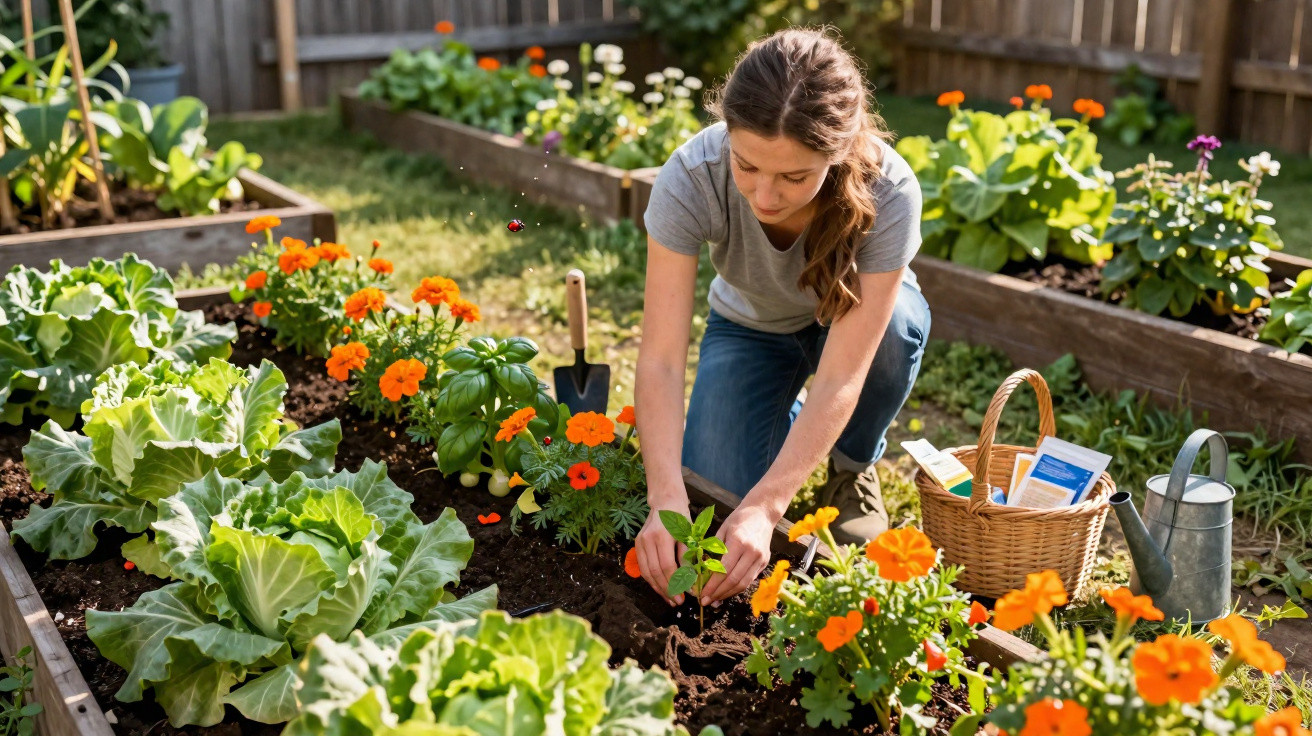
More and more amateur gardeners want to pick lettuce, tomatoes and herbs without constantly reaching for a bottle of chemicals. The so-called push–pull strategy tackles exactly that: it plays on insects’ sense of smell, steers pests away on purpose, and at the same time attracts beneficial allies into the garden. It sounds like a specialist trick from agricultural research, yet it’s surprisingly straightforward to use in an ordinary back garden.
How the push–pull strategy works in a vegetable garden
The principle is simple: you plant the vegetable patch so that pests find the crop area as unappealing as possible, while a nearby area feels far more tempting. In practice, you use two kinds of plants:
Plants that repel pests (push), and plants that attract and “catch” them (pull).
The repellent plants sit within and alongside the main vegetables. They release scents that confuse pests or encourage them to keep away. A little further off, you create a zone planted with particularly enticing species. That’s where the hungry insects drift to - and they largely bypass lettuce, cabbage and the like.
The result is fewer feeding holes, a much lower need for sprays, and a noticeable increase in beneficial insects around the plot.
Which plants work as protection and as decoys
Many familiar garden plants act like miniature scent cannons. Some are excellent at drawing pests in, while others either deter troublemakers or attract helpful predators and parasites.
Decoy plants: deliberately diverting pests
- Mustard (Sinapis): Highly attractive to flea beetles that would otherwise attack cabbage, radishes or beetroot. Sown along the edge of a bed, it can intercept a large share of the flea beetles.
- Hosta: Essentially a luxury buffet for slugs. If you plant the perennials in a line along the garden boundary, you create a kind of slug bar that pulls them away from salad beds.
Place decoy plants where you can easily see them, so you can monitor them and, when pressure is high, cut them back in time or remove them altogether.
Protective plants: a living barrier against pests
- Phacelia: Brings in many beneficial insects, including ground beetles, ladybirds, lacewings and parasitic wasps. These predators and parasitoids eat or parasitise pests such as aphids and caterpillars.
- Anise, dill, nasturtium: Particularly appealing to hoverflies and ladybirds, which can reduce entire aphid colonies in a short time.
- Basil, lavender, marigold, tansy: Their strong scent cloud disrupts aphids and, in some cases, whitefly. Planted in rows between vegetables, they form a fragrant barrier.
- Thyme, sage, ferns: Their aroma makes routes unattractive to slugs. Combined with decoy plants such as hosta, their movement paths can be steered effectively.
- Marigold with tomatoes: The roots release substances that slow down soil nematodes - an important layer of protection for tomato roots.
- Leek and carrot: A classic companion-planting pairing. The leek’s smell confuses carrot fly, while the carrot scent in turn disrupts the leek moth.
The more diverse the planting, the more stable the balance between pests and beneficial insects becomes.
How to plan a push–pull bed in your own garden
You don’t need to redesign the whole garden at once. A trial area of 3 to 5 metres is enough to begin with and to learn what works.
Step-by-step guide
- Choose the area: Pick a bed where pests regularly cause issues, for example with cabbage, carrots or lettuce.
- Create a decoy strip: Along one side, establish a 30 to 50 centimetre-wide border for decoy plants - for instance mustard or plants that are especially attractive to slugs.
- Mix in protective plants: Between vegetable rows, add aromatic plants such as basil or lavender every 20 to 30 centimetres.
- Build in beneficial zones: Near the vulnerable crops, sow a small 1 to 2 square metre patch of phacelia. It provides pollen, nectar and shelter for beneficial insects.
- Check regularly: Inspect the decoy plants, cut off heavily infested sections, and with mustard, remove the entire plant and re-sow if necessary.
This creates a mosaic of vegetables, aromatic plants and flowering strips that guides insect movement through the garden like gentle traffic management.
When to sow and how much care is needed
Timing determines whether pests actually switch to the decoy plants. The “pull” plants need to be established before the pests appear.
- Spring: Sow mustard, phacelia and the first herbs as soon as the soil can be worked. This ensures early decoy food is ready when, for example, flea beetles become active.
- Summer: Repeat sowings of phacelia and flowering plants to keep blooms coming and maintain a steady food supply for beneficial insects.
- Monitoring: Decoy plants must not become “permanent hotspots”. If you never cut back or clear them, you can end up nurturing stable pest nests there.
What matters most is a bit of attentiveness: quick checks, a glance under leaves, and now and again using a hand lens. Over time, you’ll recognise which areas in your own garden are the critical points.
Advantages, limits and useful combinations
Push–pull is not garden magic; it relies on straightforward biological mechanisms. It offers several benefits:
- A much lower reliance on chemical plant protection products
- More flowers, and therefore greater insect diversity in the garden
- Healthier soil, because there’s less poison and more root activity in play
- Improved yields when crop plants suffer less feeding stress
It isn’t completely effortless. If you use push–pull, you need to be willing to look in more often, tweak zones, and re-sow plants. Sometimes certain pairings perform less well in a particular garden, for instance due to soil, local climate or neighbouring plants. In that case, a small change often helps: different herbs, a different decoy plant, or a new position.
The approach becomes especially effective when combined with proven organic gardening methods:
- Crop rotation: Changing what grows where makes life harder for soil-borne pests.
- Mulching: A mulch layer keeps moisture in and supports soil life, but it must be watched closely where slugs are a risk.
- Mechanical traps: Beer traps, boards, slug collars or yellow sticky traps add direct interventions alongside scent-based guidance.
Practical examples for typical pest problems
Cabbage bed with flea beetles
On the sunny edge of the bed, mustard is sown as a decoy, with the cabbage varieties planted behind it. Basil and marigolds grow between the cabbage rows. Nearby, a strip of phacelia is in flower. The flea beetles congregate largely in the mustard, where they are easier to observe and control if needed, while the cabbage leaves show far fewer holes.
Slugs in lettuce
A strip planted with hostas and low perennials draws the hungry molluscs towards the edge of the garden. Around this zone, boards or stones act as shelter traps that can be checked quickly. Thyme and sage sit right by the lettuce bed; many slugs prefer to avoid those dry, aromatic areas.
Why smells in the garden are so powerful
Plants are not defenceless. They produce scent compounds to deter pests, attract the natural enemies of those pests, or “communicate” with each other. Many insects rely more on smell than on a plant’s appearance. That is exactly where the push–pull strategy starts: it alters the garden’s scent profile.
Anyone who uses this method for a few years develops a strong feel for this “scent architecture”. Some gardeners now plan beds by smell zones first and varieties second. The result is gardens that not only look attractive, but quite literally smell of protection.




Comments
No comments yet. Be the first to comment!
Leave a Comment