
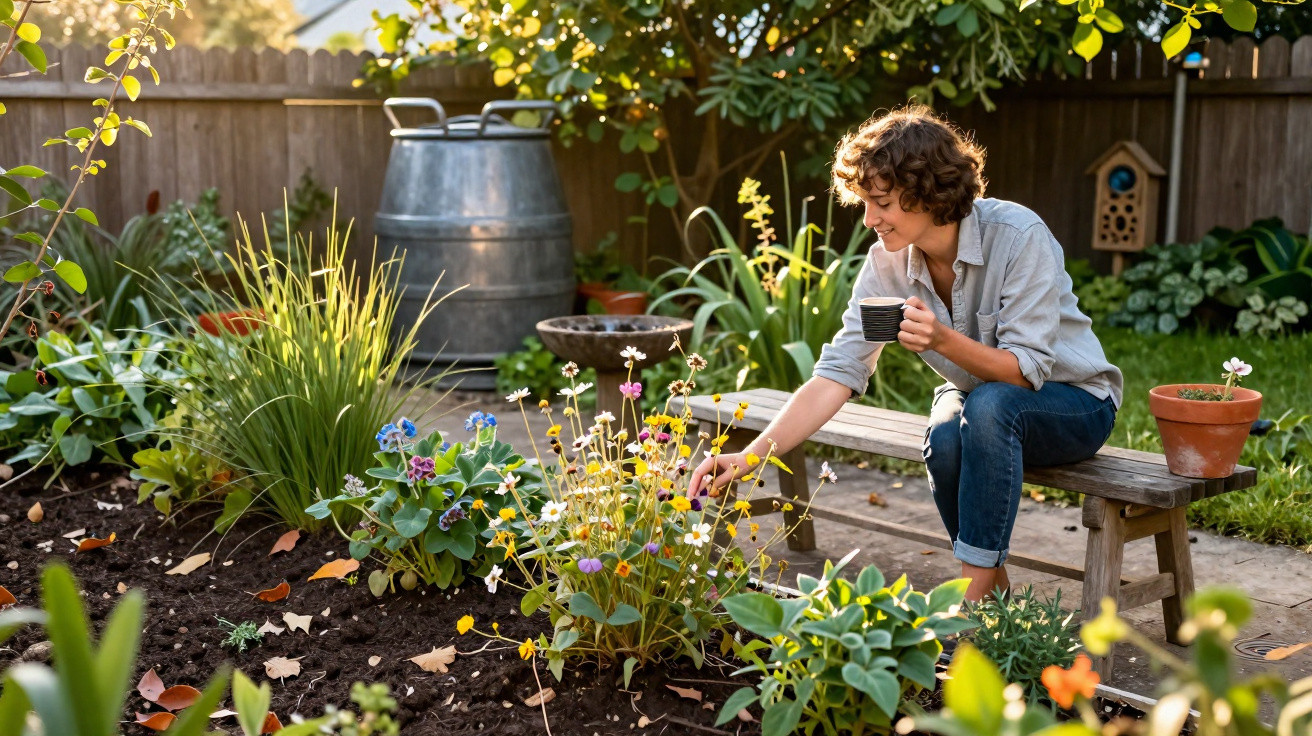
The first clue was the sound. It was not loud, merely unbroken: bees tracing slow circles between lavender stems, a blackbird disputing with something unseen in the hedge, and leaves murmuring together despite the lack of any proper breeze. Standing there with a coffee, I wondered why my little city garden had begun to resemble a packed café at rush hour.
Nothing had been trimmed to perfection. A dandelion had boldly opened in the centre of the gravel path, while a spider had stretched a web over the watering can during the night. The whole place seemed a little beyond my control, as though the garden had decided it no longer needed to seek approval.
Oddly, it felt exactly as it should.
Then the thought arrived: softly, but unmistakably.
When “messy” is your garden’s way of saying “I’m OK”
You may know the curious sensation: a garden looks nothing like a magazine feature, yet you cannot look away. Movement appears in every direction, creating a gentle disorder that never quite becomes still. The lawn is not a pristine green carpet, and the borders do not form rigid outlines.
But the air seems full of life.
Plants prop one another up, insects follow unseen flight routes, and birds flicker in and out like uninvited visitors who are nevertheless meant to be there. That continual backdrop of buzzing, wingbeats and rustling is the first subtle indication that the system is functioning. It is not immaculate or tightly managed. It is simply working.
A reader once told me about her “failed” garden. She had aimed for the traditional style: clipped box spheres, exposed soil around roses and a weekly mow set to the lowest height. It looked crisp in photographs, but in person it felt unexpectedly lifeless.
One spring, she left for a ten-day work trip and returned to grass up to her ankles, self-sown cosmos and clover throughout. At first, she panicked. Then she spotted other changes: butterflies that had never previously appeared, children stretched out on the lawn watching beetles, and a robin shadowing her as she removed a handful of weeds.
Her garden had escaped the limits of her careful plan. Suddenly, it was more alive than it had ever been.
That sense of “unpredictability” often points to one straightforward fact: your garden contains enough diversity to regulate itself. Different plants support different insects, predators discreetly prevent pest numbers from soaring, and flowering happens in succession so something is always available to eat.
What appears haphazardous from a human perspective can be an exceptionally orderly ecological calculation. Aphids arrive and ladybirds find a feast. Snails enjoy tender foliage, and blackbirds gain breakfast. Clover may “spoil” an immaculate lawn, yet it fixes nitrogen in the soil while feeding bees.
The garden is not defying you. It is arranging its own peace treaty.
How to support garden balance without losing your mind
When your garden already feels vibrant, the aim is not to flatten its wildness. Instead, give that energy a few light boundaries. Begin modestly by choosing one corner that can be “looser” than the rest: longer grass, mixed flowers and perhaps a log left to decay slowly.
See what develops there before altering the entire garden.
Rather than planting in rows, try arranging plants in layers. Put taller shrubs at the rear, perennials in front and ground-cover plants around their bases. Extra layers create more niches, more insects and more birds. The bed may seem a touch tangled, but the life within it can become remarkably stable.
Many of us mistake balance for control. We spray as soon as aphids appear, pull out every weed we see and worry when something chews the cabbages. We have all had that moment of noticing holes in roses and feeling as though the garden itself is passing judgement.
That’s usually the moment to breathe, not to reach for the chemicals.
Allow predators time to notice the buffet. Keep a few aphid colonies for ladybirds and hoverflies, and let some “weeds” flower, especially the small early blooms that sustain bees in leaner months. Genuine balance requires a little slack in the system.
Sometimes the most skilled gardeners are the ones who learn when not to intervene.
- Leave small wild patches
One square metre of “leave it be” can support more insects than an entire neat border. - Mow less, rather than never
Cut paths and seating spaces, while allowing the remainder to grow longer between mows. - Plant for every season
Spring, summer, autumn and even winter seed heads matter: wildlife needs food across the whole year. - Avoid sterile plants
Double flowers may look elaborate, but they often provide no nectar or pollen. - Observe before acting
Monitor a pest issue for a week; predators may be quietly dealing with it already.
Let your garden surprise you (on purpose)
A balanced garden is not like a completed painting. It is closer to a continuing conversation. On some days everything works smoothly; on others, a storm knocks down your favourite delphinium and a slug takes the final strawberry. You make adjustments, and the garden responds in turn.
The key is to stop pursuing a fixed “final result” and begin recognising patterns instead. Notice where water remains after rainfall, which flowers hum most loudly at midday and which corner serves as a bird route. Once those invisible traffic lines become clear, your decisions shift. You grow more of what brings life in and less of what merely occupies space.
Let us be honest: no one follows every gardening rule every day. The gardens that feel magical usually belong to people who calmly accept some disorder, trust the process and step in as editors rather than dictators.
You do not need a flawless plan. You need curiosity, patience and the nerve to allow your garden to become slightly wilder than feels comfortable. The lively, unpredictable hum you have noticed may not be a warning at all; it may be the sound of everything finding its place.
| Key point | Detail | Value for the reader |
|---|---|---|
| Life equals balance | Diverse plants and insects create a self-regulating system | Less stress about pests and “imperfections” |
| Controlled mess | Allowing wilder corners and layered planting | More wildlife, more resilience, more visual interest |
| Observe before acting | Watching patterns before intervening | Smarter, lighter work with better long-term results |
FAQ:
- Is a “messy” garden really better for nature? Often, yes. A greater range of plants, flowers and hiding places supports more insects and birds. What looks a little untidy to us may be a five-star hotel for wildlife.
- How do I know if things are actually balanced, not just neglected? Look for diversity rather than simple overgrowth: varied insect species, different bird calls, flowers across many months and no single pest overwhelming the entire space.
- Will my neighbours complain if I let things grow wilder? You can maintain clear edges and paths while allowing borders to remain softer. Defined boundaries suggest “intentional” rather than “abandoned”. Speak to neighbours if necessary, and show them the wildlife your garden supports.
- Can a small urban garden be well balanced too? Absolutely. Even a balcony with assorted pots, herbs and a small dish of water can attract pollinators and birds, forming its own miniature web of life.
- What’s one simple change I can make this week? Choose one area and stop over-tidying it. Let a section of lawn flower, retain a few seed heads or plant three nectar-rich flowers. Then watch what appears. That is your first view of balance.




Comments
No comments yet. Be the first to comment!
Leave a Comment