
In residential areas from Hamburg to Innsbruck, the same scene has been playing out for several years: hedges that were recently dense and colourful suddenly look patchy and bare. Ironically, one of the most popular privacy-screen plants is quietly failing - and clearing the way for a new garden favourite that is said to be far tougher.
Why the former favourite hedge is failing on a mass scale
From dream hedge to constant problem
The shrub that for years was seen as the go-to answer for fast privacy is coming under increasing pressure. Its calling card was brightly coloured new growth and very rapid development. In many new-build estates, this made it possible to create thick, colourful walls within just a few years - reliably blocking views from next door.
Now those very hedges are collapsing in large numbers. Plants shed leaves, entire sections become bare, and the once-perfect screen develops ever bigger gaps. The main culprit is a fungus that attacks the foliage, triggers brown spotting and ultimately causes leaf drop. Without enough healthy leaves, the shrub cannot keep going long term.
Where there used to be a continuous red or dark green wall, there are now gaps - and the view goes straight back into the living room.
Gardeners at the limit: spraying, pruning, hoping
Many hobby gardeners try to rescue their established hedges with fungicides, frequent pruning and meticulous leaf collection. It costs money, time and patience. Results are usually limited, and the fungus returns year after year - especially after mild winters and damp springs.
Landscape gardeners are increasingly reporting frustrated customers who are fed up with constant replanting, repeated cutting-back and expensive products from the garden centre. So the question comes up more and more often: “What can I replace this hedge with, without having the same problem again in five years?”
The weakness of single-species hedges
The current shrub dieback makes it clear how risky it is to plant entire estates with just one species. Before this, thuja hedges had already suffered from disease and climate stress. Now it is the next monoculture favourite.
Garden centres are already adjusting: certain problem shrubs are given less prominence on the shelves, while tougher alternatives are pushed to the fore. One name is appearing more and more often - and it has the potential to become the new standard in many front gardens.
The new favourite: Pittosporum as a modern privacy screen
Evergreen, dense and surprisingly decorative
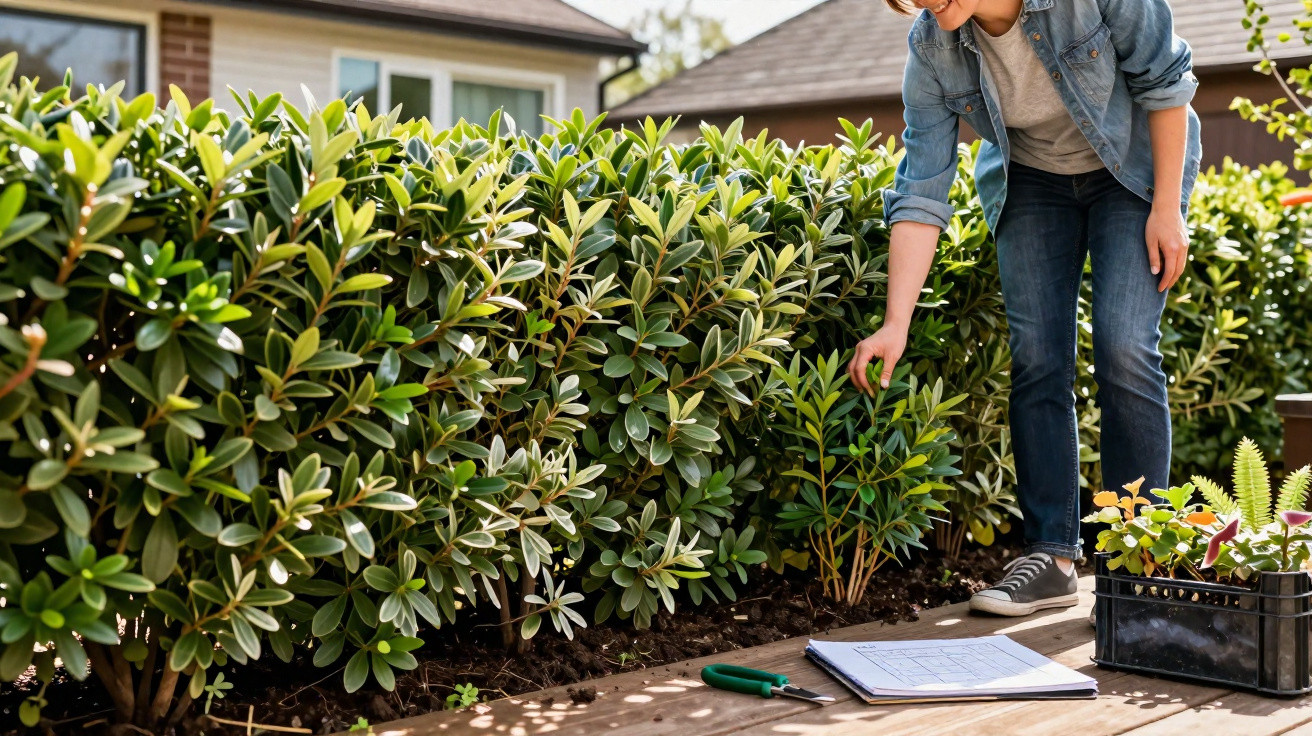
Pittosporum - often sold as pittosporum, “sticky-seed”, or as a pittosporum hedge - is considered an under-the-radar high performer among professionals. It keeps its leaves all year, grows in a compact habit and naturally forms a dense crown. Many varieties have two-tone, slightly glossy foliage in green-and-cream or dark green-and-silver. The effect feels contemporary and suits pale rendered façades, timber decking and the clean lines typical of new-build areas.
Growth is moderate at around 20 to 30 centimetres per year. That means a hedge fills in over a few years without constantly “shooting out of shape”. In most cases, one shaping cut per year is sufficient.
- Habit: bushy, well branched, up to 2–3 metres tall (depending on variety)
- Leaves: evergreen, often variegated, slightly glossy
- Growth: medium, with few runaway shoots
- Look: modern, graphic, ideal for crisp garden design
Pittosporum scores with a mix of privacy screening, colour and moderate growth - a rare trio in the hedge world.
Robust against leaf diseases
Pittosporum’s major advantage is its high tolerance of many leaf diseases that cripple other hedge plants. Fungal problems occur far less often. Even in wet periods, the leaves tend to stay healthy for longer, which noticeably reduces maintenance.
Chemical plant-protection products are almost irrelevant for this species in the private garden. Usually it is enough to plant it in a suitable position and water it well in the first few years. After that, most varieties manage with normal rainfall and occasional feeding.
How to turn Pittosporum into a true privacy hedge
Choosing the right spot in the garden
Pittosporum prefers bright to semi-shaded positions. Full, scorching midday sun reflected off gravel or paving is unhelpful, as is persistent waterlogging. In areas with harsh winters, a sheltered, less windy location is recommended - for example along a house wall or in front of a fence.
The soil should drain well. Heavy clay soils can be improved with sand and compost. In very dry regions, a mulch layer of bark chippings helps retain moisture in the ground.
Planting distance and care at a glance
| Aspect | Recommendation |
|---|---|
| Plant spacing | 60–80 cm between plants for a dense hedge |
| Planting time | Spring or early autumn |
| Watering | Regularly in the first year, later mainly during prolonged dry spells |
| Feeding | Once in spring with organic fertiliser or compost |
| Pruning | 1 shaping cut per year, ideally late spring or late summer |
If you want an especially opaque screen, plant a little closer together. In small gardens, a hedge height of 1.60–1.80 metres is often enough to keep prying eyes away from the patio table.
Why experts recommend mixed hedges
More species, fewer problems
Even if Pittosporum is currently seen as a fix for common hedge issues, many specialists warn against planting entire streets with a single species again. More extreme weather, new pests and diseases, and changing soils can destabilise any monoculture.
The answer is mixed hedging. This combines Pittosporum with other resilient shrubs such as Elaeagnus, hazel or dogwood. The result is a living, varied privacy barrier that shows different colours, flowers and textures throughout the year.
- Elaeagnus: silvery leaves, very wind-tolerant, salt-tolerant
- Hazel: looser habit, edible nuts, ideal for wildlife-friendly gardens
- Dogwood: colourful stems in winter, robust, responds well to pruning
The more diverse the hedge, the more steadily it copes with fungi, pests and weather swings.
More life in the garden
Mixed hedges support insects, birds and small mammals. Flowers provide food for pollinators, dense foliage protects nests, and berries become an important food source in autumn and winter. For many garden owners, this is now a key factor when choosing plants.
Pittosporum fits neatly into these approaches: its evergreen foliage provides the basic structure and year-round screening, while other shrubs add seasonal highlights. That way, the boundary to the neighbouring plot stays attractive and practical all year.
What garden owners can do now
Check what you have and replace it in stages
If you are already battling a declining hedge, the first step is to assess the damage carefully. Individual plants that are still vigorous can sometimes be saved, while severely affected specimens are best removed completely. Rather than clearing everything at once, a phased replacement is often the better option.
Pittosporum and other robust species can then be planted into the gaps. Over time, this creates a more resilient, more varied hedge - without leaving the garden feeling completely “open” for years.
Know the risks and limitations
Pittosporum is not a miracle shrub without drawbacks. In colder areas, some varieties can suffer dieback during severe frosts. In those cases, it is worth choosing more compact options labelled as winter-hardy. In exposed spots, light winter protection with horticultural fleece or brushwood is sensible.
It is also important to keep an eye on the eventual height: some varieties grow quite tall and can quickly feel oppressive on narrow plots. If you start shaping early and keep the hedge at a comfortable height, you stay in control - and maintain a pleasant distance from next door.
Overall, the current trend makes one thing clear: the old “quick fix” approach to hedge choice is out of date. Anyone investing in Pittosporum and mixed hedges today is not opting for the most dramatic solution, but for one that works day to day: more privacy, less stress - and a garden boundary that remains stable in the years ahead.
Comments
No comments yet. Be the first to comment!
Leave a Comment