
The photos were flawless: hydrangeas bursting in blue, a lawn smooth as cake icing, and not a single dandelion daring to show itself. From the kerb, phone raised, Hannah took a dozen pictures of her neighbour’s front garden and muttered the familiar suburban envy: “How do they do it?”
Eight weeks on, that very same garden looked… worn out. The flowers had disappeared. The borders had slumped. The big Instagram moment had drained away like a bargain filter.
That’s the point you clock it: some gardens are built for one huge reveal. The really good ones unfold more like a four-act play.
From snapshot gardens to living landscapes
Take a walk around any neighbourhood in late spring and you’ll spot them straight away: homes dressed up as if they’re heading to a prom. Tulips lined up like soldiers. Blossom-heavy trees shedding petals onto pristine driveways. It’s stunning - and a touch theatrical, like scenery waiting for the final curtain.
Then the summer heat rolls in. The tulips are gone. The flowering trees settle into a plain green hush. The garden that looked like a glossy spread suddenly feels strangely empty, and you can tell something’s missing even if you can’t quite put a finger on it.
A landscaper I spoke to in Portland has a name for places like that: “May-only gardens”. He described a client who poured thousands into a front border that was breathtaking for three short weeks. Neighbours slowed their cars to look. Instagram went into overdrive.
But by July the display had finished, the leaves had flopped, and all that spending had effectively become a flat expanse of mulch. The client rang him again, deflated, wanting to know what had gone wrong. “Nothing went wrong,” he said gently. “We just decorated for a photo instead of planning for a year.”
This is what you get when you design for your camera roll rather than your calendar. Plenty of fashionable plants are bred for spectacular, short-lived flowering rather than for staying interesting across the seasons. Typical garden centres don’t help much either, because they stock what sells today - not what will quietly look good in November.
Proper landscaping works to a slower rhythm. Yes, it considers April and August - but it also thinks about those steel-grey days in February, when one red-twig dogwood can lift your mood all by itself. A well-planned garden doesn’t hit one peak - it breathes.
How to plan a yard that never really “shuts off”
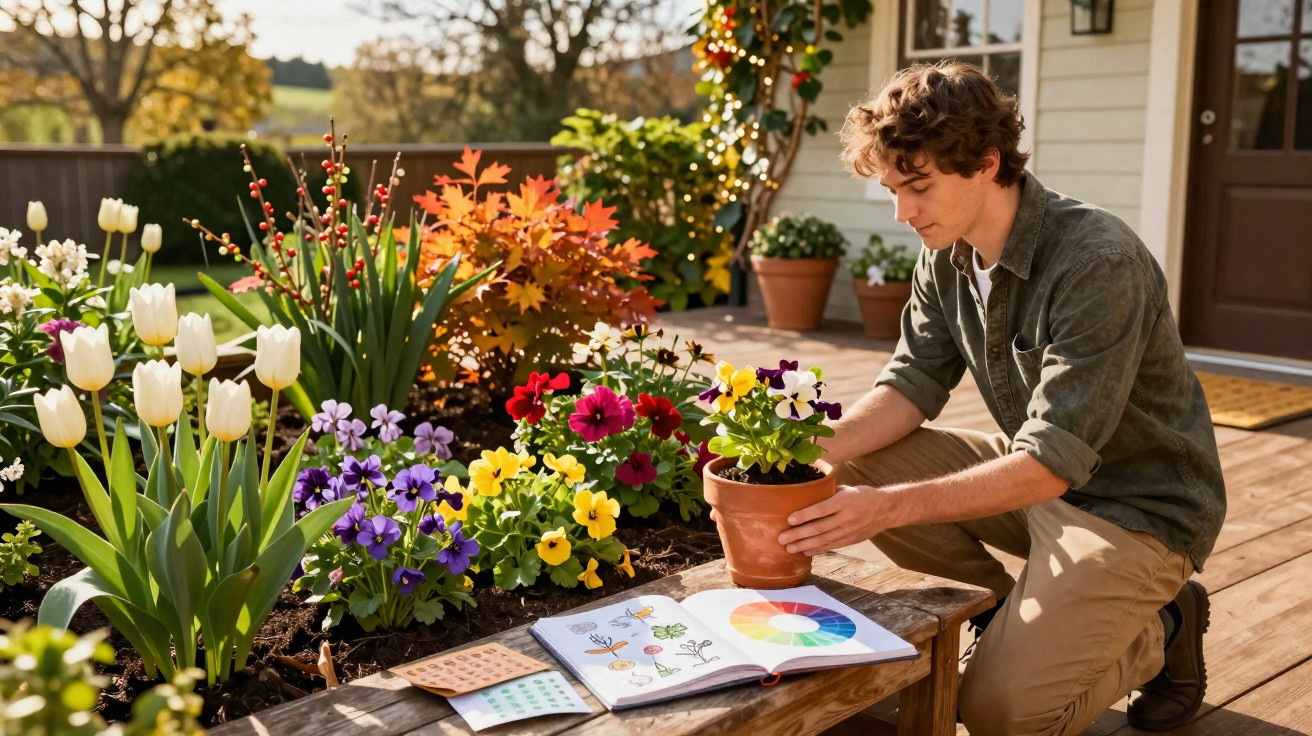
Begin with the least exciting (and most useful) task: take a sheet of paper and split it into four boxes - spring, summer, autumn, winter. Next, walk your garden and jot down what genuinely looks good in each season. Not what you hope is there. What’s actually working.
Chances are you’ll discover one box crammed full (often spring) and another almost blank (usually winter). That emptier box is where the future joy is. That’s where you add evergreen framework, textured grasses, berries, bark, and hardy perennials that don’t panic just because the months change.
Most people know the feeling: you step outside in January and the garden looks like a deserted stage after the performance. A reader from Minnesota once told me she used to call her plot “a mud-coloured rectangle for six months.” After one especially endless winter she finally snapped, took a hard inventory, and made changes.
She planted only five things: a clump of feather reed grass, two dwarf conifers beside the front path, a witch hazel for late-winter flowers, and hellebores tucked near the front step. The following February she emailed a photo: snow dusting the branches, pale flowers nodding by the steps, and tall golden grasses catching the low sun. Same home, same climate - completely different atmosphere.
The shift wasn’t only about what she planted. It was how she thought about the space. She stopped chasing a single massive hit of colour and started layering instead: first the bones, then texture, then flowers as finishing touches.
And let’s be realistic: nobody keeps up a daily spreadsheet of flowering times forever. Still, you can adopt the idea. Each time you bring a plant home, ask: “Which month does this earn its keep?” If it only performs for a thin slice of the year and you’ve already collected ten of those divas, it may not deserve that prime spot by the front path.
Colour, texture, and the quiet drama of the “off” months
There’s a straightforward approach professionals use that many of us never learn. Start by choosing your structural plants: shrubs, small trees, and evergreens that keep their shape through every season. Use these to guide the eye - along the path, around the doorway, and to soften hard corners.
Only after that should you build texture, before you even worry about flower colour. Combine fine foliage with broader, bolder leaves. Set upright grasses against rounded, mounded perennials. When the blossoms are finished, you’re still left with movement, contrast, and a sense of pattern. Colour becomes the final layer, not the foundation.
The most common slip-up? Turning up at the garden centre on the first warm Saturday and buying with your heart. You fall for whatever is blooming right then, and you drive home with a boot full of plants that all hit their stride in the same fortnight. No shame - that’s exactly how most of us begin.
A gentler strategy is to “shop the gaps”. Go in late summer or autumn and pay attention to what still looks good when everything else is flagging. Ask staff what stands out in November, or which perennials keep their seed heads into winter. The aim is quiet workhorses, not just instant headliners.
“Design for the day you feel restless in February,” one landscape architect told me. “If your yard can comfort you then, it’ll wow you in June without even trying.”
- Spring anchors – bulbs beneath shrubs, early-flowering trees, hellebores along paths.
- Summer energy – long-flowering perennials, ornamental grasses beginning to stir.
- Autumn fire – maples, switchgrass, asters, foliage that blazes rather than simply fading.
- Winter backbone – evergreens, striking bark, seed heads left standing for birds.
- All-year threads – repeated colours or shapes that quietly link one season to the next.
The kind of yard that stays with you
There’s a softer sort of beauty that never begs to be noticed. You catch it when you pull onto the drive after a long day and see grasses shifting in the breeze, or when a small clump of snowdrops reminds you winter isn’t forever. That kind of beauty comes from designing for seasons, not for photos.
A garden like that won’t look spectacular every day. Some days it simply feels peaceful, or gently alive, or a bit untidy in a way that’s forgiving. What it doesn’t feel is vacant. You begin to spot the handovers: tulips yielding to salvia, summer flowers easing back as leaves ignite in October, and stems and seed heads standing watch when everything else is asleep.
When you start rethinking your outdoor space, you’re really shaping your days ahead: the March mornings with coffee on the step, the humid August evenings when moths drift to flowers you chose on purpose, and the silent winter walk to the postbox when one evergreen or a flash of red twig makes you feel less alone.
It may never be the most shareable garden on social media. It offers something better: a steady alignment with the slow, stubborn pulse of the year - and the reminder that not everything has to bloom at once to be worth keeping.
| Key point | Detail | Value for the reader |
|---|---|---|
| Plan by seasons, not snapshots | Map what looks good in spring, summer, autumn, winter before buying plants | Reveals gaps so you invest in a garden that stays alive all year |
| Build structure before colour | Use evergreens, shrubs, and texture as the backbone, then add flowers | The garden still looks good when blooms fade or weather changes |
| “Shop the gaps” at the garden centre | Visit in under-loved months and ask what shines then | Find reliable, long-season plants instead of short-lived divas |
FAQ:
- How do I start if my yard is just lawn and a few random shrubs?
Begin with that four-season sketch. Then add a small cluster of structural plants (like one tree and two shrubs) in a key spot, plus one or two perennials that offer interest in your weakest season.- Do I need a complicated plant list to have year-round interest?
No. A mix of 10–15 well-chosen plants, repeated in groups, can give more impact than 40 different impulse buys scattered everywhere.- What about low-maintenance seasonal design?
Focus on tough, long-lived perennials, ornamental grasses, and small shrubs. Avoid thirsty annual carpets and trim only once or twice a year, leaving some seed heads for winter.- How can I add winter interest on a small budget?
Start with one standout: a colourful stem shrub, an interesting bark tree, or a bold evergreen near your main window or entry. Then add cheap touches like leaving spent flower stalks standing.- Are native plants better for four-season gardens?
Often yes, because they’re adapted to local weather and many offer great seed heads, berries, or autumn colour. Mix natives with a few non-invasive ornamentals for extra texture and bloom time.




Comments
No comments yet. Be the first to comment!
Leave a Comment