
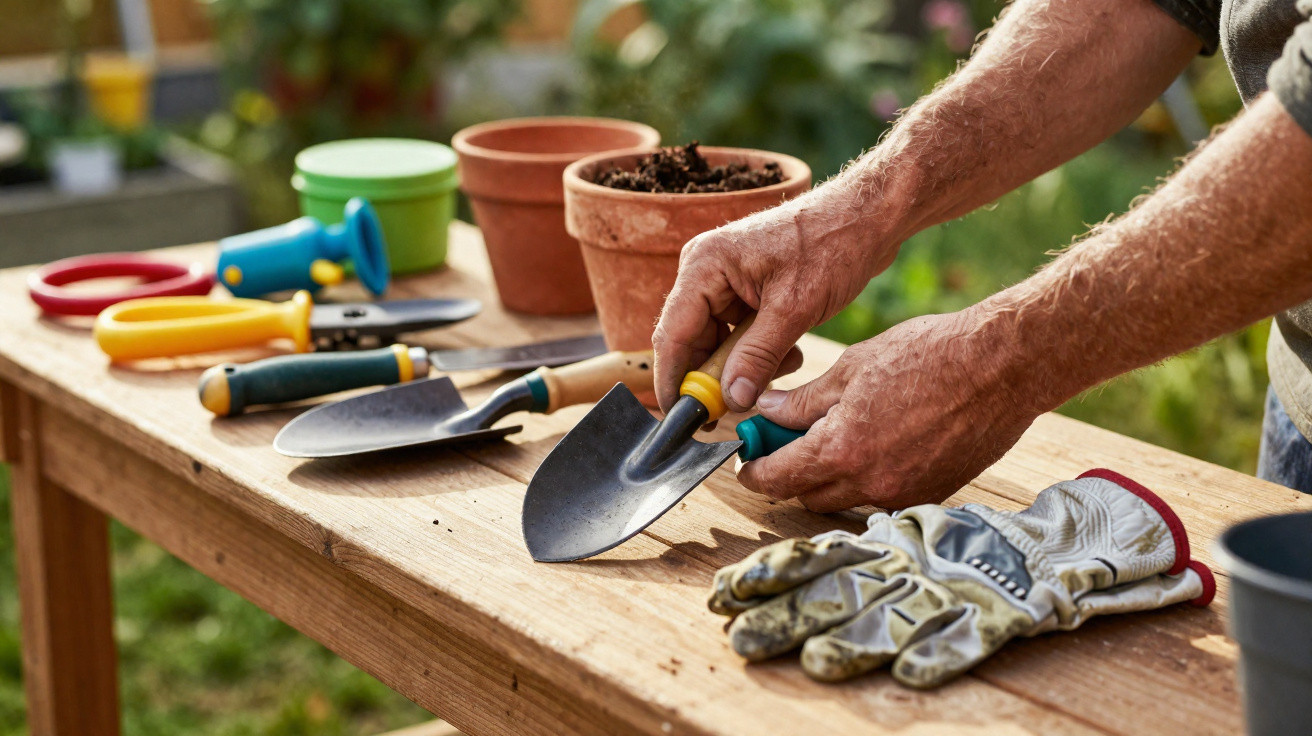
The spade is still lodged halfway in the soil, the sun is already dropping into that late-afternoon slant, and beside you sits a whole pile of shiny garden tools that, in the garden centre, all seemed to whisper, “You need me!”. The packaging promises flawless beds, effortless weeding and almost magical harvests. Two hours later, reality looks different: an aching back, muddy knees - and you’re genuinely using only three of them. Everything else goes straight back into the shed, to join last year’s hand tools as they quietly collect dust.
Most of us know that moment when the dream of the perfect garden crashes into the reality of what we’ve bought. At some point, you end up asking yourself, almost under your breath: which of these is actually useful, and which is just overpriced junk with a green label?
The few garden tools that rescue almost any garden
When you watch experienced gardeners, one thing becomes obvious: the pros carry surprisingly little kit. A decent spade, a sturdy digging fork, sharp secateurs, perhaps a rake. That’s about it. With a small set of classics like these, you can get through a full gardening year - from the first turn of the soil to the final autumn prune. Next to the overstuffed aisles of a DIY superstore, it looks almost minimalist.
And that’s exactly why it feels so liberating. Instead of being mediocre with five gadgets, you become genuinely confident with three reliable tools.
A garden planner who lives near me once showed me how it’s done. Her plot: just under 400 square metres, with vegetable beds, perennial borders and a wilder patch for insects. Her entire kit fits into a single old galvanised tub. Inside: a spade, a hand trowel, a fan rake, a bypass pruner and a hand cultivator. Nothing more. She trims her hedge with a straightforward pair of manual hedge shears, and she keeps the lawn in check with a tough cylinder mower - no battery required.
Meanwhile, the neighbour wrestles with a battery trimmer, telescopic pruners, grass shears and a lawn edger; she’s already finished and is having coffee on the patio. Let’s be honest: nobody enjoys swapping tools five times just to get one edge neat.
The reasoning is simple: one well-made general-purpose tool beats three specialist gadgets that each do a single job half-heartedly. In many gardens, a sharp spade makes a border spade unnecessary. Strong bypass secateurs handle everything from roses to fruit trees to ornamental shrubs. A solid digging fork loosens heavy soil without wrecking its structure.
Your garden repays you with healthier plants and far less frustration. Once you focus on the basics, you quickly notice how much of the rest is simply marketing - convenience promises wrapped in pretty packaging that make little difference in day-to-day gardening.
These tools are worth it - and these you can skip
Begin with a clear core set: spade, digging fork, rake, secateurs, hand trowel, gloves. That’s your foundation. If you have lots of rows and beds, a simple cultivator (or “claw”) is useful for breaking up the top layer of soil. If you’ve got a larger lawn, add a mower that actually suits the size - not the noisiest model on the shelf, but the one you’ll realistically use often.
Anything that genuinely strengthens that circle earns its place. Everything else can stay in the shop, even if the display is gleaming.
Where many people get caught out: specialist tools designed for one tiny task. The “deluxe weed puller” that’s only really good for dandelions. The electric patio-joint brush that disappears into the cellar after two uses. The laser-guided lawn edging shears that nobody sensibly takes all the way around an entire garden. The same goes for multi-tools with ten attachments, all slightly wobbly.
If you’re just starting out, it’s easy to overbuy because you feel unsure. The fear of failing without the “right” tool is powerful - and that gap is exactly where brands keep slipping in new inventions.
An old allotment association in my city dealt with this in a wonderfully blunt way. The members agreed on an unofficial tool charter:
“If you can’t dig a hole with a spade and a shovel, you won’t manage it with a specialist auger either.”
- Genuinely worthwhile: a high-quality spade, an ergonomic digging fork, sharp bypass secateurs
- Nice-to-have if it suits you: a pruning saw for thicker branches, a sturdy garden rake, a water butt with a watering can
- Often unnecessary: battery lawn edgers, electric joint scrapers, the fifth version of the same hoe
- Total dust collectors: decorative mini watering-can sets, cheap multi-tools with loose handles
- Community solution: scarifier, garden shredder, rotavator - borrow instead of buying
Buy less, garden better: how to separate what’s useful from clutter
A simple way to get clarity: imagine you had to run your garden for a year using only ten tools. Which would you choose? Write the list down before you even open the shed. Then put every item you already own through a quiet test: did I use this at all last year? Would I genuinely miss it if it were gone?
If you haven’t picked something up for two seasons, it’s probably sentimental clutter or a purchase you regret. This small thought experiment is oddly freeing - and it sorts things out more thoroughly than you’d expect.
When buying, it also helps to judge tools with a sober eye for materials and feel. A wooden handle that sits well in your palm, solid metal joints, and no flimsy plastic where the load is taken. Many of us reach for the bargain option out of habit, then act surprised when the spade shaft snaps the first time it hits a root. The disappointment ends up back in the shed - and at the next shopping trip, the cycle repeats.
A better approach: choose one fewer item, but make it robust enough that it could be passed on. In the long run, your back - and your bank balance - will thank you.
An experienced gardener summed it up dryly at a workshop:
“The best pair of secateurs is the one you grab from the box without thinking - because you trust it.”
- In the shop, actually hold tools properly instead of judging them by the packaging
- Check you can get spare parts (blades, springs), or you’ll replace the whole thing sooner than you’d like
- Use borrowing options from neighbours, hire shops or clubs for expensive powered machines
- Cut out overlapping functions: one strong rake can replace several “specialist” rakes
- Keep your core tools clean and sharpened - a blunt spade feels twice as heavy
Your garden, your tools - and the freedom of owning less
In the end, it isn’t only about spades and secateurs; it’s about a particular feeling in the garden: getting on with the work instead of constantly searching. Knowing exactly where everything is. Fewer decisions, more doing. When you strip your kit back to the essentials, many people notice their head feels clearer.
All at once, the beds look different - not as problems to be “solved” by buying another gadget, but as living spaces you can care for with a few dependable companions.
Maybe, on the next sunny day, you deliberately empty the whole shed and question every single item. Which tools carry stories of good gardening days? Which ones are just reminders of a spur-of-the-moment discount?
A pared-down toolkit isn’t a step backwards. It’s choosing routine, experience and a light touch. And that, in the end, is what separates a garden that looks like a catalogue from a garden you actually want to spend time in - even with dirty hands.
| Key point | Detail | Benefit for the reader |
|---|---|---|
| Basic tools are enough | Spade, digging fork, rake, secateurs, hand trowel as the foundation | Saves money, space and stress when choosing tools |
| Be critical of specialist gadgets | Many “problem-solvers” are barely used and gather dust in the shed | Prevents bad purchases and brings clarity to your tool collection |
| Quality over quantity | Fewer, higher-quality tools last longer and feel easier to use | Less frustration, less physical strain, more enjoyment in the garden |
FAQ:
- How many garden tools do beginners really need? For a typical home garden, 6–8 items are usually enough: a spade, digging fork, rake, secateurs, hand trowel, gloves, a lawnmower and possibly a garden rake.
- Is it worth investing in expensive branded tools? If you garden regularly, yes. Better tools last longer, are more ergonomic and make the work noticeably easier.
- Which tools are best shared with neighbours? In particular, rarely used powered machines such as a scarifier, garden shredder, rotavator or pressure washer are ideal to buy jointly.
- What should you do with old or unnecessary garden tools? You can give away working items, sell them at car boot sales or offer them in local community groups; broken ones should go to your local recycling centre.
- How often should you maintain garden tools? Ideally, do a quick clean after each use, and sharpen, oil and check for damage once or twice a year.
Comments
No comments yet. Be the first to comment!
Leave a Comment