
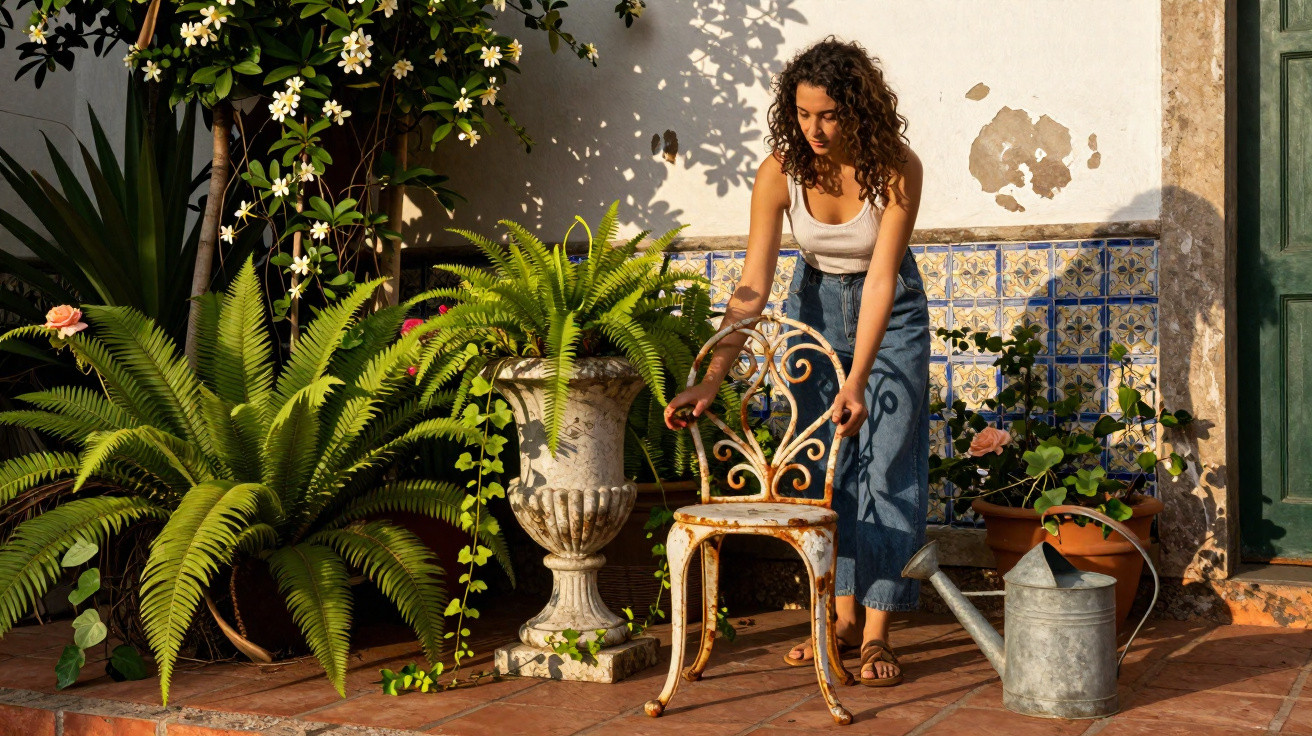
If you’re daydreaming about an enchanted Italian courtyard or a romantic cottage garden, you don’t need a total rebuild or a huge budget. Garden professionals often reach for timeworn pieces in stone, metal or timber-objects that have already lived a life-and use them as a kind of stage set on which the whole garden can be reimagined.
How one old find can shift the mood of an entire garden
The concept is straightforward: one standout object anchors the eye and sets the tone. It might be a weathered stone urn, a wrought-iron gate, a fragment of balustrade, or a retired sandstone pillar. The moment that piece is placed outdoors, everything around it is perceived differently.
"An antique object feels like a jump in time: it speaks of the past-and automatically pulls the rest of the garden along with it."
American antiques dealer and garden designer Michael Trapp demonstrates this beautifully at his property in West Cornwall, in the US state of Connecticut. Behind his early-19th-century farmhouse, he has dotted around broken elements of old architecture: columns, balusters, urns, stone slabs. What might have been seen as building rubble becomes focal points that lend the land a timeless quality.
That approach works just as well in a typical UK terraced-house garden: it isn’t the size that creates the magic, but one distinctive piece that seems to breathe history. In fact, a smaller plot can benefit even more, because the change in atmosphere is immediate.
The golden rule: choose the object first, then build around it
Many amateur gardeners buy plants and decoration at the same time-and then wonder why the result feels random. Designers tend to do the opposite: they hunt down the single old piece first, and only then let everything else fall into place around it.
Where you want the eye to pause
Good positions for a salvaged or antique feature include:
- at the end of a path or sightline
- in the middle of a bed or circular planting area
- directly opposite an important set of windows
- at the threshold between house and garden, for example beside the patio
What matters most is that you can see it from everyday viewpoints-at the dining table, from the sofa, in the kitchen, or from your favourite seat outdoors. That’s when the space starts to feel like a glimpse into another courtyard, another era.
"When you place an old piece in the garden, always ask yourself: from where do I actually experience it in day-to-day life?"
Outdoor-suitable materials: what lasts and ages well
Not everything that looks “vintage” will survive British winters reliably. If you want a lasting, sustainable result, choose materials that improve outside rather than deteriorate.
Materials that work
- Stone (sandstone, limestone, granite, marble): extremely durable; over time it often takes on moss and lichen.
- Cement and concrete: great for urns, troughs and plinths. Fine hairline cracks usually aren’t a problem.
- Cast iron: ideal for figures, fountains and brackets. Rust can be part of the look-and may be exactly what you want.
- Teak or oak: useful for benches, shutters and small gates. It silvers nicely if you don’t keep oiling it.
- Zinc and galvanised sheet metal: tubs, buckets, old watering cans-excellent as planters.
What professionals tend to avoid: pure plaster statues, very thin bargain decorations, and hollow plastic. They weather quickly, snap, or simply don’t look convincingly old.
How to find the right antique for your garden
Interestingly, the price matters less than the story and the patina. Dings, cracks and chipped edges are often what make a piece compelling. The key is character-and avoiding anything that looks mass-produced.
Typical places to source pieces in the UK
- municipal works depots or demolition firms (ask, with permission, about leftover pieces)
- local builders’ merchants or reclamation yards with a “used” section for bricks and natural stone
- flea markets, country brocantes, house clearances
- antique dealers who specialise in garden pieces
- local online classifieds, using search terms such as “stone urn”, “sandstone pillar”, “old garden gate”
"The most interesting pieces are often the ones that were minutes away from a skip-an old stone stair tread can become a plinth, a shutter can turn into screening."
Safety, proportion and clearance: three points people often forget
So your nostalgic centrepiece doesn’t become a trip hazard-or a future headache-a few practical checks help.
| Criterion | What to look for? |
|---|---|
| Stability | Centre of gravity, a frost-proof base; for tall pieces, consider setting in concrete or fixing with anchors. |
| Weight | Can two people move it? If not, plan for a small crane service or dollies. |
| Proportion | Small garden-choose slimmer, vertical forms; large garden-something more substantial can work. |
| Clearance | Leave enough space to walk around it and still tend plants comfortably. |
Without the right planting, even the best object can look out of place
The old-world effect really comes alive when plants soften and weave around aged materials. Designers often lean on species you’d expect in monastic cloisters, farmhouse gardens or historic parks.
Plants that strengthen the old-world feel
- scented herbs such as lavender, thyme, rosemary and sage
- romantic flowers: old roses, peonies, foxgloves, hollyhocks
- structure plants: box alternatives (e.g., Ilex crenata), yew, privet
- meadow-style companions: yarrow, catmint, hardy geranium
- shade-loving partners: hostas, ferns, epimediums around stone fragments
You can frame the object, let planting half-swallow it, or run a low “carpet” beneath it. The more the boundary between hard surface and soft green is blurred, the older the space will feel.
"An old stone with cushions of thyme spilling out of it automatically looks as if it hasn’t moved for decades-even if you only placed it last year."
Small ideas, big impact: reusing everyday objects
Not everyone can get hold of 19th-century columns or balustrades. You can still achieve a similar atmosphere with simpler finds-provided they look genuinely aged and aren’t overly fussy.
Examples of easy vintage-style ideas
- a galvanised tub turned into a miniature herb bed
- an old wooden ladder used as a support for sweet peas
- a plain, heavily weathered wooden bench under a fruit tree
- discarded shutters as a backdrop behind a rose bed
- a heavy concrete slab set on two rows of bricks as a rustic potting table
The key is to keep kitsch at bay: one strong piece beats lots of tiny frills. Three old enamel jugs planted with pelargoniums will feel more coherent than ten brightly coloured animal ornaments scattered across the lawn.
Risks, upkeep and a few honest warnings
If you’re chasing a historic look, it’s wise to consider potential downsides. Old sheet-metal buckets can leave rust marks on paving, porous stone can spall in hard frost, and too much metal can become dangerously hot in midsummer.
Helpful habits include:
- checking once a year whether cracks have widened
- keeping a sheltered winter spot for very frost-sensitive items (e.g., thin-walled concrete)
- keeping an eye on children and pets, especially around tall statues or loose walls
- accepting patina, but replacing rotten timber parts in good time
Finding your own balance between nostalgia and everyday use
Old-world atmosphere doesn’t mean the garden has to resemble a museum. Many spaces work best when only certain zones carry that historic note, while the rest stays firmly modern: lounge furniture on the patio, easy-care beds, perhaps even a small pool.
It becomes particularly effective when you use contrast deliberately: a simple concrete terrace that ends with an old wrought-iron gate; a very restrained gravel garden where a single, heavily weathered stone figure rises from the grey. In that way, the garden stays practical, yet gains pockets of depth that new mass-produced decoration rarely delivers.
If you’re unsure, start by experimenting with smaller pieces: an old stone along the patio edge, a course of reclaimed bricks as edging, a used window frame fixed to a garage wall. If that feels right, you can always add the larger urn, archway or heavy pillar later. The old-world charm then builds naturally-almost as if it had always been there.


Comments
No comments yet. Be the first to comment!
Leave a Comment