
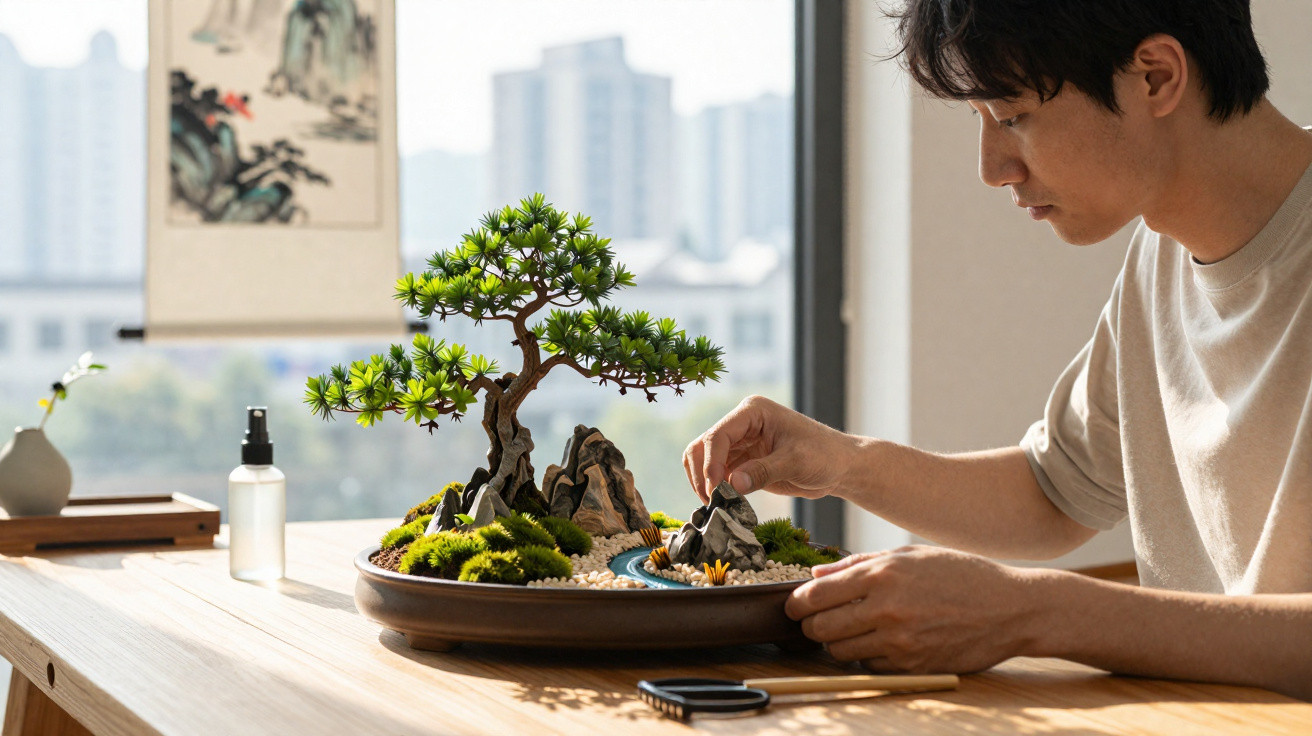
On a tabletop scarcely larger than a baking tray, entire mountain ranges, winding rivers and ancient forests come to life - vivid, yet in miniature.
What many people in the UK casually label as “a kind of bonsai” is, in fact, its own centuries-old art form: Penjing. This Chinese practice builds miniature landscapes that are not meant to be merely decorative; they compress emotion, narrative and a philosophy of nature into a shallow pot. That is exactly where the most interesting difference from bonsai begins.
What Penjing actually is - and why it’s more than “bonsai light”
Penjing translates literally as “landscape in a container”. It describes a composed scene made from plants, stones, water and often small figurines, arranged together to create a complete landscape image. The aim is not a single tree, but an entire setting - a small, self-contained world.
"Penjing seeks to capture the principles of nature - the rhythm of wind, water, rock and growth - concentrated into just a few square centimetres."
Typical elements in Penjing include:
- living plants, usually woody species, mosses and grasses
- stones that suggest cliffs, peaks or mountain ranges
- water surfaces or implied river courses
- miniature figures such as houses, boats, animals and people
The key idea is that the composition should convey a feeling - loneliness, calm, a storm, a journey, a dream. Many pieces are intentionally a touch surreal, like frozen moments from a fairy tale.
Over 1,000 years of history: from Daoist masters to international collectors
Penjing appears in China as early as the 1st century AD, and may be older still. Daoist scholars wanted to make the power of vast landscapes accessible in small form. If someone could not reach mountains, forests or gorges, they brought that “energy” into their living space - condensed inside a pot.
Early legends spoke of masters who could seemingly shrink whole landscapes. Later, Buddhist monks adopted the method and carried it to Japan. From that lineage, bonsai developed there - more tightly focused on the single tree, more formal, and guided by stricter conventions.
Within China, Penjing remained a symbol of reverence for the natural world. For a long time it was associated with scholars and the nobility. Even now, many learners commit ten years or more of intensive practice before they truly master the craft.
Penjing vs. Bonsai: what really sets them apart
At first glance, Penjing and bonsai can look alike: a small tree, a shallow container, and a great deal of patience. With a closer look, however, the distinctions become clear.
| Feature | Penjing | Bonsai |
|---|---|---|
| Focus | complete landscape scene | tree as the central subject |
| Style | wilder, more natural, narrative | highly controlled, formal rules |
| Elements | plants, stones, water, figures | usually tree + decorative stone/moss |
| Effect | miniature landscape with a story | aesthetically perfected single tree |
Where bonsai often reads like sculpture, Penjing leans towards stage design: multiple components relate to one another - a kind of landscape theatre in a pot.
The three most important Penjing styles from China
China is vast, and Penjing reflects that breadth. Regional schools such as Lingnan, Shanghai and Taiwan have developed their own traditions. At heart, though, works can be grouped into three main directions.
Shumu: the “forest in a pot”
Shumu Penjing centres on trees and shrubs. Several woody plants grow together in one container to form a miniature woodland, an avenue, or a single striking specimen on a hill.
Designers typically work with:
- careful pruning
- wiring and shaping branches
- deliberate placement of trunk thicknesses and heights
Visually, Shumu is the closest to classic bonsai, yet it often pursues a looser, more “untamed” ideal that embraces natural irregularity.
Shanshui: mountains, water and rock
In the Shanshui style, the rugged landscape takes priority. Artists arrange rocks, gravel and areas of water in a shallow tray to evoke mountains, ravines or coastlines. Plants are used sparingly, mainly as accents - for example, a hint of growth on a rocky ledge.
Rather than a tree, geology dominates. The stones’ shape, texture and colour matter most. In this miniature world, one distinctive boulder can stand in for an entire mountain.
Shuihan: when everything comes together
Shuihan is often viewed as the supreme discipline, because it combines tree landscapes (Shumu) with rock-and-water scenes (Shanshui). In a single container, you may often find:
- trees and shrubs
- rock formations
- water or marshy areas
- small houses, boats, and human or animal figures
The finished piece can feel almost cinematic: a fisherman’s house on a slope, a path through the hills, a solitary pagoda among pines. Many artists use this format to suggest abstract stories - of hermits, travellers, farmers or mythical characters.
Living art: how Penjing keeps evolving
Penjing is not a static pastime. Plants grow, the seasons shift colour and structure, and the artist responds with pruning and rearrangement. Each intervention gives the scene a slightly different character.
Today’s Penjing masters often work with far more freedom than earlier generations. Some deliberately strip compositions back to the essentials; others build highly detailed scenes that resemble fantasy landscapes. Despite experimentation, one guiding thought stays constant: to reveal the vast within the small - natural laws, impermanence, calm and chaos.
Getting started: Penjing in your own living room
You do not need to move to Shanghai or commit to a decade of training to begin. A first miniature project can be started with simple materials - provided a few fundamentals are understood.
The basics: container, light and climate
To begin, you typically need:
- a shallow tray with good drainage
- bright but not harsh light
- temperatures that stay as steady as possible, without extreme swings
For indoor setups, people often choose hardy indoor “bonsai” plants or naturally compact shrubs. For a balcony or garden, dwarf pines, juniper, small maple varieties or resilient local woody plants can work well.
Idea before technique: start with the story, then pick up the shears
Before buying the first plant, it helps to ask one question: what scene are you trying to create? A misty mountain path? A quiet lake with a boat? A hillside village in autumn?
From that initial image, you can decide:
- which tree form makes sense (upright, slanting, multi-trunk)
- where stones should sit
- whether figures or houses belong - or are better left out
If you feel unsure, browsing Penjing and bonsai books or asking advice at garden centres can help. Many shops already stock suitable plants, stones and miniature figures in one section.
Patience is the most important tool
Penjing rewards slow work. A tree does not become an “old master” in an afternoon. Small adjustments, gentle pruning and long observation achieve far more than drastic interventions.
"Oddly enough, the key isn’t the most expensive plant, but a mix of curiosity, endurance and a willingness to accept mistakes as simply the next step."
Experimentation is how you learn. A composition that does not work can usually be rebuilt; plants can be repositioned, stones reset. In that way, not only does the miniature landscape develop, but so does your own sense of rhythm and balance.
Why Penjing is especially appealing for stressed city dwellers
Many people who take up Penjing or bonsai describe a similar effect: the process forces you to slow down. You look more closely, check leaf by leaf, feel the roots, and start thinking in seasons rather than deadlines.
There is also the creative pull. Penjing blends botany, design and storytelling. If you like the idea of painting but do not fancy holding a brush, this becomes a kind of three-dimensional canvas made of soil and wood. And if you already love plants, it provides an excuse to fit a few more pots into the home - this time with a dramatic concept.
Another draw is cultural perspective. Penjing offers a window into Chinese tradition without feeling didactic. Along the way, you begin to understand how tightly nature, spirituality and everyday life are intertwined. Each shallow tray becomes a quiet conversation between cultural history and the present.
Comments
No comments yet. Be the first to comment!
Leave a Comment