
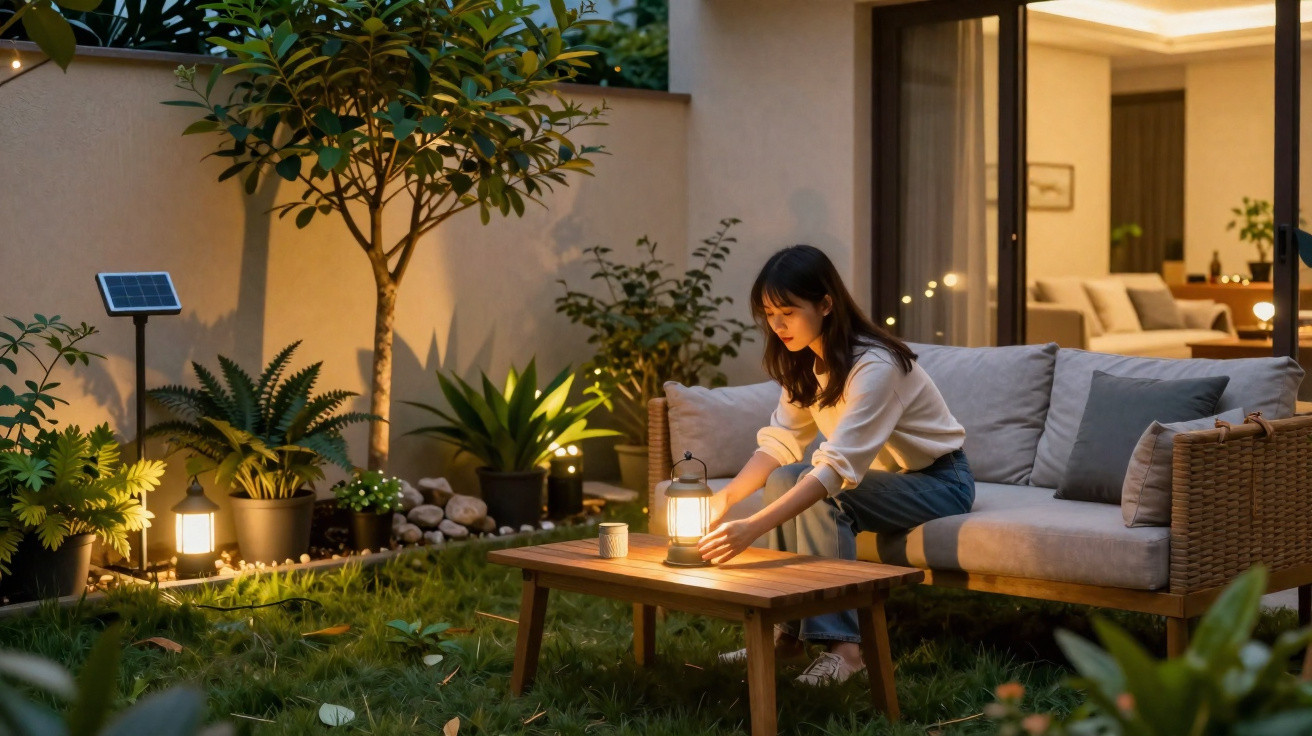
With a few simple adjustments, however, it can feel full of life again.
Many people believe that creating a cosy, cinematic garden means hiring builders, installing cables and spending heavily. Actually, several well-chosen lighting changes completed in less than half an hour can transform a chilly lawn into a warm winter view worth enjoying.
Why your garden resembles a car park at night
A garden rarely feels unwelcoming because it lacks lights. More often, the issue is that unsuitable lighting has been placed in unsuitable locations.
In many homes, one strong floodlight sits above the garage or rear door. Its beam removes definition, bleaches texture and makes all plants appear alike. When there is frost or snow, stark white light creates a cold blue glare, closer to a warehouse atmosphere than somewhere to unwind.
Outdoor comfort starts with tone, not power: gentle, warm light beats a blinding security beam almost every time.
Lighting designers use the term “temperature”, measured in Kelvins. To make a winter garden feel inviting, choose warm tones from 2700K to 3000K. These shades echo candlelight and firelight: bark appears more textured, stone walls look gentler, and snow takes on a soft golden reflection instead of an icy blue cast.
How to choose the right colour in 20 minutes
You do not need specialist equipment to change the colour temperature. Most current LED bulbs display this information clearly on their packaging.
- 2700K: exceptionally warm, close to candlelight and suited to cosy corners
- 3000K: warm white, appropriate for paths and terraces
- 4000K and above: cooler white, best kept for work zones or security purposes
Replace cold-white bulbs in exterior fittings with 2700–3000K alternatives. For portable or battery-powered lamps, select products specifically labelled “warm white”. This is often a tool-free job that takes only a few minutes.
Warm light on a bare winter tree can look more inviting than a full summer border lit in cold white.
Stop illuminating empty space and start creating a story
A common approach is to arrange matching solar stakes along a path at precise intervals, like runway lights. While this marks the route, it achieves little else: the lawn remains featureless, shrubs disappear and the garden seems smaller than it really is.
Effective exterior lighting treats the garden as a compact stage, deciding where its “actors” should appear and where the viewer’s attention should land first.
Choose your stars before choosing your spots
At night, look out from your living-room window and assess the scene. Pick three to five elements that deserve emphasis:
- a twisted tree trunk or a striking arrangement of branches
- a stone wall, fence panel or textured façade
- ornamental grasses that sway in the breeze
- a sizeable planter or sculpture beside the terrace
Set a compact spotlight at the foot of each feature, directing it upwards or across its surface. Uplighting or side-lighting reveals forms that are easily missed in daylight. Branches cast extended shadows, grasses glint, and even an ordinary timber fence takes on added dimension.
Lighting a single tree well often has more impact than lighting your entire lawn badly.
Why darkness helps create a cosy garden
When faced with a gloomy garden, many people attempt to solve it by adding fixture after fixture. The outcome can resemble a supermarket car park: there is nowhere for the eye to pause, while the window view becomes an indistinct wash of brightness.
Within lighting design, darkness serves the same purpose as silence in music. It establishes rhythm and lets illuminated details stand apart.
Keep deliberate spaces between pools of light. Let sections of lawn or hedge recede gradually into shade. This contrast makes every illuminated feature seem brighter without consuming additional energy.
The most atmospheric gardens at night are not the brightest ones, but the ones with confident shadows.
This measured approach benefits wildlife too. Constant artificial illumination can affect moths, bats and hedgehogs. Leaving areas darker, particularly those farther from the house, limits light pollution and supports the nocturnal creatures that help keep the garden in balance.
No electrician or drilling: the growth of “nomad” lighting
Not long ago, a well-lit garden required cables, trenches and a professional installer. Cordless technology now gives renters and cautious homeowners a different option.
| Type of light | Best use | Main advantage |
|---|---|---|
| Solar spotlights | Highlighting trees, walls, statues | No wiring, charge during the day |
| Rechargeable table lamps | Terraces, balconies, dining areas | USB charging, move as needed |
| Battery-powered fairy lights | Railings, pergolas, shrubs | Soft background glow, easy to install |
Today’s solar lights store more power and can still operate after overcast winter days. Numerous options include integrated sensors that switch them on automatically at dusk. Rechargeable lanterns, frequently charged by USB-C, may last for a whole evening on one charge before being carried back indoors.
Their greatest strength is adaptability. You can try out different positions, beam angles and heights without making holes in walls or installing permanent wiring.
Think of cordless lights as garden furniture: you rearrange them with the seasons and with your mood.
Making the garden a visual extension of your living room
When lighting becomes warmer and more focused, the garden is no longer a black space beyond the glazing. Instead, it begins to feel like an additional room.
From the sofa, your gaze can travel along an illuminated path towards a glowing tree, before reaching a planter on the terrace. At night, the window stops behaving like a mirror because the scene outdoors is sufficiently bright to keep your attention.
Even a compact flat can seem larger as a result. A balcony with a warm table lamp and one illuminated planter gives the indoor view more depth. You might not go outside in January, but your mind perceives extra space.
A practical 20-minute makeover: a straightforward scenario
Picture a typical suburban garden with a patio, rectangular lawn, fence and one small tree.
- Minutes 1–5: turn off the harsh security floodlight and, where possible, fit a 2700K LED bulb instead.
- Minutes 6–10: position a solar or battery-powered spotlight at the tree’s base, aiming it upwards through the branches.
- Minutes 11–15: use a rechargeable lamp or fairy lights around the seating area to form a warm “island” on the patio.
- Minutes 16–20: go indoors, switch off every other garden light and inspect the view. Alter the angles to prevent glare through the window.
After these three modest changes, the view has layers: a cosy terrace, an accent-lit tree and darker space behind it. The garden appears deeper and more private, without needing to contact an electrician.
Useful terms and small risks to understand
Two terms regularly appear on product packaging: “IP rating” and “lumens”. An IP rating indicates how well a fitting resists water and dust. In an exposed garden, choose at least IP44; for ground spotlights that face heavy rain, higher ratings offer added reassurance. Lumens indicate brightness. Accent lighting rarely requires high outputs, and around 100–300 lumens per spotlight will generally create a subtle result.
A few precautions will help maintain both safety and comfort. Do not position bright lamps at eye height if they shine directly into neighbours’ windows or towards passing motorists. Bring rechargeable lights indoors during severe frost where the manufacturer recommends doing so. Also, ensure cables from plug-in lighting do not cross paths where they could cause someone to trip.
When used with care, portable warm lighting achieves more than decoration. It changes the experience of long winter evenings, turns a black rectangle into a living image and may even make a night at home feel like a pleasure rather than a compromise.





Comments
No comments yet. Be the first to comment!
Leave a Comment