
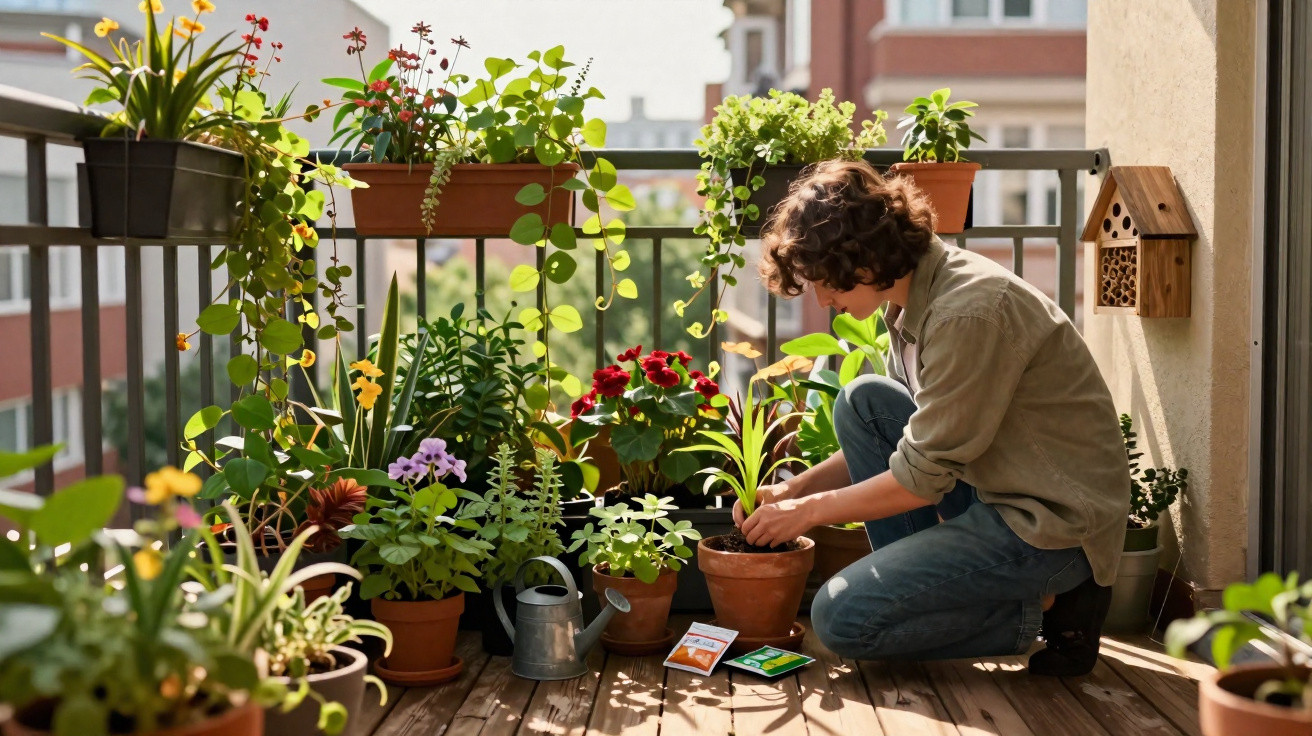
On a fifth-floor balcony, there are two plastic chairs, a struggling rosemary plant and a view across 40 identical windows. At first, that seems to be all there is. Then you notice the neighbour’s rail: an unruly thicket of terracotta pots, charity-shop containers and an old metal toolbox spilling over with marigolds. Bees float from a chipped mug planted with thyme to a tall tomato pot, darting between the buildings like miniature commuters.
You rest against your own bare railing, and a persistent little question begins to surface.
What might this small rented space truly become?
Why variety matters in a space where you can barely move
Consider this first: a small garden containing just one kind of plant resembles a conversation made up of one word. It beats silence, but it cannot really come alive.
By fitting variety into a balcony planter or slim garden strip, you do more than occupy empty spots. You build layers of living things. Plants with varying root systems, leaf forms, flowering seasons and fragrances can occupy the same compact patch of soil, each making use of a slightly different level of it.
That is where the magic begins to build.
Visit an urban courtyard given over to a single type of plant, and the feeling is immediate. Perhaps it has a uniform hedge, matching geraniums in every container or nothing but grass cut to one even height. It may look orderly, yet it also feels oddly worn out.
Then you come across a postage-stamp front garden that an older neighbour has cared for over many years. Lavender grazes your legs. Strawberries creep out from beneath a rose bush. Mint in a pot presses against a cracked step. Bees dart about, ladybirds emerge and birds stop to land rather than simply flying overhead.
The square metres are the same. The atmosphere is entirely different.
There is a reason behind that activity. Every species attracts its own visitors: particular blooms appeal to particular pollinators, some foliage shelters tiny predators that consume aphids, and certain roots form channels that help water penetrate the soil. A varied balcony planter is, in effect, a high-rise for micro-life.
Even on this tiny scale, monoculture is vulnerable. A heatwave, a pest outbreak or one forgotten watering can affect everything at the same time. Diversity lets the strengths of one plant quietly compensate for the limitations of another.
Your small space becomes tougher than it appears.
How to build diversity on a balcony and windowsill
Think in levels rather than square metres: upper, middle and ground. When you deliberately use all three, it is possible to grow an impressive range of plants.
On the upper “floor”, grow skywards: train a cherry tomato up a string, wind a runner bean around a bamboo cane or use a vertical trellis for peas. For the middle level, choose bushy herbs, compact peppers or dwarf dahlias. At ground level, add trailing strawberries, creeping thyme and low salad mixes that cascade over a planter’s edge.
You are not creating extra room; you are arranging it in layers.
At the garden centre, many people are overwhelmed by endless labels and leave with two dependable geraniums. That is a perfectly human response. Instead, choose only three functions: one plant to feed you, one to feed pollinators and one that gives your eyes a sense of calm.
This might mean lettuce + basil + calendula, or cherry tomato + lavender + trailing ivy. There is no need to obsess over Latin names or hold out for the “perfect” scheme. Plants are more forgiving than social media makes them look.
Honestly, nobody manages this every day. At times, you will forget to water. With variety, at least some plants will simply carry on growing.
“People think they need a big garden to help biodiversity,” a city horticulturist told me once, dusting soil from her hands. “But a single diverse balcony on every floor of a building? That’s an entire vertical ecosystem.”
- Vary flowering periods
Choose early-, mid- and late-flowering plants so bees have reasons to visit from spring through autumn. - Choose pots of varying depths
Use shallow planters for lettuce, deeper containers for tomatoes or roses, and small cups for micro-herbs. - Combine edible and ornamental plants
Pair marigolds with tomatoes, nasturtiums with lettuce and chives around the edges of flower pots. - Welcome “useful” insects
Grow fennel, dill or yarrow to provide hosts for lacewings and ladybirds that eat pests. - Keep one corner wild
A forgotten pot, a small heap of twigs or a tray of fallen leaves can provide refuge for unseen helpers.
The understated strength of a tiny, diverse patch
Once you begin looking closely, it becomes clear that even the smallest and most crowded places can start to throb with life. One surviving borage plant may end up supporting half the bees in the street. A mixed-herb window box can become a midnight feeding station for moths. A single pot of native flowers may attract a butterfly you have not seen since childhood.
Your garden ceases to be merely “decor” and becomes a modest act of participation. You are not simply residing in the city any longer; you are helping write its living edges.
| Key point | Detail | Value for the reader |
|---|---|---|
| Arrange your space in layers | Add vertical supports, medium-height containers and trailing plants | Cultivate more species without requiring additional square metres |
| Combine different functions | Mix edible plants with pollinator-friendly and calming choices | Get food, beauty and wildlife from one very small space |
| Accept imperfection | Retain a “wild” corner or an untidy pot | Give insects shelter and improve resilience with almost no work |
Frequently asked questions
- Question 1 Can one balcony genuinely make a difference to biodiversity?
- Answer 1 Yes. Many insects and birds travel in short stages, treating balconies, small gardens and street trees as stepping stones. A varied balcony can serve as an essential refuelling stop along that route.
- Question 2 How many plant types are needed for “real” diversity?
- Answer 2 Begin with 5–8 species that have distinct forms and purposes: at least one herb, one flowering plant, one edible, one “wild” or native species, plus one climber or trailing plant.
- Question 3 Is caring for lots of mixed plants more difficult?
- Answer 3 It may actually be simpler. Close, mixed planting shades the soil, limits evaporation and draws in natural pest controllers, meaning you will often need to water and spray less.
- Question 4 What if my balcony receives deep shade?
- Answer 4 Choose shade-tolerant plants such as mint, chives, ferns, hostas and woodland flowers. Diversity still applies; you are simply selecting from a different group of plants.
- Question 5 Must I buy specialist soil or costly containers?
- Answer 5 No. For most balcony gardens, good-quality potting mix and proper drainage will suffice. Repurposed containers with holes drilled into their bases can support a rich range of species.

Comments
No comments yet. Be the first to comment!
Leave a Comment