
With a few well-chosen measures, this can be prevented surprisingly effectively.
When rain, thawing conditions and heavy soil coincide, even the finest lawn can give way. Instead of lush green grass, you are left with a brown, slippery carpet. Many owners then wonder in frustration whether they need to abandon their dream of a tidy garden. That is not necessary: once you understand why the soil behaves this way, you can take targeted action and protect the lawn for the long term.
Why the lawn turns into a muddy track in winter
The issue is almost never caused by “bad grass”, but by the soil beneath it. Three factors are particularly important:
- Heavy rainfall: Winter rain and thaw bring more water than the soil can absorb.
- Compacted or clay-rich soil: The pores in the ground are too small or blocked, so water cannot drain away.
- Constant foot traffic: Children, dogs and wheelbarrows - every pass compacts the ground even further.
Loam and clay soils react especially severely. They hold water like a sponge and release it again only slowly. If water remains on the surface, lawn roots begin to die, bare patches develop, and the perfect conditions for moss and mud are created.
“The lawn’s real enemy in winter is not the rain, but soil that can no longer absorb water.”
Improve drainage: make the soil absorbent again
Professional gardeners start by dealing with the ground below. The aim is for water to drain down into the soil rather than pooling on the surface.
Aerate and relieve the lawn regularly
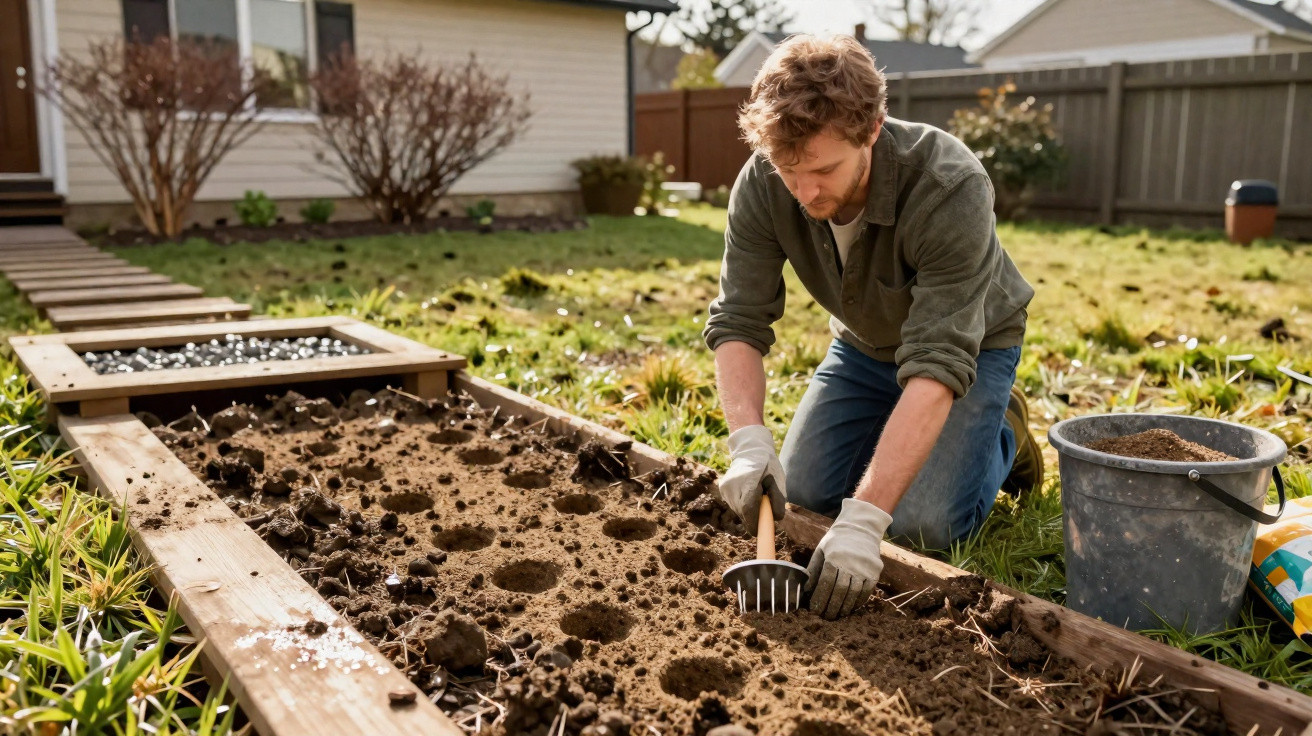
The simplest and most effective approach is aeration - in other words, allowing air into the soil. You can do this with dedicated hand tools, aerator shoes or, in the traditional way, a garden fork.
Proceed as follows:
- On a dry day, use the fork to make holes roughly 15–20 cm apart.
- Push the tines at least 8–10 cm into the ground.
- Gently move the holes back and forth to widen them slightly.
- If desired, fill the holes with sand so water can drain down more easily.
Gardeners repeat this process once or twice each year, ideally in autumn and, if required, in spring. It loosens the soil, gives roots more air and allows rainwater to drain away faster.
Work in organic matter
Clay-rich soils benefit greatly from compost or well-rotted farmyard manure. Both improve soil structure, making it more crumbly and permeable. Applying one to two centimetres of fine compost in autumn and lightly raking it in is enough to noticeably alter the soil’s properties over the years.
“Soil containing plenty of organic matter works like a natural sponge: it absorbs water, retains it - and gradually releases it to the plants.”
Quick help: temporarily dry out muddy patches
If the lawn is already sitting in water, rapid measures are needed alongside long-term strategies.
Sand, gravel and woodchips as emergency aids
After heavy rain, professional gardeners spread materials over trouble spots that absorb moisture and stabilise the surface. Particularly suitable options include:
- washed play sand
- fine gravel or grit
- woodchip or bark mulch
This layer holds moisture and stops shoes or paws from sinking deeply into the ground. Important: these measures do not solve the underlying problem; they simply provide some breathing space until the real soil improvement takes effect.
Create solid paths: avoid mud in high-traffic areas
Where the same desire lines repeatedly appear - to the garden shed, wheelie bin or patio - a structural decision is often the only answer: install a proper path.
Stabilisation grids for heavily used areas
Plastic grid panels, often used in horse paddocks and driveways, also work remarkably well in gardens. They are laid on a prepared base and filled with grit or soil. Their advantage is that they spread the load, keep the ground beneath stable and greatly reduce mud formation.
Stepping stones as a practical compromise
For a more natural appearance, choose individual paving slabs or natural stones arranged like islands across the lawn. For a stable base, it is advisable to:
- remove around 10 cm of soil at each location, making the hole slightly larger than the slab
- add a layer of sand or grit and compact it
- lay and level the slab, then fill the joints with sand
This creates a walkable route that remains visually unobtrusive while taking pressure off the lawn.
Plants that love water and ease the problem
In particularly wet corners of the garden, aeration may no longer be enough. Gardeners then turn to trees, shrubs and perennials that cope well with moisture and can use considerable quantities of water.
Typical “water-hungry” plants include:
- various willow species
- poplars
- alders
- birches
They form dense root systems, draw moisture from the soil and gradually create a drier environment. For smaller gardens, slow-growing varieties or ornamental forms are suitable, so the garden does not look overgrown.
Long-term strategies to stop the lawn becoming waterlogged again
To prevent the issue from returning every winter, professionals consider the entire system of soil, use and water management.
Improve soil structure step by step
Rather than digging everything over in a single year, many gardeners work gradually:
- apply a thin layer of compost every year
- scarify regularly to remove thatch and moss
- work sand into the soil after scarifying, especially in heavy ground
Over time, this combination changes the upper layer of soil. The lawn develops deeper roots, becomes more resilient and reacts less sensitively to wet conditions.
Install a drainage system if nothing else works
On plots where water stands permanently, such as in dips or on former wet meadows, a technical solution is often unavoidable. This is where drainage pipes come in: they are laid in trenches and connected to a soakaway or drainage ditch. For planning and connections to public systems, it is often sensible to use a specialist contractor, helping to avoid later problems with neighbours or local authorities.
How to protect the lawn in everyday use
Much of the damage simply results from using the lawn incorrectly when it is wet. A few rules of behaviour make a major difference:
- Do not drive heavy equipment across the lawn when the soil is very wet.
- Where possible, lead dogs along paths when everything is saturated.
- Avoid football matches on very damp turf - otherwise the turf can tear up in large pieces.
Small wooden grates or portable stepping boards can provide short-term help in pinch points, for example by the patio or in front of the garden gate.
Useful terms and practical examples
Many amateur gardeners stumble over technical terms that sound more complicated than they really are. “Aeration” ultimately means nothing more than getting air into the soil. Anyone who does not want to buy specialist tools can use a simple garden fork and work section by section - one half of the lawn one weekend, the remainder on the next occasion.
A practical example: in a typical terraced-house garden with heavy soil, it is often enough to treat the problem areas consistently - the path to the patio, the children’s play area and the corner where the dog always runs. Anyone who aerates, sands and, where necessary, installs stepping stones in these spots will notice considerably less mud as early as the following winter.
Those prepared to go one step further can also adapt the grass variety. There are seed mixes that withstand moisture and wear more robustly, such as sports turf for heavily used areas. Combined with improved soil, this produces a lawn that copes far more calmly with rainy periods.


Comments
No comments yet. Be the first to comment!
Leave a Comment