
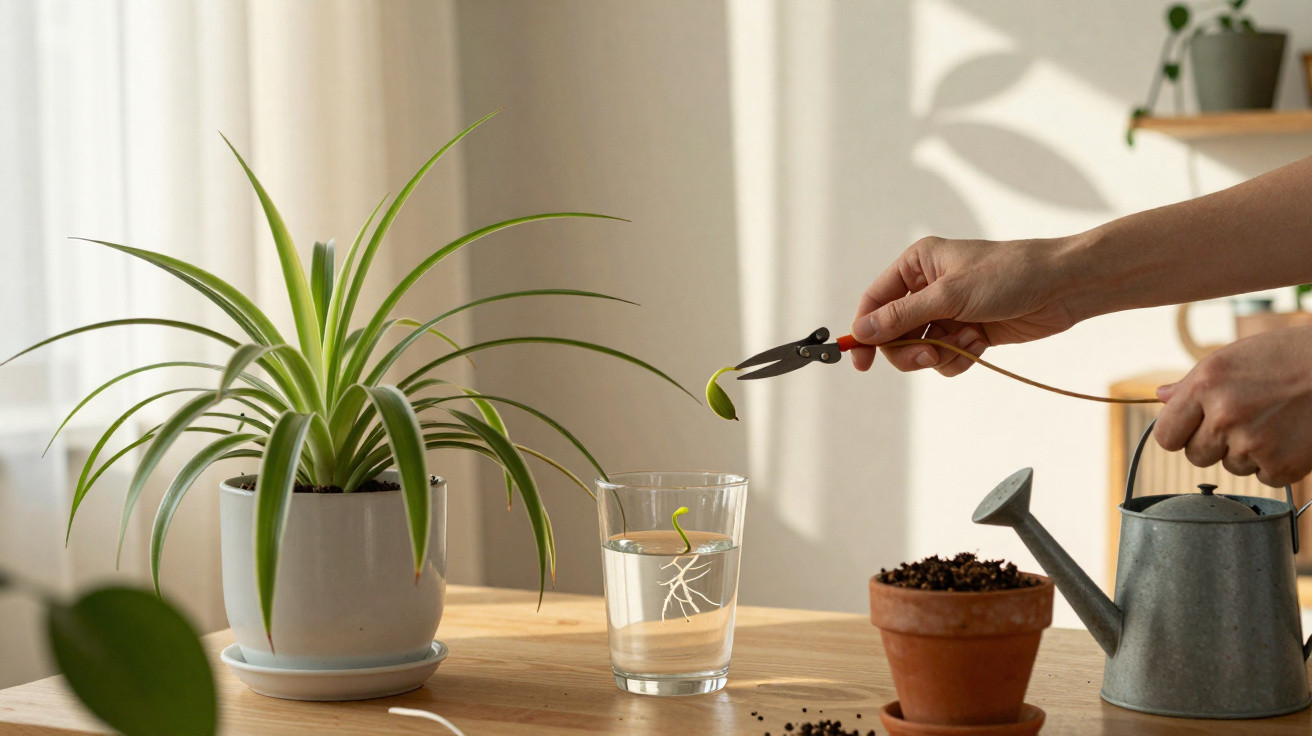
Spider plant not producing babies? Two simple care mistakes are often to blame.
Many houseplant enthusiasts know the situation: their spider plant looks healthy and grows long leaves, yet does not produce a single dangling baby plant. Chlorophytum comosum is actually known for being exceptionally easy to propagate. By giving it the right cues through light and pot size, you can nudge the plant into producing plantlets at last – and soon fill half your home with new offspring.
How the spider plant “decides” to produce babies
A spider plant does not start making babies straight away. It usually needs 1 to 2 years to become properly established in its pot. During this period, it develops strong, fleshy roots that store nutrients and water. Only once these reserves are sufficient does it switch from purely vegetative growth to propagation mode.
The familiar long, arching shoots are called stolons. Small leaf rosettes form at their ends; these later become the new plantlets. At first, these miniature plants draw on the mother plant's energy reserves.
A spider plant only produces babies in large numbers once it feels “secure” – with enough reserves, enough light and a hint of stress.
That particular balance of comfort and mild stress is crucial. When it is permanently pampered – with an oversized pot, ample fertiliser and constantly moist roots – it will favour leaves and roots over offspring. Once the pot gradually becomes snug and nutrients are no longer supplied in abundance without interruption, propagating through babies becomes worthwhile for the spider plant.
The role of light and day length: when the plant switches modes
Light is the most important trigger for flowering and, in turn, for plantlets. The small plants eventually develop from the inconspicuous flowers on the stolons. Indoors, artificial lighting can often mimic an endlessly long summer day – signalling to the spider plant that it should continue growing rather than reproduce.
For many plants, the following rule of thumb works well:
- Position: bright but away from direct midday sun, such as by an east- or west-facing window
- Day length: under 12 hours of light per day for at least 3 consecutive weeks
- Temperature: 18 to 22°C is ideal, preferably without extreme fluctuations
- Humidity: slightly raised, but without leaves remaining wet continuously
Leaving the living-room light on until late at night may inadvertently slow down stolon formation. As a practical experiment, move the spider plant to a room that stays reliably dark in the evening, such as a bedroom or a hallway with a timer-controlled light. Just a few weeks of shorter days are often enough for it to develop flower buds and, later, babies.
Pot size and fertiliser: why too much of a good thing slows it down
The pot matters just as much as light. Spider plants prefer a tighter fit than many people expect. A pot that is far too large and filled with plenty of fresh compost tells the plant: “There is room here, so keep growing wider and deeper.” It will then channel its energy into roots instead.
A slightly root-bound pot acts like a gentle wake-up call: propagation is worthwhile now – time for babies.
Practical potting recommendations:
- Repot only every 2 years, when roots are clearly pressing against the pot sides or growing out of the drainage holes.
- When repotting, move up by just one pot size rather than jumping two sizes.
- Use an airy, free-draining growing medium so that the roots receive plenty of oxygen.
Less fertiliser also means more offspring in this case. Feeding once a month in spring and summer is generally enough. Heavy, continuous feeding may make the plant lush, but it removes its incentive to direct energy towards reproduction. You can stop fertilising altogether in autumn and winter.
Watering correctly: mild stress rather than permanent wetness
The spider plant's fleshy roots are able to store water. Watering every day can quickly overwhelm the root system, leaving the plant in comfort mode. A better approach is to let the top layer of compost dry out between waterings.
A practical routine is:
- Use the finger test: the top 2–3 centimetres of compost should feel dry.
- Then water thoroughly, until a little water runs from the bottom of the pot.
- Empty the saucer after a few minutes so the roots are not left sitting in water.
This gentle alternating pattern of moisture and dryness acts as a mild stimulus. In response, the plant puts more energy into producing stolons and babies rather than endlessly pushing out new leaves.
Harvesting babies: the right time and two reliable methods
As soon as the small leaf rosettes show their first fine roots, they are ready to live in their own pots. Removing them too early risks weak growth, while waiting too long can hold back the mother plant.
All you need for separation is a clean, sharp pair of scissors or a small knife. Cut the shoot directly below the rosette; leaving a short section of stem provides a useful “handle” when planting it up.
Rooting in water
This method is ideal if you like to monitor what is happening below the surface:
- Place the base of the baby in a small glass of water, keeping the leaves above the waterline.
- Replace the water every few days to prevent rot.
- After 1 to 3 weeks, roots several centimetres long are usually visible.
- Plant it in loose compost, keeping it evenly moist for the first few days.
Planting directly in compost or pegging to the mother plant
An even simpler option is to place a small pot of compost beside the mother plant. Leave the baby attached to the shoot at first, with it resting or standing in the growing medium. Once it has formed its own roots there, cut through the connecting stem. Support from the mother plant helps it get established.
If you plant the babies directly, choose a light, well-draining substrate and keep it evenly moist, rather than wet, during the first few weeks. At this stage, young plants need only modest light: a bright position without direct sun is best. Begin feeding no earlier than after 4 to 6 weeks, and then only at a very low dose.
Common mistakes when a spider plant produces no babies
The same issues crop up repeatedly in homes. A quick check can help you adjust your own care routine.
| Problem | Possible cause | Solution |
|---|---|---|
| Healthy plant, but no babies | Pot too large, too much fertiliser, lighting for too long | Choose a smaller pot, reduce fertiliser, keep light duration below 12 hours |
| Brown leaf tips | Dry centrally heated air, hard tap water, irregular watering | Raise humidity slightly, use rested water if necessary, make the watering routine more consistent |
| Babies shrivel | Removed too early or kept too dry | Next time, detach them with more developed roots and keep the substrate evenly moist at first |
Why the spider plant is an ideal starter plant for propagation
Anyone trying cuttings and offsets for the first time is well advised to start with a spider plant. It forgives many minor errors, recovers quickly and makes its comfort level very clear by producing ever more stolons.
It also serves a practical purpose: it filters some pollutants from indoor air, tolerates tougher conditions than many tropical houseplants and suits both minimalist offices and colourful student flats.
Experimenting with different varieties is equally interesting. There are plain green forms, white-striped varieties and specimens with slightly twisted leaves. Once you have mastered the technique and are regularly collecting babies, you can gradually build a small collection – or supply friends and neighbours.
Extra tips: light, water quality and plant combinations indoors
One factor that many people underestimate is the type of lighting. Cool-white LED panels or grow lights with a high blue content support compact, vigorous growth. If you want babies from a plant in a dark hallway, use a timer to provide 10 to 11 hours of artificial light daily, giving you control over the desired day length.
Water quality matters too. In areas with very hard tap water, limescale can build up around the roots over time. Many owners use rested tap water or rainwater instead. The plant often responds with fresher foliage and steadier growth – a sound foundation for carrying plenty of babies later on.
Indoors, spider plants pair well with other hardy species such as snake plants or ZZ plants. These combinations have similar requirements for light and watering. Grouping several plants together creates a small “jungle windowsill” visually, while the slightly increased humidity immediately around the plants also benefits the offspring.
Comments
No comments yet. Be the first to comment!
Leave a Comment