
The reason is almost always incorrect watering.
The peace lily (Einblatt) has a reputation for being easy-going: it shrugs off minor care mistakes and still looks reasonably healthy. However, if you actually want it to flower, you need a different approach-no rigid timetable, but a straightforward method that follows what the plant is telling you. It’s a routine any home grower or office worker can use without specialist knowledge.
Why your peace lily (Einblatt) only grows leaves - and not flowers
The peace lily (botanical name Spathiphyllum, also known as the peace lily) comes from shady tropical forests. In its natural habitat, conditions are fairly steady: the ground stays fresh and evenly moist, but never waterlogged. That’s the feeling you need to recreate in a pot.
Flowering suffers when you swing to either extreme:
- Too dry: the plant switches into survival mode, does the bare minimum, and drops flowering from its priorities.
- Too wet: the roots don’t get enough oxygen, begin to rot, and the plant lacks the strength to produce new flower stems.
The tricky part is that, from the outside, a peace lily often looks “fine enough” even when the conditions are off. The result is simply no blooms-while the foliage keeps on growing.
"Peace lily blooms only form when the root ball stays evenly moist-never soaking wet and never bone dry."
The simple watering method that works almost every time
Instead of relying on a fixed schedule such as “water every Wednesday”, plant professionals recommend watering on demand. The key tool is as basic as it gets: your finger.
The finger test: how to hit the timing exactly
The so-called “finger test” works like this:
- Push your finger about 2–3 cm into the compost.
- If the surface feels dry but the compost underneath still feels slightly fresh and cool, that’s the ideal moment to water.
- If everything down to that depth is clearly dry, the plant needs water now.
- If the compost at that depth still feels properly damp, it’s better to wait.
In spring and summer, this usually means watering around one to three times per week. In autumn and winter, the gap can become much longer-sometimes two to three weeks-especially if the room is cooler and there’s less light.
The plant “talks” to you: reading drooping leaves correctly
A peace lily is surprisingly expressive. When the root ball gets too dry, the leaves droop. If you then water thoroughly, they often perk up again within a few hours. Take that as a clear sign that next time you should reach for the watering can a little earlier.
What matters here: this “drama” shouldn’t happen repeatedly. Each severe dry-out stresses the plant and uses up energy that would otherwise go into forming buds.
Water like a pro: watering from below instead of above
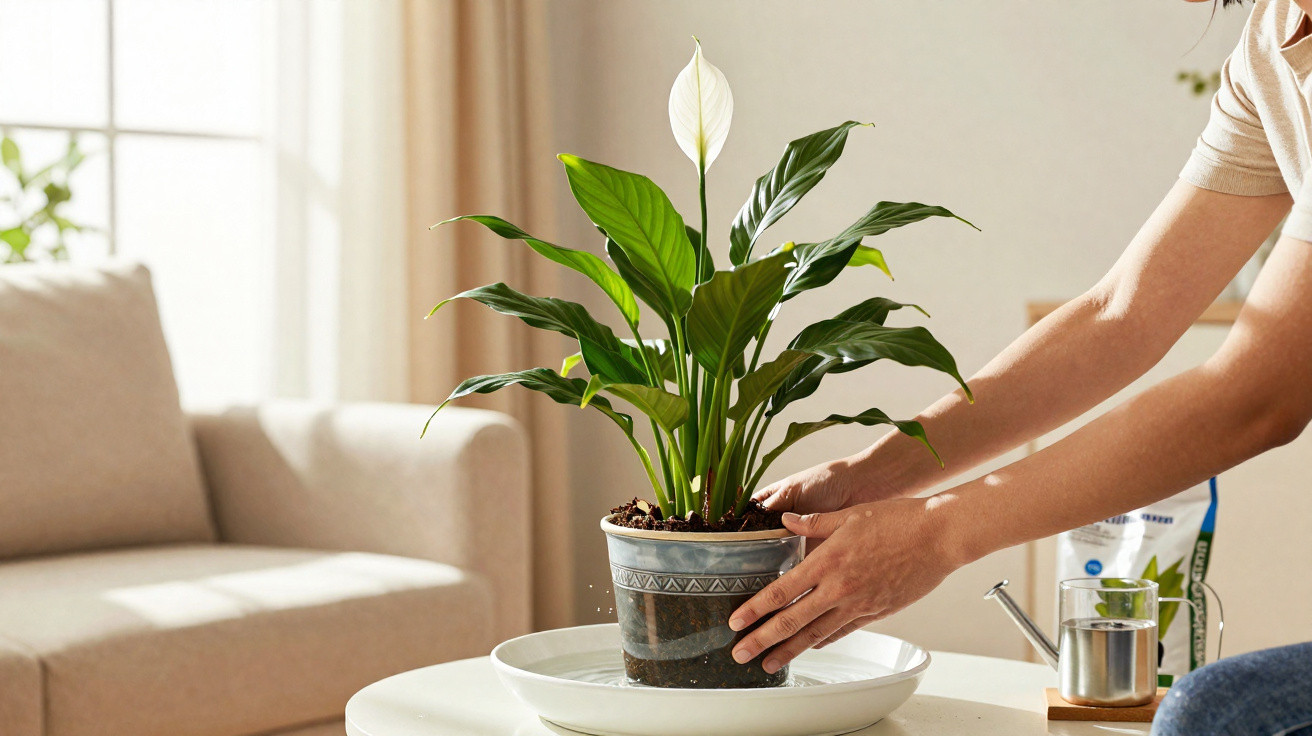
Many experts recommend bottom-watering for a peace lily. This approach helps protect the roots from waterlogging and encourages the plant to take up only as much water as it truly needs.
How to bottom-water step by step
- Place the pot in a bowl, bucket, or the kitchen sink.
- Add lukewarm water until the base of the pot is standing a few centimetres in water.
- Leave it there for 10–15 minutes.
- Lift the pot out and allow excess water to drain away thoroughly.
Through the drainage holes, moisture moves upward through the compost. Once the compost is saturated, it simply stops absorbing-an automatic cut-off that greatly reduces the risk of overwatering.
"With bottom-watering, the peace lily takes exactly the amount of water it needs-no more and no less."
One point is non-negotiable: the pot must have a drainage hole. In a decorative cachepot with no outlet, water often collects at the bottom and the roots can start to rot.
Light, humidity and temperature: the hidden levers
Even the best watering technique won’t do much if the position and indoor climate are completely unsuitable. Peace lilies like bright conditions, but not harsh midday sun.
The best spot in your home
- Light: bright to semi-shaded, with no direct sun hitting the leaves. East- or west-facing windows are often ideal.
- Temperature: as stable as possible, preferably between 18 and 24 °C. The plant doesn’t appreciate draughts or icy window sills.
- Humidity: slightly humid air helps. Dry central-heating air can reduce willingness to flower.
In very dry rooms, a simple trick can help: set the pot on a tray filled with wet clay pellets. As the water evaporates slowly, it creates a small humidity buffer around the plant.
Why low-limescale water makes a difference
Peace lilies can be sensitive to very hard tap water. Limescale on the compost surface or brown leaf edges may indicate this. Better options include:
- tap water that has stood for at least 24 hours
- filtered water
- rainwater (where it’s clean and available)
Using lukewarm water also helps: it avoids chilling the roots and allows the plant to use the water more quickly.
Feeding and repotting: the quiet partners to your watering routine
If a peace lily stays in the same pot for a long time, the nutrients in the compost gradually run down. Leaves may continue to grow, but flowering usually becomes noticeably slower.
When feeding is helpful
During the warmer months-roughly March to September-you can add a liquid houseplant feed to the watering water every two to four weeks, slightly under the recommended dose. In the darker months, the plant needs far fewer nutrients and plain water is usually enough.
A common mistake is overfeeding. Excess fertiliser can build up in the compost, gradually scorch the roots, and leave the plant looking depleted rather than ready to bloom.
Signs you need to move up a pot size
At the latest, when roots start pushing out of the bottom of the pot, or when the root ball barely absorbs water during watering, it’s time for a slightly larger pot. A light, airy houseplant compost-optionally mixed with a little expanded clay or other coarse material-helps store moisture without letting it stagnate.
Common mistakes - and how to avoid them easily
If you want to encourage your peace lily (Einblatt) to flower again, these practical checkpoints help:
| Problem | Possible cause | Solution |
|---|---|---|
| Lots of leaves, no flowers | too little light, fluctuating moisture | move to a brighter spot, adopt the finger test |
| Leaves droop constantly | alternating too dry and too wet | water more evenly, bottom-water when needed |
| Yellow leaves | too much water, compacted compost | keep the pot free-draining, water less often, loosen the compost |
| Brown leaf edges | dry air or high-limescale water | increase humidity, use softer water |
How long until a flush of blooms - and what’s genuinely worth doing
Even if you change everything today, nothing in the pot transforms overnight. A peace lily needs time to adjust to improved conditions. Often, the first buds appear after a few weeks to a few months, once light, water and nutrients are working together better.
The effort remains modest: a quick finger test, an occasional soak from below, some patience, and a reasonably suitable location. In return, the plant rewards you with firm, glossy leaves and repeated white spathes that make a living room or office feel noticeably more welcoming.
Once you understand how closely watering, humidity and light interact, you can apply the same thinking to other houseplants too-for example spider plants, flamingo flowers (anthuriums) or monstera. The principle stays the same: look, feel and respond, rather than following a calendar on autopilot.

Comments
No comments yet. Be the first to comment!
Leave a Comment