
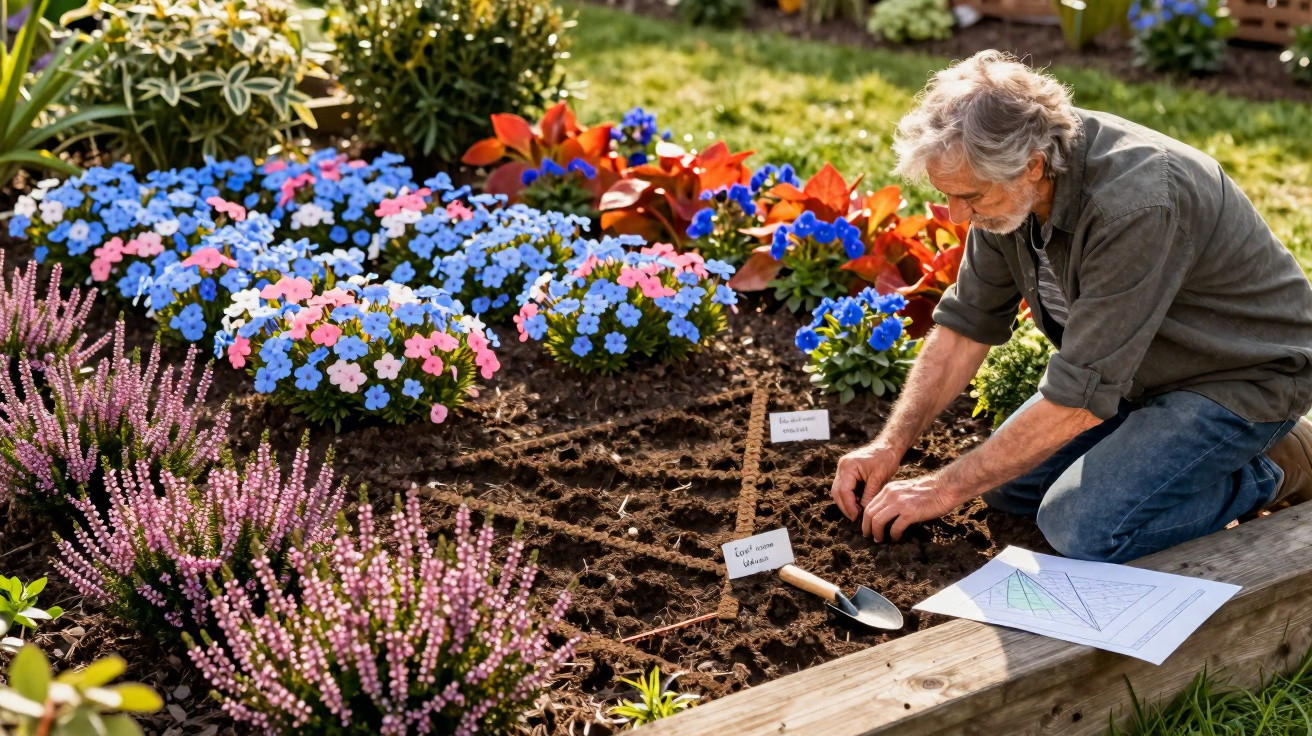
With the right planting combination, a bed can stay colourful for all 365 days of the year.
Many amateur gardeners dream of a flower bed that never looks bare, admits hardly any weeds and continues flowering year after year with minimal effort. The answer is not found in unusual rarities, but in three intelligently chosen ground-cover plants that take turns perfectly through the seasons. By understanding how they work together and following a few straightforward planting rules, you can create a remarkably low-maintenance carpet of permanent colour.
Why ground-cover plants are the secret asset in an ornamental garden
Ground-cover plants are often considered dull, or even labelled “bullies” that crowd out other plants. Yet they can rescue a border when everything else has long since lost its vigour. Many are hardy perennial plants that withstand frost well below freezing and return reliably every year.
Perennials with a creeping habit fulfil several functions at once:
- They cover bare patches of soil and help prevent it from drying out.
- They suppress weeds by allowing very little light to reach the ground.
- They guard against soil erosion on slopes and banks.
- They add colour and structure when other plants are taking a break.
When combined correctly, three different ground-cover plants create a living ribbon of colour throughout the year – without continual replanting.
The key is not simply to plant any random mixture, but to choose a deliberate trio whose flowering periods and growth habits complement rather than compete with one another.
The three-plant formula: a trio for 365 days of flowers
The principle can be reduced to a simple formula: three creeping perennials, five young plants per square metre, planted during the right season. That is enough to establish a long-lasting flowering strip that provides colour from January through to December.
The tried-and-tested trio comprises:
1. Winter heath (Erica carnea) – colour in the depths of winter
While the rest of the garden is still dormant, winter heath gets to work. Depending on the weather, it flowers from January to April, producing countless tiny bell-shaped blooms in white, pink or purple.
- Position: full sun to partial shade
- Soil: preferably acidic, loose and well drained
- Special feature: it remains green in winter, providing valuable structure
At this point it visually dominates the planting area and takes centre stage, while its two companions are still building strength “below the surface”.
2. Moss phlox (Phlox subulata) – a flowering carpet in spring and summer
From around May, moss phlox moves to the forefront. It forms dense, low cushions that resemble a carpet of flowers, bridging the period between spring and summer.
- Flowering period: approximately May to August
- Colours: white, pink, lilac and blue, depending on the variety
- Height: usually only 10–15 cm, making it ideal at the front of a border
As winter heath gradually finishes flowering and retreats into the role of a green backdrop, phlox takes over the colour display. Its compact growth closes gaps that would otherwise quickly be occupied by weeds.
3. Hardy plumbago (Ceratostigma plumbaginoides) – autumn flowers and fiery foliage
The third partner comes into its own in autumn: creeping hardy plumbago. It bears vivid blue flowers as its foliage simultaneously turns a rich red, creating a bold contrast that lasts from September into December.
- Flowering period: broadly from September to December
- Effect: blue flowers combined with reddish autumn foliage
- Position: full sun to partial shade, preferably somewhere warm
Winter heath, moss phlox and hardy plumbago pass the baton through the year – each plant shines during its own season.
While hardy plumbago reaches its peak in autumn, the heath and phlox use the period to replenish their reserves without demanding visual attention. As a result, there is no seasonal “gap”.
How three ground-cover plants grow without smothering one another
Many amateur gardeners avoid mixed planting schemes because they fear one species will overwhelm the others. The solution lies in “layering” – both below ground and above it.
The three perennials vary in their:
- Root depth and spreading behaviour
- Nutrient requirements
- Flowering time and growth cycle
They therefore occupy different levels within the bed, in effect. One roots more shallowly, while another reaches a little deeper. One grows strongly in spring, whereas another only really gets going in late summer. This significantly reduces competitive pressure.
When one species is resting, the other two make use of the space at the surface. The bed remains visually full without the plants displacing each other. This kind of “stratification” reflects natural plant communities, where a single species rarely dominates alone.
Planting plan: triangles rather than rows create a calmer look
Planting ground-cover plants in rows often produces an artificial, rigid appearance – and leaves openings through which weeds can emerge. A triangular layout is both more attractive and more practical.
Allow five young plants per square metre – arranged in small triangles, with the three species alternating.
Proceed as follows:
- Divide the area roughly and visualise it as a series of triangles.
- Plant a different one of the three perennials at each “corner” of a triangle.
- Avoid creating large islands containing only one species.
This arrangement resembles a natural mosaic. The transitions between winter, summer and autumn flowering plants become softer. Where one species grows a little less vigorously, its neighbours fill the space. Beginners need only set the plants slightly offset rather than in perfectly straight lines – the effect develops almost by itself.
The right planting time and ideal quantity
For the method to work, expensive varieties matter less than two basic details: planting time and density.
| Criterion | Recommendation |
|---|---|
| Planting time | Mid-October or early spring |
| Density | 5 young plants (pots) per square metre |
| Number of species | Consistently use only three species |
A denser planting scheme will cover the ground more quickly, but it reduces air circulation and structure. If plants are spaced too widely, you will have to contend with weeds for longer and will not achieve a closed carpet for several years.
Everyday care: fewer weeds and hardly any replanting
Once the area has become established, maintenance requirements fall considerably. As the soil remains shaded almost continuously, only a few weeds manage to push through the carpet. An occasional inspection is worthwhile to remove any particularly vigorous strays.
Typical locations include:
- Slopes and banks that are difficult to mow
- Borders alongside paths or driveways
- Small front gardens that should look attractive all year round
- Gaps between shrubs or beneath lightly canopied trees
A light trim after flowering can encourage denser growth. Fertiliser should be applied sparingly; many ground-cover plants cope well with lean soil and form more compact, healthier cushions in these conditions.
What to consider when choosing the site and combination
For the trio to work in harmony, all three plants should have similar requirements. A sunny to partially shaded site with free-draining soil is well suited. Waterlogging is particularly harmful to winter heath and hardy plumbago.
If you are unsure whether the soil is suitable, work in a thin layer of sand or fine grit before planting. This improves drainage and helps prevent root rot. In very heavy, clay-rich soil, a slightly raised bed may even be worthwhile.
Conveniently, the three-plant combination can easily be supplemented with individual specimen perennials or ornamental grasses. Taller perennials may rise from the ground-cover carpet like “islands”, provided they do not shade the whole area.
Practical examples and common mistakes to watch for
For a narrow bed alongside a footpath, you can use more moss phlox at the front, with winter heath and hardy plumbago planted in a mixed arrangement behind it. This keeps the low edge appealing, while different colours appear behind it as the year progresses.
Common mistakes include:
- Using too many different species in the same bed
- Uneven planting distances that leave large holes
- Choosing a site that is constantly too wet
- Over-fertilising, which makes the plants soft and prone to disease
Those who stick to the straightforward three-plant formula and consistently plant five plants per square metre will usually have a dense, stable system after one to two years. After that, the garden more or less works for itself – delivering what many neighbours will then notice with surprise: a bed that practically never looks empty.



Comments
No comments yet. Be the first to comment!
Leave a Comment