
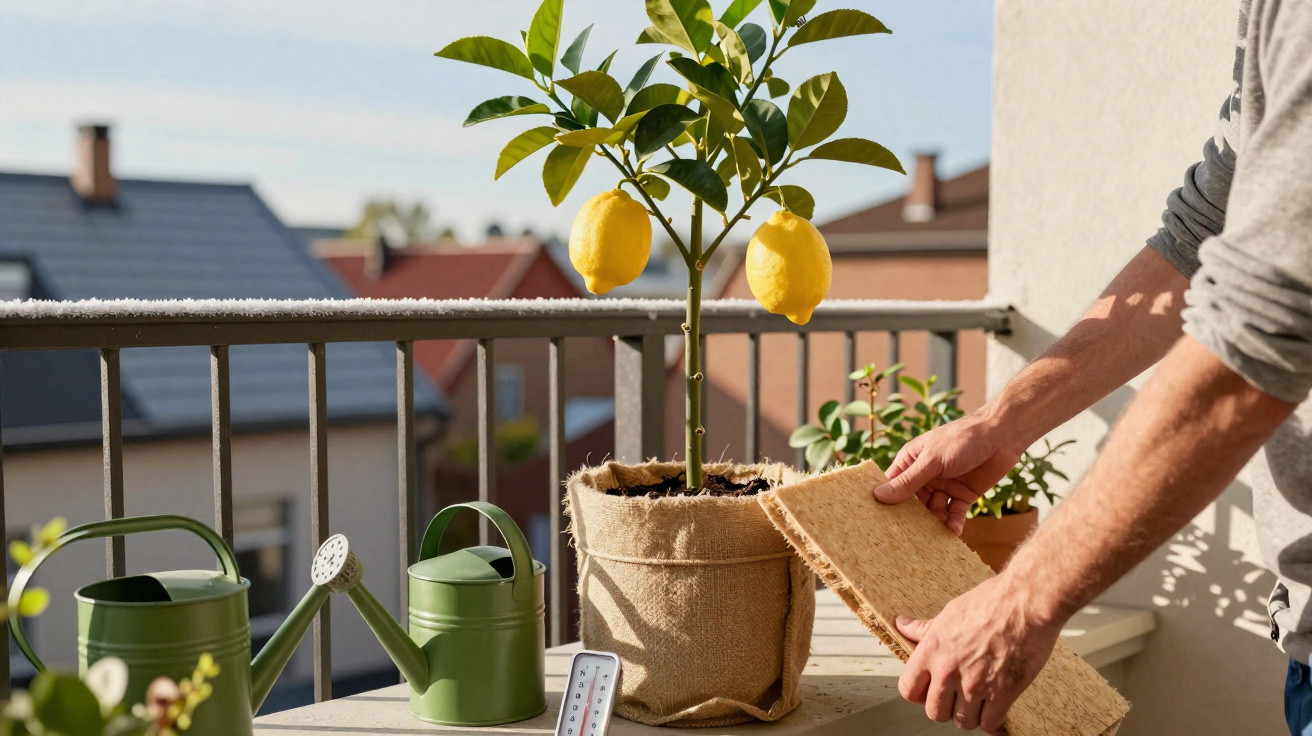
Many hobby gardeners breathe a sigh of relief in February: the potted lemon tree has made it through winter, and the first fresh leaves are appearing. That is often exactly when the cold returns - quietly, from below. Anyone who only protects the canopy and the rim of the pot can miss a treacherous source of danger: the ice-cold balcony or patio floor. With one simple, almost invisible aid, you can cut this risk dramatically.
Why a potted lemon tree suddenly looks limp in March
Citrus plants have a reputation for being tough when they’re in a sheltered spot. Even so, many owners face the same frustration: the tree looked healthy the day before, the leaves were glossy - and then, two or three days after a cold night, the plant suddenly seems dull. Leaves lose their sheen, curl inwards, and turn darker. The cause is often not frost in the air, but frost damage to the roots.
In early spring the days can already be mild, and the sun warms balconies and patios. At the same time, nights can still drop to just below freezing. It’s precisely this mix that makes a lemon tree in a pot so vulnerable. The roots sit close to the pot wall and directly above concrete, stone or tiles. What feels warm during the day stores cold at night like a battery and passes it into the base of the pot.
"The stealthy killer isn’t the cold air, but the cold ground beneath the container."
If you only drape fleece over the canopy at this point, you may protect leaves and young shoots - but you leave the most important area exposed: the root zone. That’s where it’s decided whether the tree copes with late frosts or gradually declines.
The simple aid: an insulating board under the pot
The most effective step is surprisingly unglamorous: put an insulating layer beneath the container. It acts like a thermal barrier between the cold surface and the root ball.
Suitable options include:
- a thick sheet of polystyrene or other rigid foam (for example, from packaging)
- a sturdy cork or wooden plant stand with some thickness
- several layers of cardboard as a temporary measure, kept dry
- leftover insulation boards from a DIY shop
A thickness of around 2 to 5 centimetres is ideal, and the board should extend 1 to 2 centimetres beyond the base of the pot all the way round. That way, it shields the entire root area from the cold beneath.
"An insulating board just a few centimetres thick under the container can be the difference between frost damage and healthy new growth."
Don’t forget drainage: air and water still need to pass through
When insulating, don’t block the drainage hole, otherwise you risk waterlogging. A simple DIY fix using household bits works well: corks. If you split three wine corks lengthways and place the halves under the pot, you create a thin air gap between the pot and the board. The space is enough for water to drain away, and it also adds an extra buffer against the cold.
Set it up like this, step by step:
- Cut the board so it’s slightly larger than the base of the pot.
- Split three corks lengthways in half.
- Place the cork halves on the board in a triangle.
- Carefully set the pot onto the cork pieces so it stands firmly.
It takes only a few minutes, costs nothing in the best case, and can be reused every year.
What’s really going on with a “cold balcony”: the thermal effect
Concrete, stone tiles and brick store temperature particularly well. After a mild day, these surfaces can feel pleasantly warm. On a clear night, however, they radiate that warmth away quickly and become cold fast. Through direct contact, that cold then moves from the pot base into the root ball.
In the ground, soil mass acts as a buffer. In a pot, that mass is missing. Roots sit close to the edge and are exposed to temperature swings with little protection. The result: fine hair roots - the ones responsible for water uptake - freeze first. The plant can then hardly move moisture, so leaves seem to dry out almost overnight even though the compost still feels damp.
A typical pattern is sunny days with night temperatures around -1 to -3 degrees in March or April. If you water without using an insulating board and leave the pot directly on stone, you’re taking a real gamble with this kind of root shock.
How to combine protection measures until after the “Ice Saints”
Keep the insulating layer in place until around mid-May, because up to the traditional “Ice Saints” period there can still be local night frosts. Depending on your location, it’s worth combining several measures without wrapping the whole tree up.
More layers of protection without “suffocating” the lemon tree
This order works particularly well:
- Insulating board under the pot as the base, left in place until mid-May.
- Position close to a house wall facing south or south-west, where residual warmth gathers.
- Light winter cover over the canopy (fleece) only when frost nights are forecast; stretch it over canes so it doesn’t sit directly on the leaves.
- A “second skin” around the pot: bubble wrap or sheep’s wool, disguised with hessian or fabric to keep it looking tidy.
A loosely fitted fleece often increases the temperature around the canopy by about three degrees. Combined with ground insulation, that is enough in many areas for a lemon tree to get through short cold snaps, even though it officially only tolerates temperatures around -6 to -7 degrees for brief periods.
Watering, position, container: extra ways to help your lemon tree
Alongside the insulating board, watering habits matter a great deal. A soaking-wet root ball cools faster than slightly moist compost. So, just before an expected frost night, the compost shouldn’t be sopping - it should be only moderately moist. It mustn’t dry out completely either, as that adds further stress.
Practical tips for balconies and patios:
- The day before a possible frost night, water only moderately.
- At night, move the pot closer to the house wall; during the day, return it to the brightest spot.
- Avoid shallow saucers of water during frosty spells - they freeze through quickly.
- Choose a larger container where possible, as more compost volume cushions temperature fluctuations.
You can also plan ahead when choosing the container. Thick-walled terracotta pots or double-walled plastic containers hold temperatures steadier than thin plastic pots. With an insulating board underneath, this creates a kind of “mini cellar” for the roots, while the canopy gets light and milder air during the day.
Why the effort is worth it - and what else the trick is good for
A lemon tree in a pot takes years to become truly substantial and to crop reliably. One hard late frost can undo all that effort. An insulating board under the container is minimal work for a big payoff. It’s barely noticeable, can be left under the pot through summer if needed, and it also protects the root zone from sudden temperature swings during cool, wet periods.
This trick isn’t only useful for lemon trees. Other frost-sensitive container plants benefit too, for example:
- small orange and mandarin trees
- olives in pots
- bay, rosemary and other Mediterranean herbs in large containers
- young fig trees in tubs
If you place several containers side by side on insulation boards, you effectively create a sheltered zone on the balcony. The plants provide each other with extra shielding, the wind has less to grab hold of, and the ground doesn’t radiate cold so intensely at night.
One more factor many people underestimate: in towns and cities, microclimates can vary sharply. On a windy penthouse balcony, the same night frost can feel far more severe than in a sheltered courtyard. A simple insulating board under the pot offsets some of those differences - helping your lemon tree start the next spring with fresh shoots and blossoms, rather than having to struggle back from the base.

Comments
No comments yet. Be the first to comment!
Leave a Comment