

Many homeowners will recognise the scene: winter has finally ended, the first tulips are appearing, yet the space in front of the house still feels flat, washed-out and somehow lifeless. Rather than placing a few pots at random again, it pays to work to a simple plan - and that plan can start in April with an evergreen climbing plant that gives year-round structure and, from spring through to late summer, acts like a magnet for nectar-seeking birds and insects.
Why an evergreen climber transforms a front garden so dramatically
A front garden often shapes your home’s first impression in seconds. A patch of lawn, a couple of shrubs, perhaps a container - that is as far as many schemes go. What is usually missing is the third dimension: height, vertical interest, a “green stage set” against a façade, fence or garage.
This is where an evergreen climber shows its biggest advantage. It:
- instantly adds depth and layering to the view,
- hides bare walls or unattractive fencing,
- stays “dressed” through winter, and
- offers birds and insects both food and shelter.
For this job, evergreen honeysuckle - botanically Lonicera - has proved particularly reliable. This twining climber often keeps its foliage in mild winters, climbs upwards quickly, and produces countless strongly scented, tubular flowers in spring and summer. That very flower shape is what makes it so appealing to smaller nectar-feeding birds and to insects such as bumblebees and butterflies.
"A single strong Lonicera plant can, for months, become the most important ‘refuelling stop’ for birds and pollinators in an entire street."
April as the starting gun: why the timing is such a smart choice
April is a turning point in the garden. The soil has started to warm, but there is still plenty of moisture held in the ground. Planted now, new additions have an excellent chance to root quickly and deeply before high-summer heat and dryness set in.
If you plant a slightly larger Lonicera - two to three years old, as commonly sold at many garden centres - you can often expect a first more substantial flush of flowers in the same year. At that stage the plant has moved beyond its “childhood” phase and tends to channel more energy into buds rather than purely into leafy growth.
The most important site rules
To get the climber performing at its best, a few basics matter:
- Light: Ideally 6–8 hours of sun per day; morning and late-morning sun are perfect.
- Soil: Rich, loose and free-draining. Waterlogging around the roots quickly causes trouble.
- Water: Water regularly during the planting year; after that, the plant copes well with short dry spells.
- Support: A framework, trellis, arch or pergola is essential - Lonicera wants something to pull itself upwards.
If your front garden is very small - or you only have a balcony - Lonicera can also be grown in a large pot. What matters most is a free-draining mix with a drainage layer and a container that is generous enough that the roots are not cramped after only a year.
Scent, colour, life: how the front garden changes within a few weeks
As soon as the first flowers open, the atmosphere in the front garden shifts. The blooms sit like small trumpets among dense growth, in warm shades ranging from cream through yellow to orange-pink, depending on the variety. Up close, the scent is sweet - almost like a blend of honey and vanilla. As the air cools, the fragrance often becomes stronger towards evening.
Place a Lonicera near the front door, by the carport, or over a low pergola, and you experience it at close quarters: you open a window in the evening or step outside - and you are suddenly standing in a cloud of perfume while insects and birds visit the flowers.
"The front garden loses its ‘pass-through’ feel and becomes a small place to pause, where you stop for a moment and breathe in the scent."
Why these particular flowers are so attractive
The tubular flower shape is nature’s specialist offer. It is designed for animals with long beaks or long tongues that can reach deep inside. In American gardens that role is often filled by hummingbirds; in Europe, bumblebees, wild bees, and day- and night-flying moths and butterflies do the job.
They seek out Lonicera mainly because:
- the flowers contain plenty of sugar-rich nectar,
- new blooms keep coming for weeks rather than fading all at once, and
- pale varieties remain easy to spot even at dusk.
If you choose regionally adapted or native varieties, you often give local pollinators better conditions than with exotic alternatives. Studies show that native species can, in some cases, be visited significantly more often.
How to plant and care for Lonicera properly
Planting is straightforward, provided you follow a few simple steps.
- Dig a planting hole twice as wide as the root ball; make it only slightly deeper.
- Mix the topsoil with compost or well-rotted farmyard manure; lighten heavy soils with sand.
- Set the plant in so the top of the root ball sits level with the surrounding soil.
- Backfill, firm gently, then water thoroughly to settle the soil and remove air pockets.
- Tie the plant in immediately to a trellis, support wires or pergola.
For ongoing care, a simple yearly routine is enough in most locations:
- Spring: Apply a dose of organic feed or a slow-release fertiliser; loosen the soil surface.
- Summer: During extended dry spells, water deeply but not too often - less frequent, thorough watering is better.
- After flowering: Shorten shoots lightly to keep shape and encourage fresh branching.
Hard renovation pruning into old wood is only needed if Lonicera has been left for years and has completely lost its form. With a moderate trim each year after flowering, the climber stays easy to manage.
How to turn one climbing plant into a small eco-system
The real strength of evergreen honeysuckle is not just decorative. Combined with a few complementary plants, it can create a small, stable mini eco-system in the front garden.
These companions work especially well:
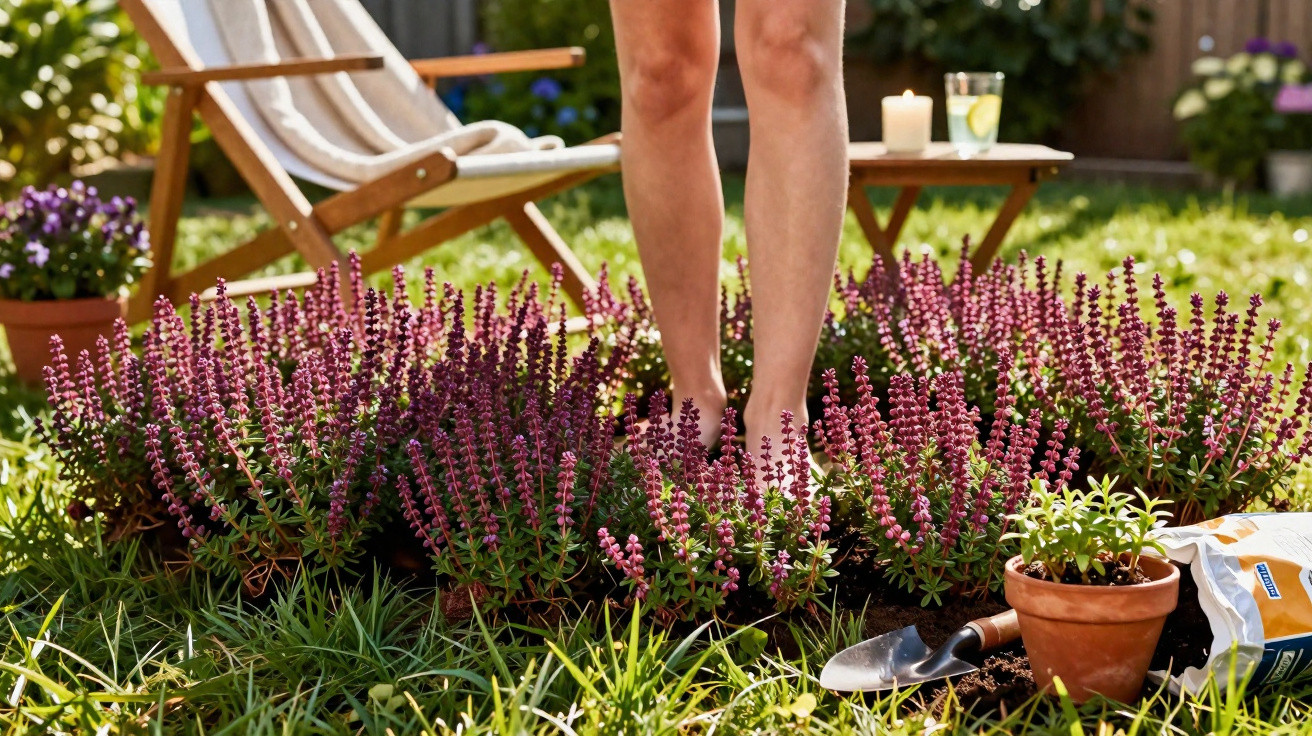
- Lavender as a low planting at the base - it attracts bees and tolerates drought,
- Sage and thyme in sunnier spots - adding extra pollen and fragrance,
- early-flowering bulbs such as crocuses or daffodils - linking winter into spring.
If you avoid chemical sprays in this area, even a narrow planted strip along a fence or driveway can create a continuous feeding corridor for bees, butterflies and birds. In that mix, Lonicera acts as the “backbone”, reliably providing nectar from spring into late summer.
Useful notes on choosing varieties, risks and combination ideas
Not every Lonicera behaves in the same way. Some types grow extremely vigorously and, in warmer regions, can escape from gardens. If you want to be cautious, ask at the garden centre for native types or clearly recommended ornamental forms that are easier to keep under control.
Smaller front gardens tend to suit compact varieties with moderate growth. These usually reach two to four metres and can be trained on a narrow trellis. For house walls, carports or screening panels, stronger varieties are also suitable - those can climb five to six metres quickly.
One detail that is often overlooked: evergreen climbers add weight to walls. With older masonry, it is worth checking the condition of the render and brickwork. A free-standing metal or timber trellis positioned in front of the façade takes pressure off the wall and is often easier to maintain or replace when needed.
If you enjoy designing and experimenting, you can pair Lonicera with a second, later-flowering climber - for example a clematis that takes over in high summer. That way, the flowering surface stays interesting for most of the season, while the evergreen honeysuckle provides the underlying structure.
With a little planning in April, an unremarkable front garden can become a lively entrance that keeps its shape all year, smells like perfume in summer, and is constantly visited by small winged guests in peak season. One well-positioned climbing plant can be the difference between “just green” and a front garden people remember.



Comments
No comments yet. Be the first to comment!
Leave a Comment