
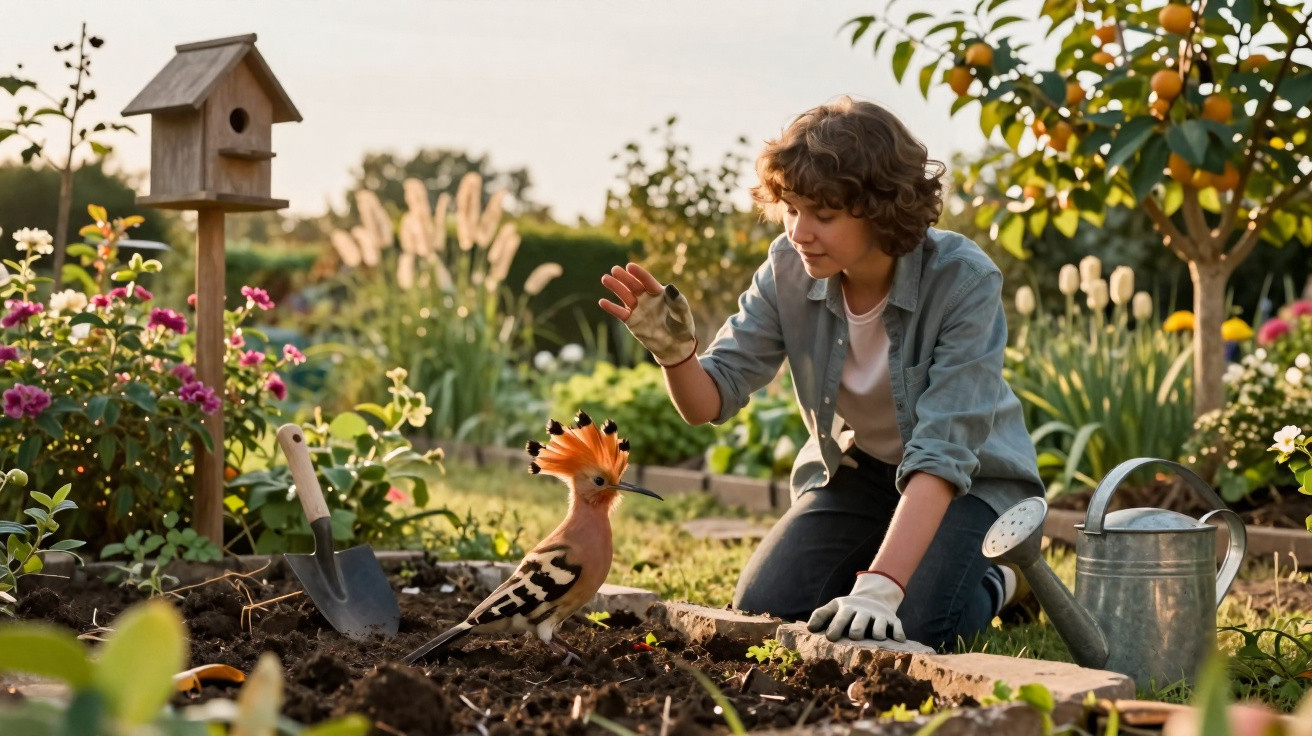
Seeing a hoopoe up close is the sort of moment that tends to stick. With its striking crest, long down-curved bill and almost exotic plumage, it can look oddly out of place in an ordinary suburban garden. Yet the hoopoe is selective about where it pauses. When one turns up, it is rarely a fluke; it is often a fairly clear signal of what your soil is like, how your garden’s microclimate behaves and even how you manage the space day to day.
What the hoopoe tells you about your soil
From a biological perspective, the hoopoe is, above all else, a highly specialised insect-eater. It quite literally survives on whatever is crawling in the ground and just beneath the soil surface.
Using its long, downward-bending bill, it probes into loose earth and pulls out creatures most gardeners hardly ever see:
- Grubs and larvae of cockchafers
- Crickets and grasshoppers
- Mole crickets
- Beetle larvae and other soil-dwelling invertebrates
- Caterpillars, including those of processionary moths
"If a hoopoe hunts in your garden for several days in a row, it’s signalling: the soil is alive - properly alive."
A bird like this only spends time where foraging pays off. To feed itself and, later, its chicks, it needs a substantial supply of insects - which is only possible in places that are:
- rich in soil fauna,
- not poisoned with insecticides,
- and at least partly open, sunny and kept short.
A golf-course lawn, routinely treated with chemicals, offers it nothing. What becomes interesting instead are gardens where close-cropped patches alternate with bare ground, and where compost, old timber or a more natural border strip keeps the underground teeming with life.
Why the hoopoe chooses your garden
Hoopoes that breed in Europe typically spend the winter south of the Sahara. In spring they fly thousands of kilometres back into Europe, including Central Europe. So it is not a random visitor: it is a bird that actively searches for suitable territory - and will move on again if conditions stop meeting its needs.
Across much of southern Europe, hoopoes are seen far more often. In countries such as Germany or Austria, by contrast, they are considered rare in many regions. If one appears in the middle of housing or in a more urban-fringed area, that usually points to a few specific features:
- Your garden offers enough calm - no constant noise and no continual disturbance.
- The surrounding area still includes open landscapes, such as meadows, vineyards or traditional orchard meadows.
- The land has not been routinely treated with plant-protection products over long periods.
- There are places to rest and potentially to nest, such as old trees, cracks in walls or nest boxes with sufficiently large entrance holes.
"In areas where only a few pairs are known, repeated sightings are almost like a small lottery win for nature lovers."
Specialists have noted that, after marked declines in the 1990s, hoopoe numbers have begun to edge upwards again. Contributing factors include stricter protections and a gradual shift away from maximum chemical use towards more nature-friendly land. As temperatures rise, its range also tends to creep northwards - a classic beneficiary of climate change, as far as one can even talk about "beneficiaries" in this context.
A bird with a backstory: the symbolism it carries
For centuries the hoopoe has appeared in stories, myths and saints’ legends. Its feathered crown - which it can raise or flatten - has made it a notable creature in many cultures.
In older writings from parts of the Middle East, it represents guidance and an inward search. In a well-known poem, a hoopoe leads other birds on a journey in which they pursue meaning and truth. In imagery from ancient Egypt, it is used as a symbol of gratitude and family connection.
In parts of Europe, too, its call - the distinctive "hup-hup-hup" - was long associated with the sound of spring beginning. Its arrival shortly after the first mild days suggested a fresh start, a phase when things quite literally begin to move again. It is hardly surprising that some place names, old sayings and children’s rhymes have been linked to it.
"Many people instinctively experience an encounter with a hoopoe as a 'good sign' - and from a natural-history point of view, they’re not entirely wrong."
How to turn your garden into a hoopoe paradise
If you would like to see hoopoes more often, you do not need to overhaul the entire garden - but you do need to adjust a few key habits. The aim is a quiet, toxin-free, insect-rich habitat with patches of bare ground.
Practical steps for amateur gardeners
- Avoid insecticides: every treatment against "pests" simply removes the hoopoe’s food source.
- Don’t keep the whole lawn short: a mix of closely mown areas and wilder zones supports more species.
- Allow bare soil: small unplanted patches or sandy spots make feeding easier.
- Leave dead wood, stone piles or log stacks in place: they provide shelter for insects, which then feature on the menu.
- Keep disturbance low: during the breeding season, reduce continuous loud music, frequent mowing and intensive building work as much as possible.
If you want to take it a step further, you can also try providing suitable nesting sites. Hoopoes like to breed in tree cavities, wall crevices or larger nest boxes. Purpose-made boxes with an oval entrance hole, roughly the size of a fist, are now available from specialist suppliers. They should be installed high enough up and positioned where they are not constantly disturbed.
How to judge its role in the garden properly
Hoopoes eat plenty of insects that amateur gardeners often see as troublesome - especially soil-dwelling larvae that nibble at roots. That can make the bird feel like a natural "pest regulator" without you having to intervene.
One misconception persists: some people worry the bird might wipe out "useful" insects or upset the ecological balance. Ecologically, however, it is simply taking part in processes that already exist. It uses what is present and can help soften extremes - for instance, when certain larval species become overly abundant.
| Aspect | What it means in the garden |
|---|---|
| Foraging in the soil | Lowers numbers of harmful larvae without using chemicals |
| Preference for quiet areas | Encourages gentler, lower-intensity garden management overall |
| Liking for structurally varied spaces | Rewards gardens with a high diversity of plants and micro-habitats |
| Species status | A protected breeding bird, regionally rare in places, with strong symbolic value |
If the hoopoe smells strongly - and why that isn’t a bad sign
If you get close to a nesting site, you may sometimes notice a strong, unpleasant smell. Older texts even refer to the "stinking cock". This trait serves a purpose: the chicks can produce a foul-smelling, oily substance intended to deter predators. For people it can be hard to get used to, but for the bird it is an effective defence.
If you have such a nest in the garden, there is no need to panic or try to remove it. The breeding period is limited, and after a few weeks the smell fades again. In return, you may get the rare opportunity to watch something unusual right outside the patio door.
Better understanding the signs nature gives
Many garden owners are surprised that a single bird can say so much about a plot of land. The hoopoe is simply one example among many species that indicate soil condition, food availability and how chemicals are used. Frequent blackbirds point to different conditions than larks or tree sparrows, and anyone who listens closely will soon notice how the garden’s soundscape changes over the year.
If you adapt your garden over the long term to the needs of such species, the benefits come in several ways: the soil develops better structure, plants grow more robustly and you can more often do without sprays. At the same time, the place starts to feel genuinely alive - with visits from birds you might otherwise only see in field guides. And when the orange-brown, crowned bird touches down again, it looks less like a miracle and more like the natural result of a thriving, healthy garden.
Comments
No comments yet. Be the first to comment!
Leave a Comment