
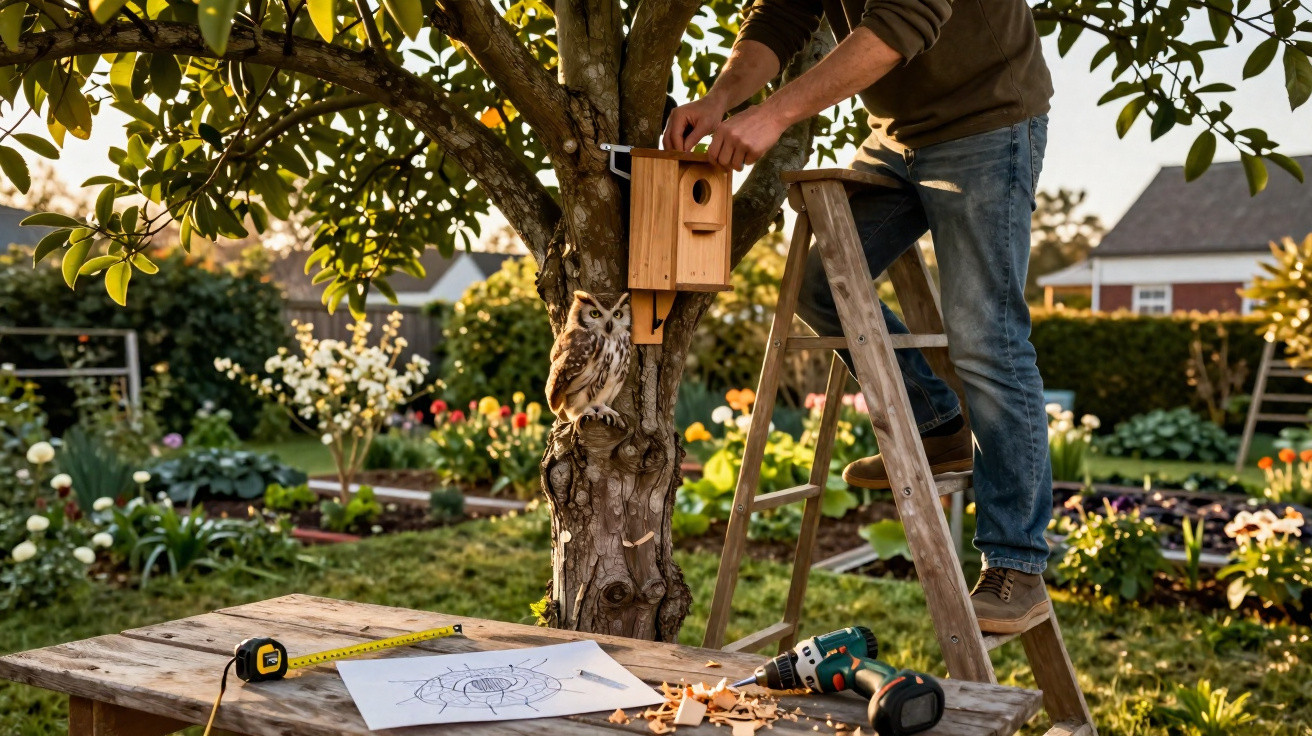
Whether it’s a village, the edge of town or a remote smallholding: at dusk they perch in old trees, on barn roofs or church towers. Owls are often described as adaptable, yet modern farming, a shortage of nesting sites and overly tidy gardens are making life harder for them. There’s a surprisingly simple step any garden owner can take to help them through the critical breeding season - with no big budget and without needing a forestry qualification.
Owls are more common than many think - yet still at risk
When people picture owls, they often imagine a solitary woodland bird deep in the countryside. In reality, the picture is broader. Ornithologists estimate around 30,000 breeding pairs in a Central European country such as France, and Germany is of a similar order. Owls occur in almost every type of region - from coastal landscapes to upland hills.
It’s also worth noting that “owl” doesn’t mean one single species, but a large group of more than 250 species worldwide. In Central Europe, the species most often encountered include:
- Tawny owl - arguably the most widespread species in woods, parks and larger gardens
- Little owl - favours traditional orchards, old farmsteads and pasture with mature trees
- Boreal owl - more typical of conifer forests and hilly uplands
- Eurasian eagle-owl - the large, striking “king of the night”
- Long-eared owl - slender, with distinctive ear tufts
- Pygmy owl - among the smallest, often hunting along woodland edges
Despite this variety, many populations are beginning to slip. Old hollow trees are removed, barns are sealed, façades are renovated, and traditional orchards are cleared. What looks neat and “done properly” to us can quietly take away owls’ nurseries.
"Owls don’t need a bird table - they need safe nesting sites that we unknowingly take away from them."
Why every nesting site matters right now
From late March into early April, many owl territories enter their most intense period: the breeding season begins. Males call the familiar “hoo-hoo” that carries across fields and housing on still nights. Females reply with shorter, higher calls. These vocal exchanges lead to pairing - and soon afterwards the female starts searching for a suitable place to lay her eggs.
Depending on the species, the clutch typically totals two to four eggs, which are incubated for around four weeks. During this time, as little as possible should happen close to the nest. Disturbance can quickly result in the brood being abandoned. In more densely populated areas, natural cavities are scarce - and often not quiet enough.
That is exactly where private gardens and farmyards can make a difference. Anyone with space outdoors can offer owls an alternative to crumbling tree hollows - with a simple wooden nest box.
The most important tool: a suitable nest box
While songbirds may accept open nesting baskets, owls need sturdy, enclosed boxes with a protected entrance hole. Without these substitute roosts, many potential broods never happen.
"A solid nest box can produce owl chicks again and again over many years - often in the very same spot."
A box suitable for owls should follow a few basic rules:
- Sturdy timber: thick boards (at least 18–20 millimetres) help protect against cold, heat and damp.
- A dry interior: the roof should slope slightly forwards, and any gaps should be carefully sealed.
- The right entrance: depending on the species, the opening needs to be several centimetres across; it must not be too large, so martens or cats cannot easily get in.
- An opening lid: a hinged roof makes occasional checks and cleaning far easier.
- Natural finish: untreated wood is sufficient; strongly smelling paints and stains are more likely to put birds off.
Inside, a layer of straw or coarse wood shavings helps prevent the eggs from sitting on bare timber. Soft materials such as cotton wool are unsuitable, as they can snag on claws and beaks.
How hobby DIYers can build their own owl box
Anyone comfortable with a saw and cordless drill can put together a nest box in an afternoon. The construction is essentially a compact wooden box with an entrance on the side or front.
Basic build in straightforward steps
- Cut boards for the base, side panels, back panel and roof.
- Drill or cut an entrance hole in the front or side, sized to the target species.
- Screw all parts together using rust-resistant screws, keeping joints as tight as possible.
- Add coarse shavings or straw inside; avoid smooth plastic linings.
- Fit the hanging system to the back - for example, sturdy steel brackets or long, continuous bolts.
Important: the box must not sway like a bell. It needs a firm, quiet fixing - for instance to a strong tree trunk, a barn wall or a gable end.
| Aspect | Recommendation |
|---|---|
| Height above ground | At least 3–4 metres, ideally 5–7 metres |
| Orientation | As sheltered from wind as possible, angled slightly east or south-east |
| Surroundings | A quiet area with little night-time foot traffic |
| Access | A clear flight path, with no branches directly in front of the entrance |
Buying ready-made instead of building - what matters
Not everyone wants to pick up a saw. Specialist retailers, garden centres and dedicated online shops sell nest boxes for different owl species. It pays to look closely before buying.
- Read the product details: does it explicitly state that the box is suitable for owls?
- Check the materials: solid timber is clearly preferable to thin plywood.
- Look at the fixing system: is the supplied hardware sufficient for a stable installation?
- Ask about support: many sellers provide guidance on height and placement, and some include fitting instructions.
Cheap decorative boxes from DIY stores are rarely suitable for real breeding. If you’re unsure, contact a local nature conservation group or bird protection organisation - they often know which models have proved reliable.
Why owls are so valuable for gardens and farming
Owls may seem mysterious, but above all they are highly specialised natural pest controllers. Their diet consists mainly of mice, voles and other small mammals. A single breeding pair can consume hundreds - sometimes thousands - of rodents over one season.
"Supporting owls reduces damage from mice in meadows, fields and gardens - without any poison."
Farmers and fruit growers benefit in particular. Fewer voles can mean more stable trees, healthier roots and lower losses. In some areas, agricultural businesses deliberately put up nest boxes to cut back on rodenticide use.
Common mistakes that put owl broods at risk
Good intentions don’t automatically produce good outcomes. A few recurring errors are especially common:
- Placing the box directly above a patio or a heavily used path
- Installing it in brightly lit spots with permanent outdoor lighting
- Checking and photographing too frequently during incubation and rearing
- Using slippery interior walls that chicks cannot grip
- Leaving unprotected power lines or wire fencing in the immediate flight path
Avoiding these traps turns a small effort into genuine protection in your own garden.
How to tell whether the box has been accepted
Owls are experts at keeping out of sight. Even so, there are a few signs that a box is in use:
- White, chalky droppings below the entrance hole or on the ground beneath
- Pellets - grey, cigar-shaped lumps made from fur and bone - around the tree or wall
- Calls at dusk in the immediate area of the box
Shining a torch directly into the box - or putting a hand inside - isn’t worthwhile. The stress caused to the birds is out of proportion to human curiosity. With patience, you may still catch a glimpse of the residents - often when the young are close to fledging and clamber about at the entrance.
Doing more than simply hanging a box
A nest box is a powerful lever, but the surrounding habitat matters just as much. For owls to find enough food, they need structurally rich areas: meadows, hedgerows, rough margins, and old fruit trees. A perfectly short lawn next to a gravel garden offers almost no hunting opportunities.
Letting parts of the garden grow a little wilder supports mice and insects - and therefore the entire food chain. It may seem counter-intuitive at first glance, but in the long run it helps stabilise populations of birds of prey and owls.
Practical tips for everyday life with owls in the garden
If you want to support owls, a few routine adjustments help:
- Do noisy garden work such as chainsawing or brush cutting in daylight during the breeding season, not at dusk.
- Use poison for mice sparingly - or not at all - so no contaminated prey ends up in an owl’s beak.
- Cover open water butts and containers with grilles or wooden slats so young birds cannot drown.
- Keep pets away from the nest box area where possible, especially in the weeks leading up to fledging.
By keeping these points in mind, you’re not only providing a nursery for these “shadow hunters”, but also making it easier for them to raise young in an increasingly tidied-up, human-shaped landscape.
Comments
No comments yet. Be the first to comment!
Leave a Comment