
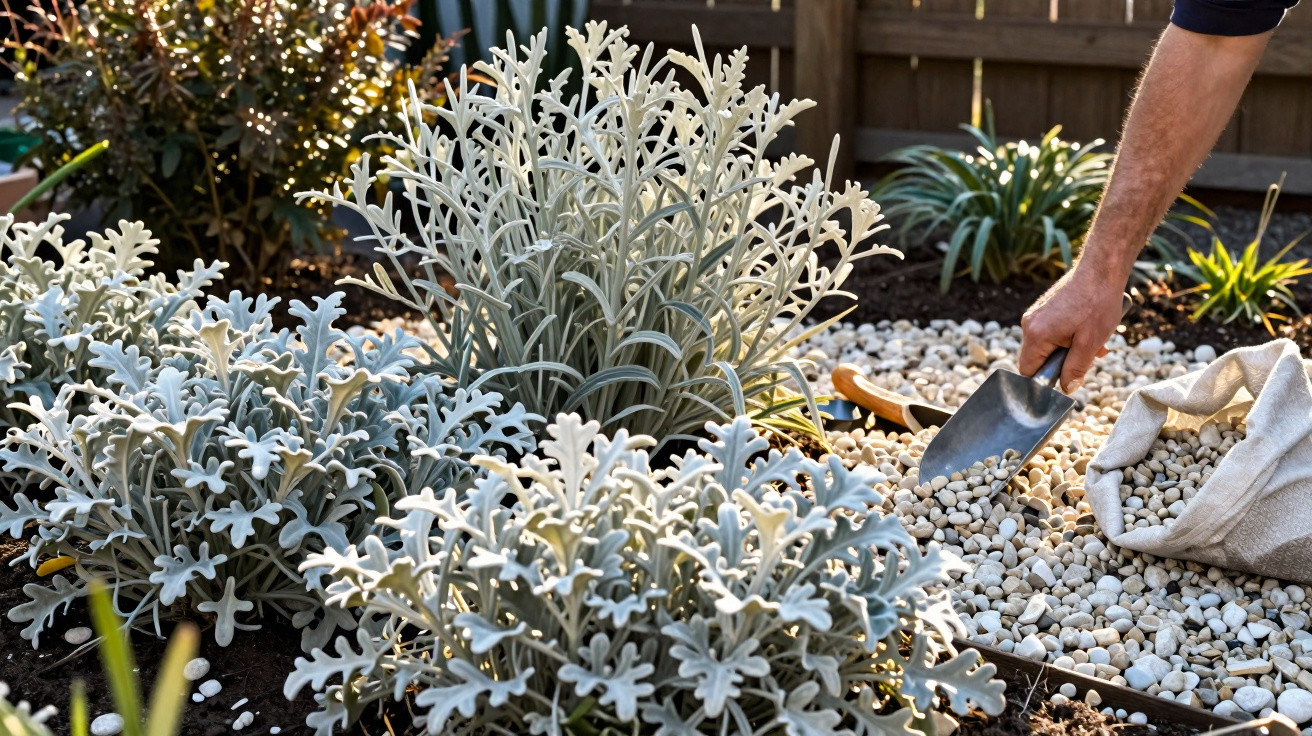
Spring can drag its heels: borders still look brown, waterlogged and a bit bleak. Exactly at this point, a smart planting trick can create the impression that winter has left behind a dusting of snow in the garden. With two tough perennials and a little stone, you can paint a silvery, shimmering scene that instantly lifts even the barest plot.
A visual extension of winter in the spring border
Why the “snow effect” looks so striking in March
In early spring, the first hints of green push up cautiously. Dark soil dominates, and flowers often won’t appear for weeks. That is where pale foliage does the heavy lifting: silver leaves against a dark backdrop catch the eye immediately. The result feels elegant and tidy, and it pulls attention away from the rest of the garden that is still sparse.
Light does the rest. Even weak, low spring sunshine is enough to make bright leaves and pale stones look as though they glow. The space reads as larger, more clearly organised and noticeably more alive - even when very little is actually in bloom.
“Light foliage on dark soil creates the same wow effect in March as the first big flower - only far more reliable.”
Using contrast as a design tool for small gardens
This approach is especially effective in compact town gardens and front gardens, where it can add surprising depth. Light planting along edges frames paths and beds, makes them appear wider, and reduces the visual heaviness of tight corners. Even a narrow strip of soil can suddenly feel like a deliberately designed garden room.
The silver dream team: velvet and lace in the border
The fluffy carpet: lamb’s ear as the base
At the centre of the look is lamb’s ear (Stachys byzantina), often nicknamed “bunny ears” for good reason. This perennial forms dense cushions of broad, softly furry leaves. They feel like velvet and reflect light in a milky, pale sheen.
Key advantages for anyone who prefers low-effort gardening:
- very easy to care for and long-lived
- copes well with poor, dry soils
- tolerates summer heat better than many flowering perennials
- gradually forms a closed carpet that suppresses weeds
In the border, lamb’s ear creates the “velvet floor” that makes everything else look better later on. It’s most effective right on the bed edge or along a path, where the soft foliage is clearly visible.
Silvery lace: Artemisia for height and structure
As a partner, an Artemisia species comes into play, often simply referred to as wormwood or, in some cases, southernwood. Its finely cut leaves, grey to almost white, look like metallic lace or a fern caught in frost. Set against the broad leaves of lamb’s ear, the contrast is instantly eye-catching.
Artemisia adds:
- extra height and structure to the planting
- light, flexible stems that sway in the wind
- excellent drought tolerance
- a modern, almost Mediterranean character
Together they form a pairing of “velvet” and “lace”: soft at the bottom, airy and fringed above - both in cool silver tones that, in March, resemble hoar frost or icing sugar.
A layer of stone as the trick: creating the perfect snow illusion
Why pale chippings multiply the effect
The real sleight of hand comes from a third ingredient: light ornamental gravel or chippings. Spread a 3 to 5 centimetre layer of grey-white or white stones around the plants, especially along the bed edge.
Visually, something fascinating happens: the eye struggles to see where the silvery leaves end and the stone begins. From a distance it can look like a thin sheet of snow across the bed, with a few leaves peeping through.
“When leaf and stone are almost the same brightness, everything merges into a single ‘snowfield’ - right in the middle of spring.”
Mineral mulch protects the plants twice over
The stone layer is not just for looks; it also works as valuable mulch. It:
- stores warmth during the day and releases it again at night
- keeps the plant crown drier, helping to prevent rot
- slows evaporation without making the perennials damp
- suppresses weeds, so there is far less weeding to do
Plants with grey, densely hairy foliage are far happier in drier conditions, and they dislike waterlogging intensely. Mineral mulch therefore suits the character of this silver pairing perfectly.
How to set it up step by step
Prepare the soil: drought lovers need air around the roots
Lamb’s ear and Artemisia hate sitting in wet ground. If you plant them into heavy soil that holds water, they won’t stay attractive for long. A thorough soil preparation before planting is worth the effort:
- Loosen the soil deeply in the planting area.
- If the soil is clayey, mix in coarse sand or fine gravel.
- Add a layer of gravel or chippings in the planting hole so water can drain away.
- Use only moderately fertile soil; avoid fresh, strong compost.
The better the drainage, the denser and healthier the silver carpet will become over the coming years.
A quick spring tidy for maximum sparkle
In very early spring, a brief care session is enough to bring out the full shine. Gently pull out old, rotting or blackened leaves from lamb’s ear, or remove them with a sharp, clean knife. Artemisia can also be cut back, shortening older growth.
This “light treatment” gives younger, paler leaves room and airflow. The plants respond with stronger new growth - and the whole bed looks crisp, as though it has been freshly pressed.
The ideal mix: how many plants the bed actually needs
Practical quantities for a standard border
To recreate the effect along a typical bed edge, you can use this simple rule of thumb:
| Element | Quantity for approx. 1–1.5 m bed edge |
|---|---|
| Lamb’s ear (Stachys byzantina) | 2–3 young plants as a carpet |
| Artemisia (e.g. southernwood) | 1–2 plants as structural accents |
| Light ornamental gravel / chippings | 1 bag, to achieve a 3–5 cm layer |
You can space the plants out a little. Over the next few years they will grow together and create the intended, almost continuous silver surface.
Dark companion plants for maximum contrast
The “snow effect” becomes even more convincing if dark-leaved perennials sit behind it. Good options include:
- purple Heuchera with deep red to almost black foliage
- black mondo grass (Ophiopogon planiscapus ‘Nigrescens’)
- dark-leaved ornamental grasses or compact shrubs with bronze-toned leaves
This makes the silver duo visually step forward, almost as if it were lit. In particular at dusk, these plantings stay bright and readable for longer than beds made up of greens alone.
Value beyond looks
Why silvery plants are genuine climate helpers
Grey, hairy leaves are a natural adaptation to heat and drought. The fine hairs reflect part of the sun’s radiation, so the plants lose less water. By using more perennials like this, you quietly prepare your garden for longer dry spells.
There is another benefit too: avoiding chemical weedkillers and using mineral mulch helps protect soil life and groundwater. Many insects also make use of the structured, evergreen cushions as shelter and resting places.
Ideas for further combinations
If you enjoy the look, the idea can be extended. These work well in the silvery section, for example:
- lavender and catmint for a Mediterranean feel and bee activity
- white tulips or daffodils as seasonal highlights in spring
- low, white perennial pinks for a delicate scent in early summer
In this way, a simple trick using two perennials and a little gravel becomes a lasting design feature that keeps the garden more interesting from grey March into summer - and makes passers-by wonder whether a final trace of snow is still lingering in the bed.



Comments
No comments yet. Be the first to comment!
Leave a Comment