
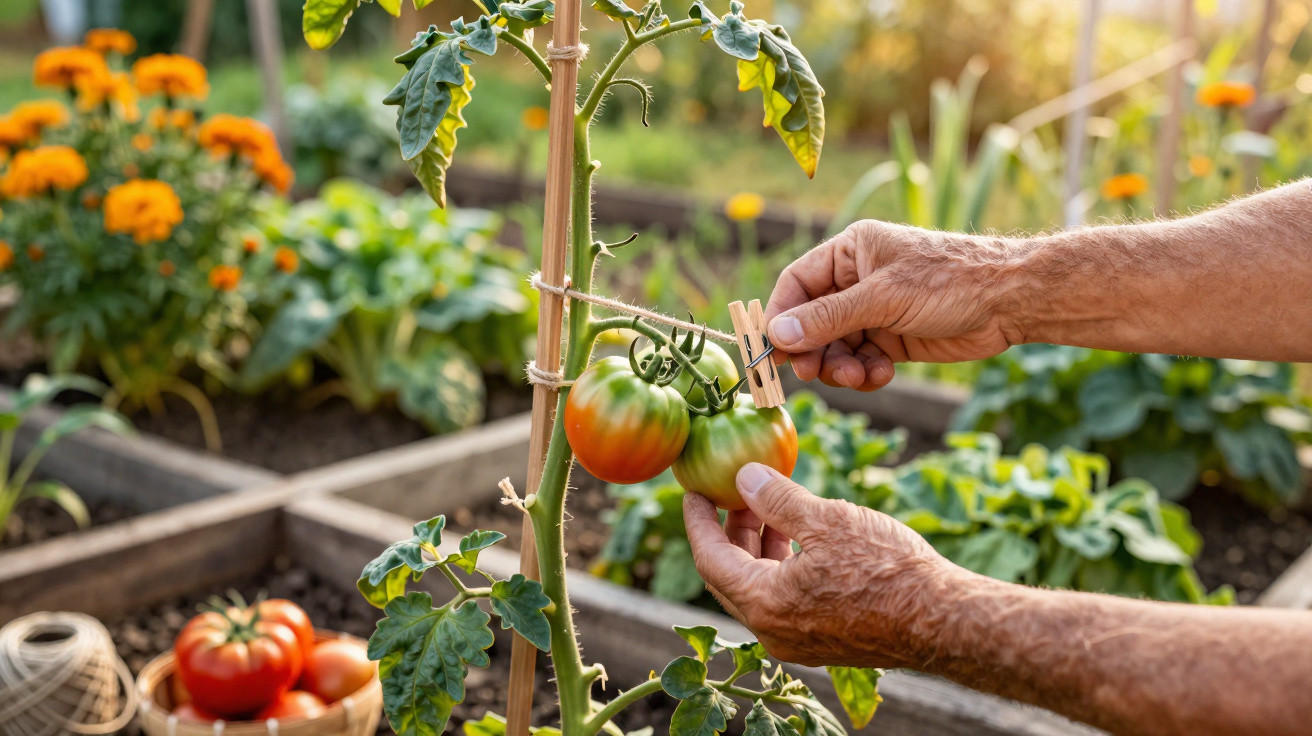
One July morning, as I walked past my neighbour’s vegetable patch, I thought I was looking at a gardener’s whim: an old wooden clothes peg was clipped against the stem of a tomato plant, just beneath a truss already laden with fruit. There was no coloured ribbon, no label, nothing that looked decorative. Another peg sat a little higher up, secured between the cane and the stem like a discreet little bodyguard. We all know that moment when we spot someone’s simple trick and wonder why we had never thought of it ourselves. My neighbour smiled when he saw me studying his arrangement. “Wait two weeks and you’ll understand,” he called out as he watered his plants. The reason was far less gimmicky than it first appeared.
A clothes peg is not decoration: it takes the strain off the tomato plant
On a tomato plant, weight builds up quickly and almost without warning. A stem that looked sturdy in June can end up bent double beneath a few trusses of fleshy tomatoes, particularly after a thunderstorm or a thorough watering. The clothes peg then acts as a gentle connection between the stem and its support cane, without the need to tie string tightly around the plant.
My neighbour positions pegs every 20 to 30 centimetres on his most vigorous plants. He mainly uses ordinary wooden clothes pegs salvaged from an old laundry basket, clipping them so that they keep the stem close to the bamboo cane without crushing it. That may seem insignificant for a tomato weighing 150 to 250 grams; with a truss of five fruits, however, the weight becomes a completely different matter.
The logic is straightforward: the stem keeps thickening as the days pass, while a tie that is too tight can damage or scar it. A peg provides a movable support that is easy to reposition as the plant grows. It is often the quiet little tricks that prevent major disappointments in the vegetable patch, especially the broken stem discovered too late, just before harvest.
How to use a clothes peg without damaging your tomatoes
The right approach is to place the peg between the cane and the main stem, leaving a little room. It should never clamp directly onto the stem as though it were meant to hold it prisoner: it follows the plant’s movement and stops it from pulling too far away from its support. A clean wooden peg with a gentle spring works better than a very stiff model that could grip too hard.
Timing matters too. Fit the peg when the plant first begins to lean, before the fruit starts pulling on the stem; waiting until it is already lying over or split makes everything more difficult. Let’s be honest: nobody really does this every day, but a quick check after watering or a gusty spell is more than enough.
One common mistake is attaching a peg too close to a heavy truss in the belief that it will give better support. It is better to position it a few centimetres above or below, on a still-strong section of stem, then make sure air can circulate freely around the leaves.
“A tomato plant does not need to be immobilised: it needs guiding without being strangled,” sums up my neighbour, who has grown his plants for more than 20 years.
- Choose a clean peg with no rust marks or mouldy wood.
- Leave space between the stem, the cane and the peg’s spring.
- Move the peg as the plant gains height.
- Remove the pegs at the end of the season and dry them before storing them.
A small gesture that changes how you view your vegetable patch
This technique does not promise giant tomatoes overnight, nor is that its purpose. Above all, it helps protect what the plant has already produced by reducing breaks, rubbing against the support cane and stems trailing on the ground after summer rain. A damaged tomato is not always lost, but it becomes more susceptible to disease and slug attacks.
The clothes peg also has an advantage that gardening accessories do not always offer: it is visible, movable and costs next to nothing. Special tomato clips are useful, of course, but a peg found in a drawer will often do the job when handled carefully. Gardening is not about collecting new objects; it is also the art of repurposing what you already have.
Ultimately, this small detail tells a very familiar story. You begin with three plants bought on a whim, water them between two overly busy days, then find yourself watching every yellow flower and every tiny green tomato. When the first truss becomes heavy, a well-placed clothes peg can prevent the heart-sinking feeling gardeners know so well.
There is still one simple rule: inspect your plant before adding anything. A dwarf variety grown in a pot will not have the same requirements as a two-metre cherry tomato climbing its cane. The most effective actions are rarely spectacular, but they address a real problem at the right time.
| Key point | Detail | Added value for the reader |
|---|---|---|
| Support without tightening | The peg is placed between the cane and the main stem, with a little space left around it. It guides growth rather than compressing the plant, which can continue thickening naturally. | Reduces the risk of stems being marked, broken or weakened by string pulled too tight, especially when trusses start becoming heavy. |
| Act early | Fit the peg as soon as the stem leans or moves away from the cane. After rain, a strong gust or a period of rapid growth, a quick check is enough. | Avoids having to act urgently on a branch that is already bent, split or lying on the ground, where fruit could then be damaged. |
| A simple, reusable solution | Wooden models with a gentle spring are often the most suitable, provided they are clean and dry. They can be used for several seasons if stored under cover. | Offers an economical, accessible and easily adjustable tip, without systematically buying specific ties for every tomato plant. |

Comments
No comments yet. Be the first to comment!
Leave a Comment