
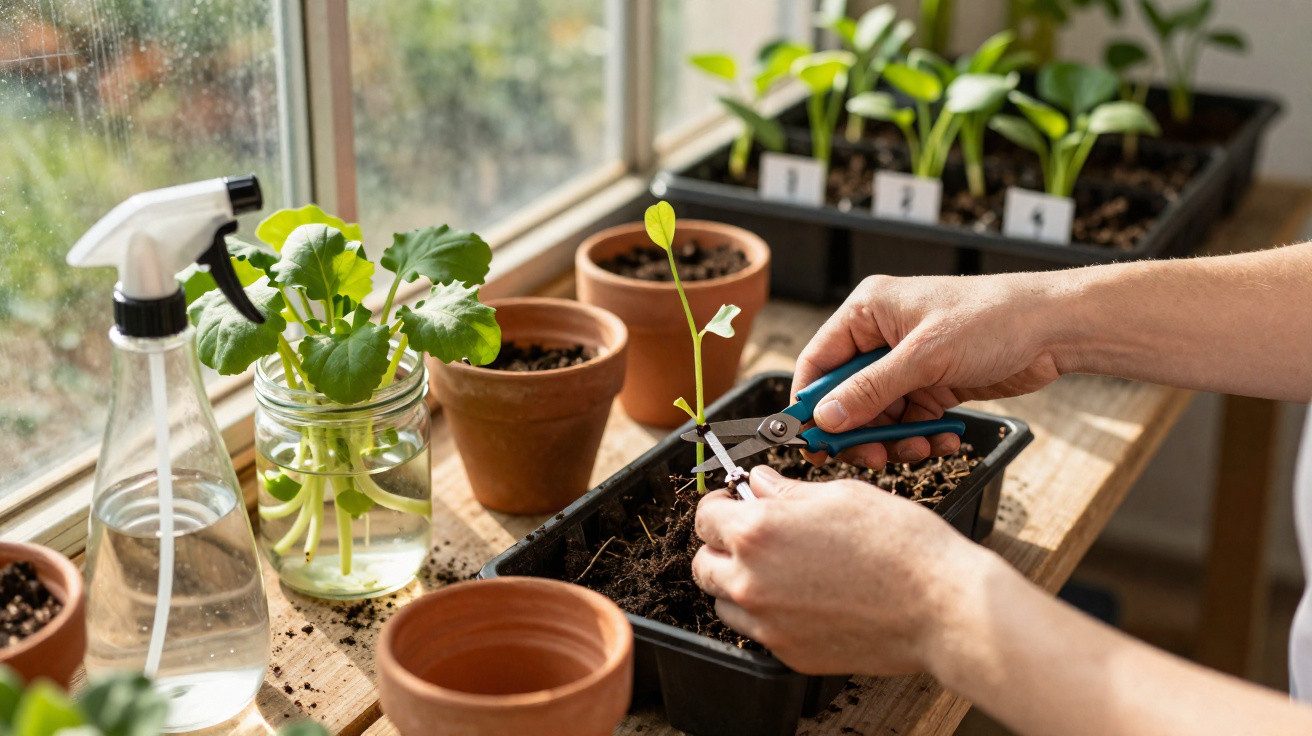
Buying plants from a nursery can quickly strain the budget, particularly during planting season. Yet a clean pair of secateurs, a few small pots and plants already growing in the garden are often all that is needed. Taking cuttings makes the most of renewed spring growth: shoots are flexible, actively growing and able to produce roots surprisingly quickly.
Why spring encourages rooting
In a temperate climate, the return of growth speeds up the movement of sap. Days become longer, the soil warms by a few degrees, and young stems build up enough energy to heal after being cut. This is the stage horticulturists call “softwood”: a shoot that is still green and bends easily between the fingers, unlike hard, brittle wood.
A softwood cutting loses less water than one taken during very hot weather. It also forms a root system more readily in a light growing medium. Over the following weeks, the young plant establishes itself in a pot before being moved into a container or flower bed at the start of summer.
“A healthy, non-flowering stem that is still flexible will often have a far better chance of taking than a long shoot that has already hardened.”
The benefit is not just financial. Propagating a plant that has already adapted to the garden also preserves foliage, colour or a growth habit that you value. For instance, a geranium that has overwintered well on a windowsill will produce offspring that are very similar to the parent plant.
Seven plants that are easy to propagate from cuttings at this time
The following species suit a wide range of uses: flowering borders, trailing planters, low hedges, herbs and decorative foliage. Some will root in water, while others need a small pot and a little patience.
- Geranium: Take a non-flowering stem about 8 cm long. Remove the lower leaves, allow the cut end to dry for a few hours, then place the cutting in light potting compost. Too much moisture quickly harms young roots.
- Japanese maple: Select a young shoot measuring 10 to 15 cm, just after the leaves have opened. Rooting hormone may be helpful. Keep the small pot beneath a transparent cover in a bright spot away from direct sun.
- Basil: Cut just below a node, then put that node into a glass of water. The first roots often emerge after a week. Pot it on once they are a few centimetres long.
- Red-twig dogwood: Its future red stems create a striking feature in winter. Take young shoots, remove the lower foliage and place them in a moist, free-draining, loosely packed mix.
- Ornamental sweet potato: A section of stem with a node is enough. Put the node in water, replace the water regularly, then pot it up once roots appear. Its foliage will soon create cascades in hanging baskets.
- Ornamental sage: Look for strong basal shoots growing close to the base of the plant. Place them in a very free-draining mix. This perennial will then form new clumps that are valuable to pollinating insects.
- Box: This plant takes longer to root. Take small shoots from the current year, remove the leaves from the lower half, then plant them in a sandy growing medium. Keep the pots in light shade.
Useful equipment without unnecessary expense
Basic equipment is more than sufficient. Well-sharpened secateurs make a clean cut, reducing damage to the parent plant. Disinfect the blades with rubbing alcohol between plants, especially when leaves are marked or distorted.
Set aside small pots with drainage holes, seed compost, coarse sand or perlite, a spray bottle and labels. The ideal mix retains a little moisture while allowing air to circulate around the developing roots. Heavy, compacted and waterlogged compost encourages mould.
| Item | Purpose | Key point to watch |
|---|---|---|
| Secateurs | Cleanly cutting shoots | Blades must be clean and sharp |
| Small pot with drainage holes | Establishing young plants | Water must drain away quickly |
| Light compost | Starting root growth | The growing medium must never become compacted |
| Cover or transparent bag | Maintaining gentle humidity | Regular ventilation is essential |
Mistakes that can make a batch of cuttings fail
The first trap is using flowering stems. At this point, a plant directs much of its energy towards buds and flowers rather than producing roots. It is better to select a vigorous, green shoot with no sign of disease or insects.
The second issue is water. A cutting does not yet have roots that can take up much moisture, but it can rot very quickly in saturated compost. The growing medium should feel moist beneath a finger, never muddy. A light misting of the foliage helps on dry days.
“Gentle humidity, light without scorching sun and a free-draining growing medium: this trio protects young stems during their vulnerable stage.”
Do not pull on a stem to check its progress. This can break the newly forming fine roots. After two or three weeks, slight resistance when it is moved extremely gently often indicates that rooting has begun. Box may need several months, whereas basil and ornamental sweet potato respond much faster.
Understanding the node on a stem
A node is the point where a leaf or branch begins. This area contains cells capable of producing roots and new shoots. With basil or ornamental sweet potato, immersing a node greatly improves the chance of success. For species grown in small pots, burying a node in the growing medium serves the same purpose.
Creating denser planting schemes
Cuttings also make it possible to plan well-matched combinations. Sages create a flowering line in a sunny position, while dogwoods provide structure at the back of a flower bed. In a container, an upright geranium paired with the trailing foliage of ornamental sweet potato adds volume without multiplying purchases.
Once the young plants are well rooted, gradually acclimatise them to outdoor conditions. Put the pots outside for a few hours on mild days, then extend this exposure over several days. This hardening-off process reduces stress, particularly after time spent under a cover or in a bright room.




Comments
No comments yet. Be the first to comment!
Leave a Comment