
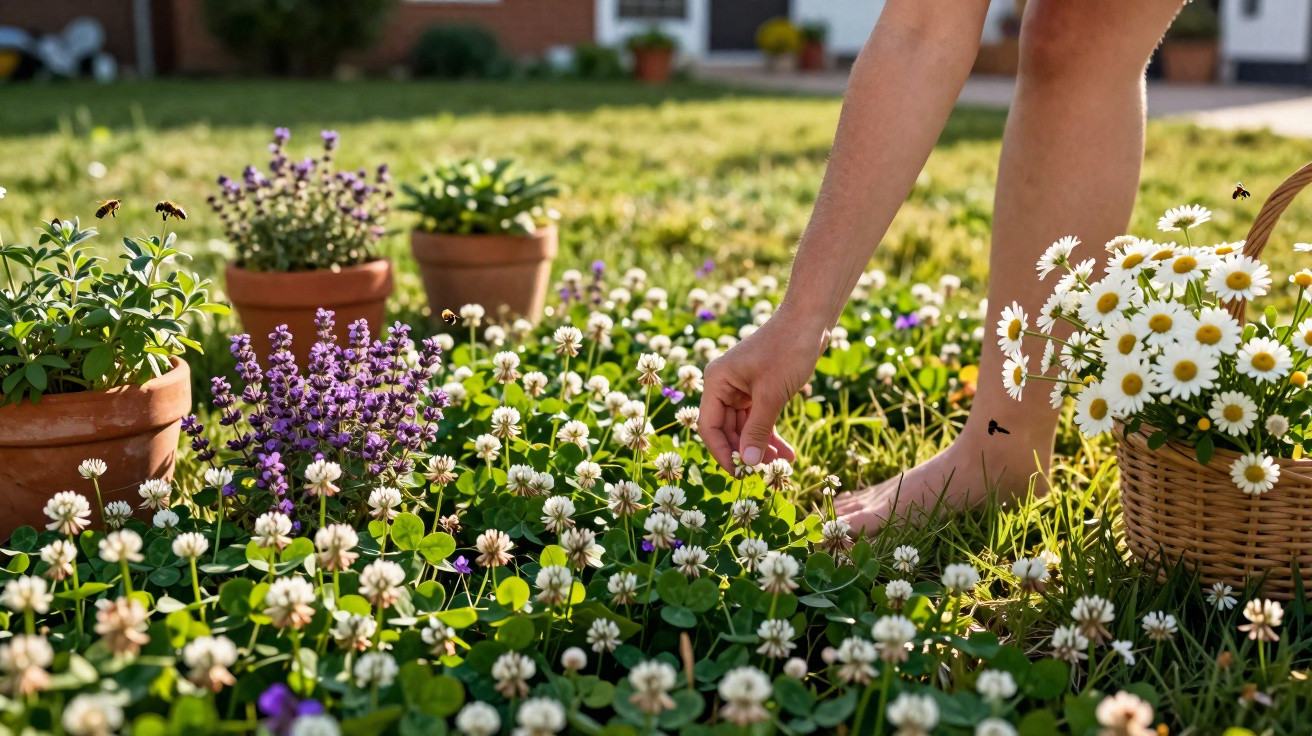
One Saturday in June, a neighbour’s garden makes the contrast immediately obvious: beyond the gate, there is no evenly green lawn needing weekly mowing, but a low carpet of clover, daisies, thyme and tiny purple flowers. Bees go quietly about their work, the ground stays cool despite the heat, and nobody is rushing for the watering can. We all know that moment when a garden suddenly feels more alive than expected. In the past, whether in modest gardens or around orchards, an immaculate lawn was not really a priority. People planted useful, hardy and sometimes edible things, above all plants able to cope without demanding constant attention. The result looked less like a display. It was more like a small haven for life. Today, that old idea is returning with surprising force.
Before the perfect lawn, a garden had to be useful
The large expanse of closely cut grass so familiar outside homes is a fairly recent feature of everyday gardens. It recalls the parks surrounding grand English estates, followed by the modern suburban ideal, complete with lawnmower, crisp edges and the very human desire to control everything. In rural areas, people were more likely to keep a packed-earth yard, a meadow, an orchard or planted strips. Ground was never left unused simply because it looked attractive. It fed livestock, people, insects or fruit trees. Every square metre of a garden had to earn its place.
In some areas, clover was sown between vegetable rows or beneath fruit trees. This unassuming plant quickly covers the ground, suppresses competing growth and captures nitrogen from the air through its roots. A patch of white clover can remain green with far less water than a conventional lawn during a dry summer. Earlier generations did not use terms such as “biodiversity” or “differentiated management”, but they clearly recognised what survived easily. They watched. Then they repeated what worked in their own gardens.
That reasoning explains why ground-cover plants are returning to small gardens: they shield the soil from the sun, slow evaporation and prevent the dispiriting sight of yellow patches as soon as the first heatwave arrives. A lawn made mainly of ryegrass often needs frequent mowing and watering to remain immaculate. A more varied plant carpet, however, can tolerate being slightly less uniform. That is exactly where its strength lies. The garden stops being a surface to maintain and becomes a living environment that finds part of its balance by itself.
Clover, thyme and chamomile: modest plants that transform a lawn
Before replacing a lawn, take an honest look at the site. An area trampled by children, a dog or summer meals needs different plants from a dry corner in front of a south-facing wall. White clover copes reasonably well with occasional foot traffic and grows in many soil types. Creeping thyme thrives in warm, free-draining places, while Roman chamomile creates a fragrant carpet in light soil. Start on a small scale: ten square metres are enough to see how the garden responds.
A common mistake is to rip out the entire lawn over one weekend, then scatter a supposedly “flowering” mix at random. The urge to get it over with is understandable: yellowed grass is irritating, weeds are too, and the promises on seed packets appear straightforward. Let us be honest: nobody really does this every day. It is better to prepare the soil, remove the most invasive perennial plants, then establish suitable species. A wildflower meadow does not become magical in a fortnight; its beauty often emerges in the second season, once the plants have found their place.
In old gardens, diversity was not ornamental: it met highly practical needs, from foot traffic and harvests to shade and food for pollinators.
“The best ground cover is not the one that looks most impressive in a photograph, but the one that stays alive when you forget to water it.”
- White clover: tough, rich in nectar and pleasant underfoot.
- Creeping thyme: ideal for dry, sunny areas.
- Roman chamomile: fragrant, low-growing and perfect for light soil.
- Lesser periwinkle or ground ivy: useful in shaded corners.
- Wild strawberry: covers the ground and may sometimes offer a surprise to pick.
A less-mown garden, but one far more alive
The real change is rarely visible on planting day. It appears one morning when a bee settles on clover beside the patio, when the soil beneath trees remains soft after three weeks without rain, or when children spot a strawberry hidden among the leaves. This kind of garden still needs some care, of course: cutting back, keeping plants in check and watching bare patches. Yet the relationship changes. Instead of trying to erase every blade that sticks out, you learn to work with it.
Earlier generations did not live in a maintenance-free paradise, and their gardens could be harsh, poor or heavily worked. Their lesson lies elsewhere: plant what has a reason to stay. Today, with drier summers and recurring water restrictions, this approach feels less nostalgic than genuinely practical. Sharing a photo of a former patch of lawn that has been transformed can even inspire an entire neighbourhood. A border of thyme, a strip of clover, a clump of chamomile: sometimes only a little is needed to change the feel of a garden.
| Key point | Detail | Added value for the reader |
|---|---|---|
| Replace the lawn | Choose ground cover according to sunlight and foot traffic | Less watering and less mowing |
| Prioritise clover | It stays low, feeds pollinators and enriches the soil | A hardy, living plant carpet |
| Install gradually | Trial a small area before transforming the whole garden | Avoid unnecessary expense and unwelcome surprises |




Comments
No comments yet. Be the first to comment!
Leave a Comment