
Many keen gardeners find themselves staring at their rose bushes each year, unsure what to do next. Prune at the wrong moment and you can dramatically cut back spring flowering-or even leave the plant weakened. The workable window is surprisingly narrow, and it depends less on the calendar than on the thermometer and where you live.
The perfect timing: why everything is decided between mid-February and mid-March
Pruning roses can look like a relaxed job, but in reality it is a race against the clock. The key period sits right at the end of winter, when the plant is beginning to wake up, yet hasn’t fully surged into strong growth.
"The ideal period for pruning roses is-depending on the region-roughly between mid-February and mid-March, shortly before vigorous growth starts."
If you reach for the secateurs much earlier, you increase the risk of frost damage. Freshly cut stems can start to grow quickly, producing soft, water-rich new shoots-and these are extremely vulnerable to frost. One bitterly cold night can wipe those shoots out completely. Frost can also penetrate deeper through fresh cuts into the wood, and in some cases an entire branch may die back.
Leave it far too late, however, and the rose will already have spent a lot of energy on leaves and long shoots. If you then cut back hard, you remove a large share of that investment. The plant has to sprout again and loses some of its flowering potential.
Thermometer, not calendar: prune only when the worst frosts have passed
Your best guide is not the date, but the weather pattern. As long as severe night frosts are still a regular threat, keep the pruning shears in the shed.
"Roses are only next once the period of hard frosts is largely over-better a few days too late than a week too early."
In many areas this often lines up broadly with around mid-March, when the chance of deep sub-zero temperatures drops noticeably. That gives the shrub a level of confidence that fresh cuts and new growth won’t immediately freeze back.
Buds give nature’s green light
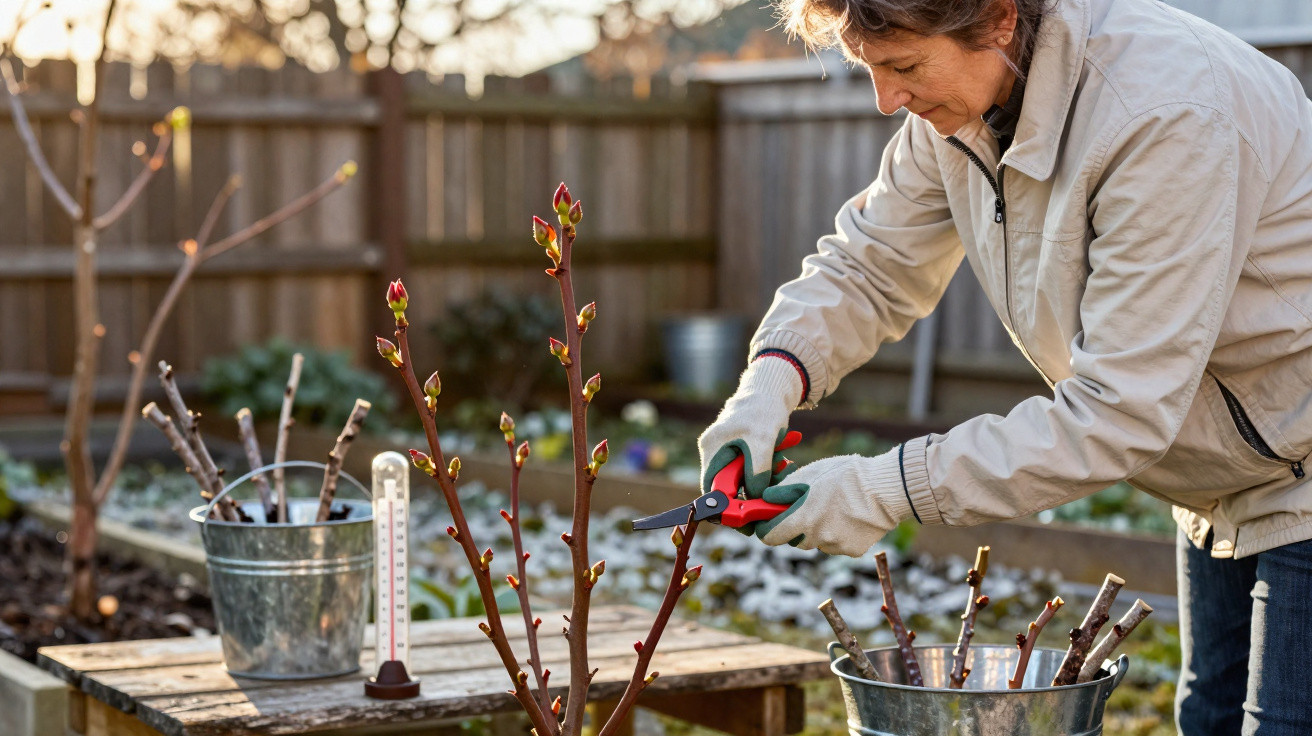
Alongside checking the forecast, a quick walk around the garden can tell you a lot. If you watch your roses closely, you can pinpoint the right moment quite accurately.
- Buds begin to swell and show colour
- Small red or pinkish bumps appear along the stems
- Shoots look plumper, but without fully opened leaves
This stage is often described as the start of growth, when buds are “breaking”. Sap is already rising, but the plant hasn’t yet poured its energy into large amounts of foliage. That is the sweet spot. If you can already see plenty of leaves, act promptly so the shrub does not exhaust itself unnecessarily.
Region matters: different pruning dates in mild and cold locations
Because local climates can vary widely, there is no single date that works everywhere. Between coastal areas, sheltered valleys and higher ground, the difference can easily be several weeks.
Mild spots and sheltered areas: an earlier start from February
In places with comparatively mild winters-such as coastal locations, urban heat pockets, or particularly sheltered valleys-roses can often be pruned noticeably earlier. After February, severe frosts there are usually less common.
"In mild areas, the starting signal is often as early as the second half of February-if you wait too long, you may already be pruning in full bud break."
In these locations, roses frequently get going strongly in March. If you only pick up the secateurs then, you remove some of the freshly produced growth and the energy that went into it. A planned, earlier cut is clearly advantageous here.
Cooler regions, further north and higher ground: patience into March
In more exposed areas-further north and east, across many upland regions, or in higher villages-frosty spells can drag on well into March. In those conditions, patience pays.
For these gardens, a date around mid-March, and sometimes even towards the end of March, is more realistic. Many gardeners keep traditional late-cold snaps in mind and know that chilly spells can arrive later than in milder parts of the country. Pruning slightly later helps protect developing buds because it pushes new growth back.
What happens inside the rose: why timing makes such a difference
When you prune a rose, you are intervening directly in the shrub’s biology. The cut influences where the plant directs its energy and, ultimately, how many flowers it produces.
Rising sap: channel energy into fewer, stronger shoots
In winter, sap withdraws deep into the roots. As light and warmth increase, the rose pumps those reserves back upwards, aiming to create new shoots, leaves and later flowers as quickly as possible.
"A cut shortly before or at the beginning of this rise in sap ensures the plant’s full strength is concentrated on fewer, carefully chosen buds."
That is how you get robust, well-supplied shoots with larger, fuller blooms. If everything is left to grow unchecked, energy gets spread across many thin twigs-typically resulting in a poorer display.
Why pruning late leaves roses tired
If the rose has already produced lots of leaves and long, soft shoots, it has used up substantial reserves. A hard cutback at that point means much of that energy ends up on the compost heap. The plant must work twice, producing new shoots from the same reserve. That can weaken it, make it more prone to disease, and reduce flowering.
How to prune properly: technique on pruning day
Once you have chosen the moment, the “how” matters. Poor cuts can encourage disease and spoil the shape, while clean, considered cuts rejuvenate the shrub.
"Basic kit: sharp, clean, disinfected secateurs-blunt blades crush the wood and give fungi an easy way in."
The three-bud rule for bushy roses
For bedding roses and shrub roses, a long-standing, straightforward guide is the so-called three-bud rule.
- Starting from the base of a shoot, count three clearly visible buds upwards.
- Cut directly above the third bud.
- Make sure this bud is facing outwards.
New shoots then grow from those outward-facing buds. The plant opens out like a bowl, stays airy and tidy in the centre, and leaves room for light and air.
The right angle: a lightly slanted cut
Make the cut on a slight slant, at a gentle angle, around 5 millimetres above the bud. The slope should fall away from the bud so rainwater does not run onto the sensitive growth point, but drips off to the opposite side. This noticeably reduces the risk of rot and fungal problems at that spot.
Spring clean for the shrub: thin out what holds the rose back
A sensible rose prune is much more than simply shortening stems. The shrub needs a regular, thorough “house clean” to stay healthy.
Old wood, weak growth: remove it
Start by taking out any dead or diseased branches. They are often grey-brown, sometimes black, and they snap rather than bend with any elasticity. You can also remove thin, feeble twigs that would produce little to no worthwhile flowering.
"By the end, the shrub should be left with strong, bright green shoots-they carry the main load of the coming flowering season."
More light and air: open the centre
Roses thrive on sunshine and good airflow. Remove shoots that cross, rub against each other, or grow steeply inwards. The aim is a loose, bowl-shaped framework that allows light and air to reach the centre without obstruction.
With that structure, leaves and blooms dry faster after rain, fungi struggle to gain a foothold, and the shrub stays more vigorous overall. At the same time, the plant looks more balanced and attractive.
Care after pruning: helping the plant recover
After cutting back, the shrub is under stress. It has lost material, it has open cuts, and it needs to redistribute its resources.
- Clear away all prunings and fallen leaves thoroughly; do not leave them under the shrub.
- With sensitive varieties, protect larger cut surfaces with a suitable product if you are inclined to do so.
- Apply a light organic feed once the soil has warmed and the rose is visibly growing.
- Keep the soil loose and water moderately in dry spells-avoid waterlogging.
This helps the plant enter the new season with sufficient nutrients and a stable water supply. The combination of well-judged timing, clean technique and appropriate aftercare pays off in May and June: in dense, fragrant clouds of blossom.
Common questions from hobby gardeners: practical examples and risks
What if I pruned far too early?
If a harsh frost period follows an early cut, your options are limited. For container roses, moving them to a sheltered position-such as against a house wall-and using horticultural fleece can help. In borders, you can mulch the root area and cover sensitive crowns with brushwood. Any damaged shoots should be shortened again in spring until healthy wood is visible.
Can I sometimes skip pruning altogether?
Yes-roses often survive-but they can look scruffy, produce fewer and smaller flowers, and become more susceptible to fungal diseases. Without pruning, shrubs age, the centre becomes shaded, and flowering declines. Regular, moderate pruning keeps the rose younger and more vigorous.
For beginners in particular, it helps to remember simple rules such as “prune in mild weather when the buds start to swell” and “better slightly too late than too early”. If you stick to that, you will see how a seemingly bare, thorny shrub can turn into a packed fountain of colour within a few weeks-almost as if someone has flicked an invisible switch.





Comments
No comments yet. Be the first to comment!
Leave a Comment