
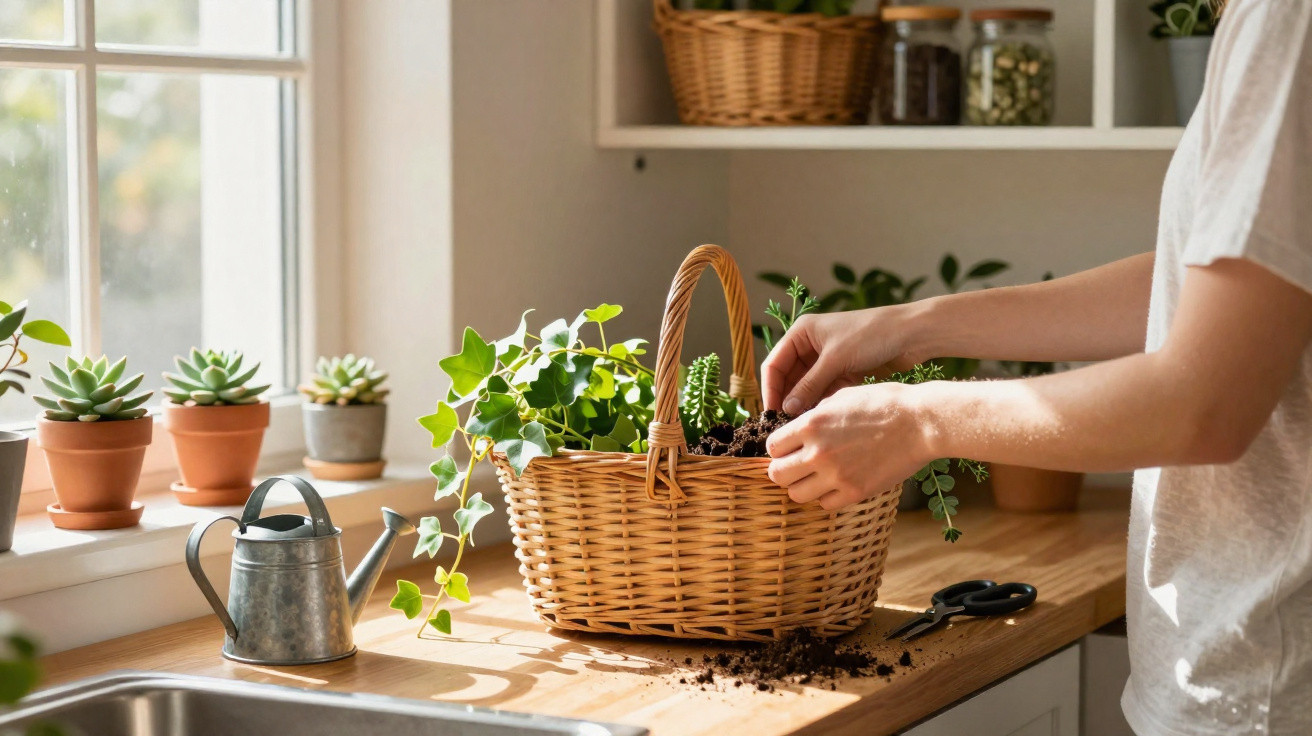
A dusty wooden basket from a charity shop, a slightly dented wire basket from your gran’s day: it’s exactly these kinds of bits and pieces that often end up shoved right at the back of a cupboard. Many people just shift them from one corner to another because they’re “too good to throw away”, yet they don’t really have a place anymore. The truth is that an old basket like this is the perfect starting point for a hanging mini garden-saving space while instantly lifting even the dullest corner of a room.
Why an old fruit basket is ideal for hanging plants
Whether it’s wood, metal or wire mesh, a fruit basket already has most of what plants appreciate. The structure is open, so air can circulate properly, and there’s usually enough room to hold several pots or a full little arrangement. That’s what makes it such a strong base for an upcycling project that’s kinder on both your wallet and the environment.
“With just a few quick steps, a discarded fruit basket becomes an airy plant shelf under the ceiling-without using a single centimetre of floor space.”
If you’re buying second-hand baskets, it’s worth inspecting them carefully. Cracks in the wood, rusted-through areas, or a musty smell can all be warning signs. A sturdy basket without major damage will cope later on with soil, moisture, and the combined weight of the plants.
Preparation: making old look good again
Before the basket goes anywhere near the ceiling, it needs a bit of attention:
- Thorough clean: Warm water with a little washing-up liquid, plus a brush and a cloth, is usually enough to remove dust, old marks and lingering smells.
- Leave it to dry: Wood and metal should dry out completely so mould doesn’t become an issue later.
- Protective coat: A thin layer of clear varnish, wood stain or metal paint helps protect against moisture from watering and can refresh the look if you want.
If you like a vintage feel, you can deliberately leave small dents and scratches. They give the finished plant basket personality and make it look like it has a few stories behind it.
What you need for a floating plant basket
The conversion itself is surprisingly straightforward, and a lot of what you need may already be in your toolbox or shed.
- Cleaned fruit basket (wood, metal or wire)
- Tear-resistant cord or a decorative chain
- Hooks or rings for hanging (with or without drilling)
- Fleece, coconut fibre liner or jute for lining
- Lightweight potting mix and expanded clay pellets (or similar drainage)
- Suitable houseplants, ideally trailing varieties
- Scissors, pliers and, if required, a drill
Instead of a chain, a slightly thicker macramé cord or a chunky natural rope can look brilliant. The key factor is load capacity-the weight increases noticeably once soil and water are involved.
Turning the basket into a secure hanging home for green plants
First, the inside of the basket needs a simple “liner”. Fleece, coconut mats, or a piece of jute will keep the soil in place while allowing water to drain away slowly. The result is effectively a large planter with natural drainage.
“Hang it first, then fill it properly-this way nothing needs shifting afterwards and the basket stays balanced.”
Step by step to the hanging system
- Plan the suspension points: Three or four attachment points around the rim improve stability. They spread the load evenly and stop the basket hanging at an angle.
- Drill holes (if needed): With more solid wooden baskets, small drilled holes make it easier to secure cord or chain neatly.
- Thread in cord or chain: Each side must be the same length. At the top, all strands meet in a central ring or knot.
- Test the hang: Hook up the empty basket as a trial and press down gently. If anything slips or tilts, adjust the lengths before adding weight.
When it comes to the fixing point on the ceiling or wall, the surface matters. In concrete, you’ll need a heavy-duty wall plug; in wood, a standard shackle or hook may be enough. If you’d rather not drill, use exposed beams, a sturdy curtain pole, or specialist hooks that can be hung in place.
The best plants for a hanging fruit basket
To make the old basket look like a miniature jungle, choose houseplants that trail or cascade. They suit the open shape and spill naturally over the edge.
| Plant | Growth | Care level |
|---|---|---|
| Pothos (devil’s ivy) | Long, fast-growing shoots | Low-maintenance, forgives mistakes |
| Ivy | Climbing or trailing | Prefers cooler conditions |
| Tradescantia | Dense, colourful growth | Needs a bit more light |
| Philodendron with long vines | Large leaves, lush look | Medium, sensitive to waterlogging |
| Small indoor strawberry plant | Trailing runners with fruit | Needs more light and even moisture |
A mix of leaf colours and shapes can look especially striking: fine, delicate trails alongside bold, heart-shaped leaves, perhaps with a pale-patterned variety among deep green plants. For the simplest approach, keep plants in their individual pots and place them inside the basket-then you can swap them out much more easily.
Watering without a flood
It pays to be cautious with watering at the start. Two small waterings are better than one overgenerous soak. A base layer of expanded clay pellets (or other coarse material) helps prevent waterlogging. If water drips down immediately after watering, you’ve used too much-reduce it next time.
A quick finger test also helps: if the top layer feels slightly dry but the soil underneath is still cool and only lightly damp, your routine is about right. If the basket hangs above delicate flooring, a shallow tray or a runner can protect against the inevitable early misjudgements.
Vertical décor with impact for small rooms
In smaller flats in particular, using space near the ceiling is a big win. The floor stays clear, the hoover and mop have more room to manoeuvre, and you still get greenery into the room. An old fruit basket creates a new focal point at eye level.
“A floating plant basket brings nature indoors without sacrificing a shelf or side table.”
If you have several baskets, hang them at different heights to create a kind of green cloud above a sofa, dining table or desk. Add a dimmable lamp nearby and, in the evening, you’ll get a cosy, almost lounge-like atmosphere.
Mistakes you’re better off avoiding
- Soil that’s too heavy: Standard garden soil quickly becomes dense and weighty. Choose a light houseplant potting mix instead.
- The wrong spot: Some plants can’t cope with direct sun, while others need it. Match the plants to the location, not the other way round.
- Inadequate fixings: Cheap hooks or undersized wall plugs can be dangerous. The mounting should be rated to carry more than the basket will actually weigh.
More ideas for creative ceiling baskets
If you like the hanging plant corner, it’s easy to take the same idea further. Shallow baskets work well for small herb gardens in the kitchen. Basil, thyme and chives can grow within easy reach above the worktop without taking up counter space.
It also gets interesting once you add lighting. A small string of fairy lights loosely threaded through the wire can create a soft sparkle among the leaves in the evening. With metal baskets, it’s even possible to adapt designs with a built-in lamp holder and cable into combined light-and-plant features-just make sure you use safe, certified components.
If you struggle with real plants, a mixed approach can be ideal. Some baskets can hold hardy choices like pothos or succulents, while others are filled with dried flowers or high-quality artificial plants. You still get a green look, but the upkeep drops significantly.
In the end, a plain, long-forgotten fruit basket becomes a personal home accessory that no furniture shop will have on its shelves. With a bit of confidence, a few screws, and a handful of plants, even the darkest corner can turn into a small, airy plant oasis-without spending much and with plenty of room for your own style.
Comments
No comments yet. Be the first to comment!
Leave a Comment