
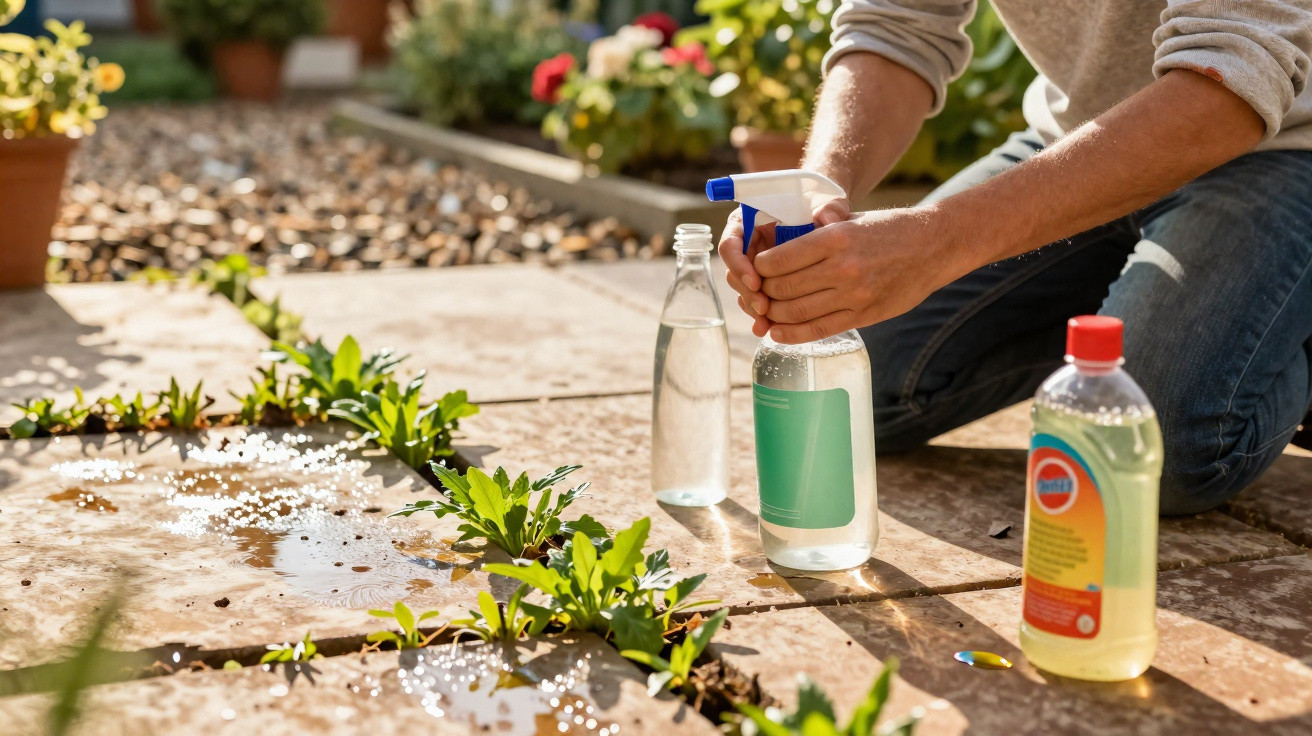
Many hobby gardeners reach for a bottle of vinegar almost on autopilot when the first shoots appear between paving stones or across gravelled areas. At first it seems to work remarkably well, but a few weeks later everything is green again. Meanwhile, a different and surprisingly straightforward approach has started to catch on in gardens - using an everyday product that most people already keep under the kitchen sink.
Why ordinary household vinegar rarely helps for long
Vinegar has been a long-running “insider tip” for tackling weeds on paths and patios. It attacks the parts of the plant above the ground: leaves discolour and the shoots droop. Visually, the area can look tidy again at first. The snag is underground - the roots often remain largely untouched in the soil.
After a few days or weeks, the plants simply regrow from root systems that are still alive. Anyone treating large areas, or heavily overgrown joints, with vinegar alone can quickly end up stuck in a cycle of spraying, waiting, and then seeing fresh growth.
"Vinegar mainly burns what you can see - not what keeps the plant alive."
For a few delicate shoots, vinegar can be enough. On tougher, well-established patches, you would need to repeat applications so often that it becomes irritating, the smell stings your nose, and the soil is put under unnecessary stress. That is why many gardeners have looked for a way to boost the effect - without resorting to harsh chemical weedkillers.
Washing-up liquid as an underestimated ally against weeds in paving joints
This is where something that sounds almost too ordinary comes in: everyday washing-up liquid. This type of cleaner contains surfactants, which are designed to lift grease and dirt when you are doing the washing-up. In the garden, they serve a different purpose.
Plant leaves have a thin, waxy protective layer that makes water bead and run off. Washing-up liquid breaks through that layer. As a result, the sprayed solution sticks better, does not immediately slide away, and can penetrate into the plant cells.
Even used on its own, washing-up liquid can make it harder for a plant to retain water. The above-ground parts gradually dry out. It becomes especially useful when washing-up liquid is combined with vinegar: the mixture clings to the leaves for longer, allowing the acidity to act more intensely on the plant surface - which can also weaken the plant’s root reserves more effectively.
"With washing-up liquid, a quick ‘surface burn’ turns into a much more thorough hit against weeds in paving joints."
The simple basic mix for patios and gravel paths
Among hobby gardeners, a very straightforward recipe has become popular - one that can be mixed up with what you already have at home:
- 1 tablespoon of washing-up liquid
- 1 litre of water
- optional: 1 cup of household vinegar
Mix everything in a watering can, or better still in a pressure sprayer, and stir well. The mixture is mainly suitable for:
- paving joints on patios and driveways
- gravel and chipping paths

Comments
No comments yet. Be the first to comment!
Leave a Comment