
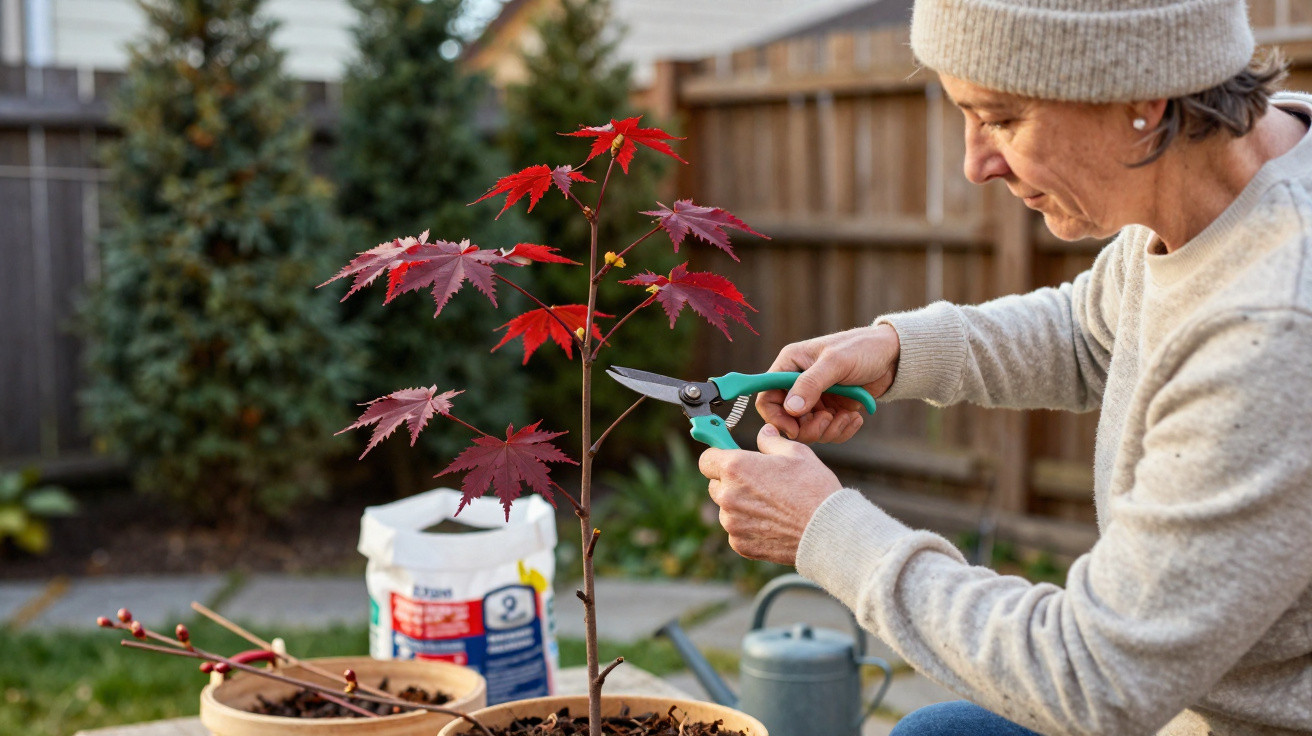
Japanese maples are often the jewels of a garden: expensive to buy, with a delicate crown and spectacular autumn colour. Yet these are exactly the trees that can react extremely badly if secateurs or a saw are used at the wrong time. Anyone trying to “tidy up” in late winter risks heavy sap bleeding, long-term weakening and, in the worst cases, a slow decline that can end in the tree dying.
Why pruning a Japanese maple is trickier than it seems
The Japanese maple (Acer palmatum) grows slowly, has thin bark and seals wounds only very gradually. That means large cut surfaces stay exposed for a long time. As soon as sap begins to rise in late winter, any larger cut can trigger a real flow of sap. In the process, the tree loses stored resources it urgently needs for spring growth and for defending itself against disease.
Because the wound remains damp for longer, fungal spores and bacteria can take hold easily. In mild, wet winters in particular, pathogens establish quickly. The impact often doesn’t show until months later: individual branches die back, leaves stay small, and autumn colour is noticeably weaker.
"An ill-timed cut can trigger heavy sap bleeding in Japanese maples and leave the tree vulnerable for months."
For that reason, specialists advise pruning Japanese maples only during the deepest dormant period-late autumn or mid-winter-when the tree is truly “asleep” and sap pressure stays low.
Late winter as a last opportunity - with lots of caveats
In February, many gardeners feel the urge to get going: borders are cleared, roses are pruned, and perennials are cut back. With a Japanese maple, that end-of-winter sprint can be genuinely risky, because this is exactly when the plant starts pushing sap through the stems again.
Tree-care professionals caution that, if pruning drifts too far into the run-up to spring, sap bleeding begins with every larger limb. That slows wound closure, weakens the tree’s immune response and makes it more vulnerable to frost damage and disease.
This is why many experts treat February only as a narrow window. Small corrections can be made, but bigger interventions are better postponed until the next winter. At the latest, once buds begin to swell significantly, stop-any fresh cut can behave like an open tap.
Key rules for pruning in late winter
- Do not remove thick branches once buds are clearly swelling.
- Never cut when temperatures are below 0°C - frozen wood can split and tear at the cut.
- In one season, remove no more than a quarter of the living crown to avoid stress.
- Do not use a powered hedge trimmer - it creates many poor wounds instead of a few clean cuts.
If you’re unsure whether the tree is still dormant or already “waking up”, it’s safer to skip pruning this year or restrict yourself to dead wood only.
Prune properly: keeping your Japanese maple strong
Good pruning on Acer palmatum is closer to delicate cosmetic surgery than rough thinning out. The aim is to highlight the tree’s natural, elegant shape and to remove damage-not to “trim it into shape”.
You can follow this basic sequence:
- Pause and study the tree: look from all sides for branches that cross, rub, or grow inwards.
- Remove dead and diseased wood first: take out grey, brittle shoots with no buds.
- Choose between rubbing branches: where two branches touch, remove one completely at its point of origin.
- Less is more: when in doubt, leave a branch and reassess next year.
A very sharp, clean tool is essential. Cuts should be smooth, without crushing the tissue. Make cuts just above the branch collar (the slightly thickened area at the base of the branch). Do not cut into the trunk itself, as this creates wounds that are particularly slow to heal.
"Every cut should have a reason: remove dead wood, prevent rubbing, emphasise the natural form - nothing more."
What’s still acceptable in February - and what must wait
In late winter, professionals limit themselves to fine work. Small, clearly dead twigs can be removed, while obvious structural changes are left untouched until the next winter. Larger corrections-such as taking out a thick branch that spoils the shape-should be moved to the period of deep winter dormancy.
If you’ve already missed the ideal timing, intervene only for safety: remove broken limbs, deal with immediate hazards, otherwise monitor the tree, keep the root area tidy and later protect it with a thin layer of mulch.
Location and care: helping the tree cope better with pruning
A Japanese maple is more likely to forgive a small mistake when its siting and care are right. What matters is a sheltered position, no harsh midday sun, and soil that stays evenly moist but never waterlogged.
| Aspect | Recommendation |
|---|---|
| Location | Partial shade, sheltered from wind, no extreme midday heat |
| Soil | Humus-rich, slightly acidic to neutral, well drained |
| Watering | Evenly moist, no waterlogging, no complete drying out |
| Feeding | Moderate in spring, organic slow-release feed or compost |
| Mulch | Thin layer of bark humus or leaves, kept away from the trunk |
A well-cared-for tree forms smaller wounds that close more easily and reacts with less stress to corrections. Even so, avoid heavy feeding, as it can encourage soft growth that is more prone to damage and disease.
Common pruning mistakes - and how to avoid them
A lot of harm is done with the best intentions. Typical missteps include:
- Shaping it like a hedge: the crown is “combed” and tips are sheared off-this ruins the natural silhouette and creates dozens of small wounds.
- A drastic cut out of impatience: an overgrown tree is heavily reduced; the maple responds with stress, water shoots and increased susceptibility to disease.
- Thick layers of wound paint: heavy coatings can trap moisture and create ideal conditions for fungi.
- Cutting during hard frost: frozen tissue tears and splits at the cut.
If you take your cue from the fine, almost graphic growth habit and justify every intervention, you usually avoid these problems automatically. A Japanese maple’s appeal lies in its natural elegance-the less you try to “model” it, the better it tends to look.
When non-experts should bring in a professional
If a large, older maple stands very close to a house, over pavements or near a boundary, more extensive work may be required. This is where hobby gardeners quickly reach their limits, especially as correct cutting on mature specimens takes experience.
A professional tree-care company can judge which branches genuinely need to be removed and which should remain for structural stability or appearance. For trees that were expensive or have strong sentimental value, a one-off visit from a professional can be cheaper in the long run than risky trial and error.
If you choose tools carefully, pick the right moment and err on the side of restraint, there’s a good chance your Japanese maple will stay healthy for many years. It repays that care with vivid colour, fine structure and exactly the look that makes so many gardeners fall for it in the first place.

Comments
No comments yet. Be the first to comment!
Leave a Comment