
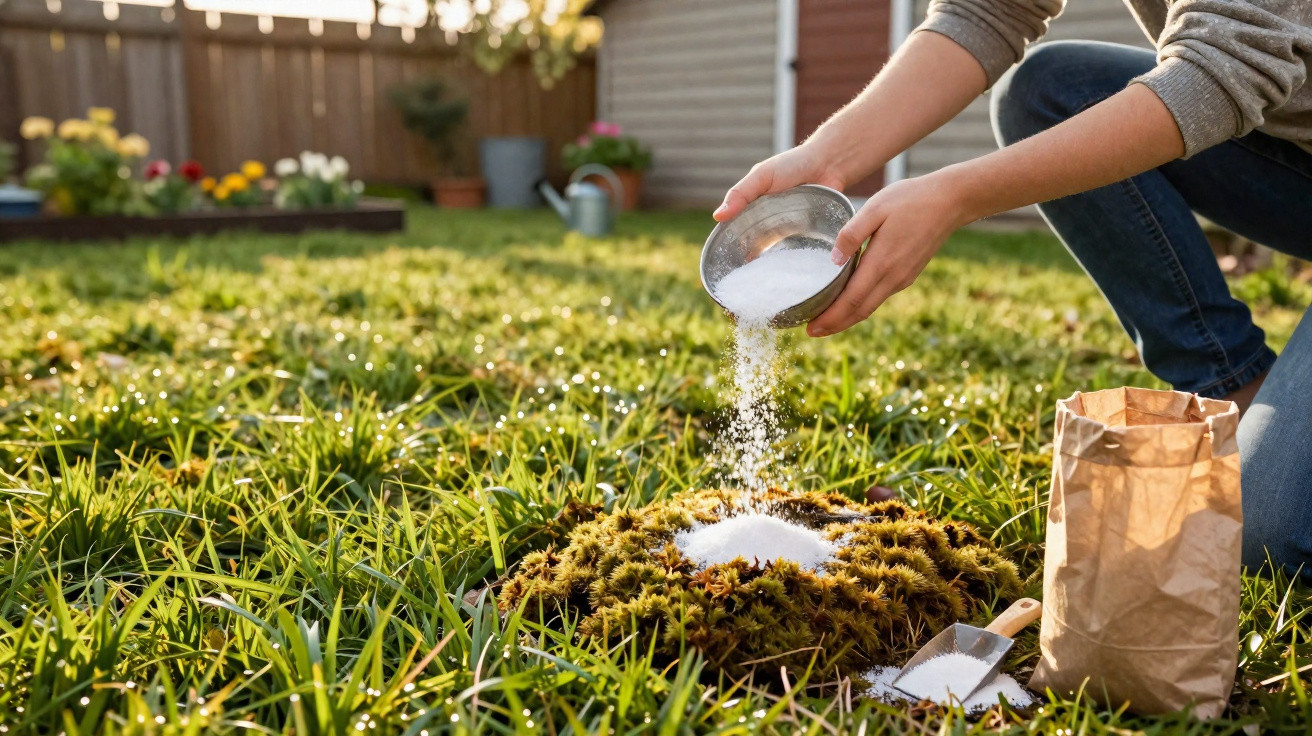
Rather than reaching for pricey specialist feeds or harsh moss killers, something completely different is ending up on the lawn: ordinary household sugar. It sounds like an online joke, yet it has been creating a stir on British and French gardening forums - and it is now persuading gardeners here to get the sugar shaker out for more than just coffee.
From dream lawn to a dark carpet of moss
Wet winters, shady spots, heavy soils: in many gardens the lawn eventually tips out of balance. What used to be lush green turns into a dark, spongy mat that looks more like moss than grass. Underfoot it springs back like an old sponge, the blades yellow, and bare patches start to appear.
A key culprit is what gardeners call lawn thatch - a layer of dead grass, root fragments and clippings that builds up right on the soil surface.
"This thatch holds moisture at the surface, blocks water and air in the soil - and creates perfect conditions for moss."
When that happens, grass roots stay shallow and weak, and moss steadily takes over. At this point many people reach for chemical moss killers or heavily dosed fertilisers. Some gardeners, however, are trying a very different approach - using something found in almost every kitchen.
Why sugar might help a lawn
The idea is not magic; it rests on a straightforward principle: sugar provides mostly carbon. That carbon benefits soil micro-organisms that break down organic material. In other words, they start decomposing the thick thatch that is smothering the lawn.
As that layer gradually reduces, water can soak down more effectively, oxygen reaches the roots again, and new shoots have more room. The result, in theory, is denser, tougher grass - while moss loses the advantage it had.
"Sugar does not feed the lawn directly; it feeds the soil life that, in turn, supports the lawn."
There is also another knock-on effect: while breaking down thatch, micro-organisms use up available nitrogen. In the short term this can weaken moss growth, while the grass, over time, roots more deeply and becomes more stable.
How gardeners apply the sugar trick properly
Many guides recommend plain white household sugar, either granulated sugar or icing sugar. Brown sugar or honey is unnecessary and would make the effect harder to control.
Step-by-step application in the garden
- Mow the lawn: Start by cutting the grass short, but not scalping it. This helps the sugar reach closer to the soil.
- Wait for dry conditions: The surface should be dry so you can spread the sugar evenly.
- Measure the dose: Experienced gardeners often use around 1 kilogram of sugar per roughly 40 square metres of lawn. That is a relatively gentle amount.
- Spread over the area: Apply as evenly as possible, by hand or with a lawn spreader.
- Water in well: Then water thoroughly so the sugar dissolves and sinks into the top layer of soil.
Some English-language sources mention much higher rates per area. Many experts, however, advise caution and suggest testing on a small section first - around three to five square metres - before treating the whole garden.
How quickly will you notice a change?
If you scatter sugar over the lawn, do not expect an instant transformation. The earliest changes happen underground: micro-organisms become more active, and the thatch begins to break down slowly. Visible results usually take a few weeks.
Common observations from gardens where the method has worked include:
- Moss looks duller and gradually becomes less dominant.
- The lawn turns a more even green, without an unnaturally vivid “artificial turf” colour.
- Bare areas fill in bit by bit and the sward appears thicker.
- The surface feels less spongy underfoot.
One important point: sugar is not a substitute for proper lawn care. Without regular mowing, loosening compacted ground and feeding appropriately, any benefit tends to fade quickly.
Where the sugar trick reaches its limits
Professionals tend to view sugar as one small part of a broader care routine - not a miracle cure. In some situations, trying it can even backfire.
| Suitable | Problematic |
|---|---|
| Well-drained soils | Permanently damp, waterlogged areas |
| Light sun to partial shade | Deep shade beneath trees |
| Thin to moderate thatch | Heavy thatch with no preparation at all |
| Occasional use | Frequent, high sugar applications |
In damp, shady gardens, sugar can encourage fungi and mould. Ants and other insects may also be drawn to the sweet source. Anyone already dealing with slugs should likewise test cautiously.
"More sugar does not automatically mean more effect - if anything, it can simply mean more problems."
How often can you put sugar on a lawn?
Garden specialists recommend using sugar no more than once a month - and ideally less often. If you have a healthy, well-maintained lawn, you will not need this trick on a permanent basis anyway.
Using it can make sense:
- after a very wet winter with heavy moss,
- on older lawns where thatch is clearly present,
- as an add-on to classic lawn care, not a replacement.
If you feel the need to do something more frequently, you could opt for gentler methods instead of sugar, such as watering with a portion of rice water. That can also support micro-organisms without loading the surface with too much sweetness.
Without the basics, the lawn stays a problem
The sugar approach only has a chance if the wider conditions are reasonably sound. A lawn that sits in constant shade, is never scarified, and is always cut too short is more likely to react badly than gratefully - even with sugar.
A sensible routine, for example, includes:
- Scarifying or aerating: Mechanically break up thatch so air and water can move down.
- Correct mowing height: Cut slightly higher so grasses develop stronger roots.
- Balanced feeding: Avoid over-fertilising, especially with nitrogen-only products.
- Smart watering: Water less often but more deeply, rather than sprinkling a little every day.
If you keep these basics in place and then experiment with sugar in a targeted way, you are far more likely to see an improvement.
What thatch, moss and soil life are really about
Many hobby gardeners underestimate just how strongly the unseen life in the soil shapes the lawn you can see. Bacteria, fungi, mites, springtails - all of them work quietly to keep soil open and permeable.
Sugar gives these organisms a short-term energy boost. Their populations increase, they break down old plant material and release nutrients that were locked up. The soil can become more crumbly, with air and water moving more easily. Grass roots find more fine pores to grow into.
Moss, by contrast, thrives mainly on waterlogging, compaction and lack of light. If you do not tackle those factors, no trick will keep you happy in the medium to long term - not even one involving a cheap kitchen staple.
When the 79p experiment is worth it
For many lawn owners, the appeal of sugar is simple: it is an inexpensive field test. A 1-kilogram bag of supermarket sugar costs under £1 and, used sparingly, is enough for a small to medium-sized area.
Testing it is most sensible when:
- the lawn has light to moderate moss,
- thatch is noticeable but the soil is not completely smothered,
- the area is not in permanent shade and drains reasonably well,
- you are willing to improve mowing, watering and nutrients at the same time.
If, on the other hand, you are standing on a fully mossed-over, constantly wet lawn, you should tackle the causes first: improve drainage, thin out shrubs and trees, and loosen the soil. Sugar is then more of a finishing touch after the essentials.
What makes it interesting is this: many gardeners report a visibly denser lawn with a calmer, deeper green after one or two applications, while others see hardly any difference. That is exactly why the trick is so tempting - it is cheap, quick to try, and it encourages you to view your soil not as a mere base layer, but as a living system that can respond surprisingly well to a little sweet fuel.


Comments
No comments yet. Be the first to comment!
Leave a Comment