
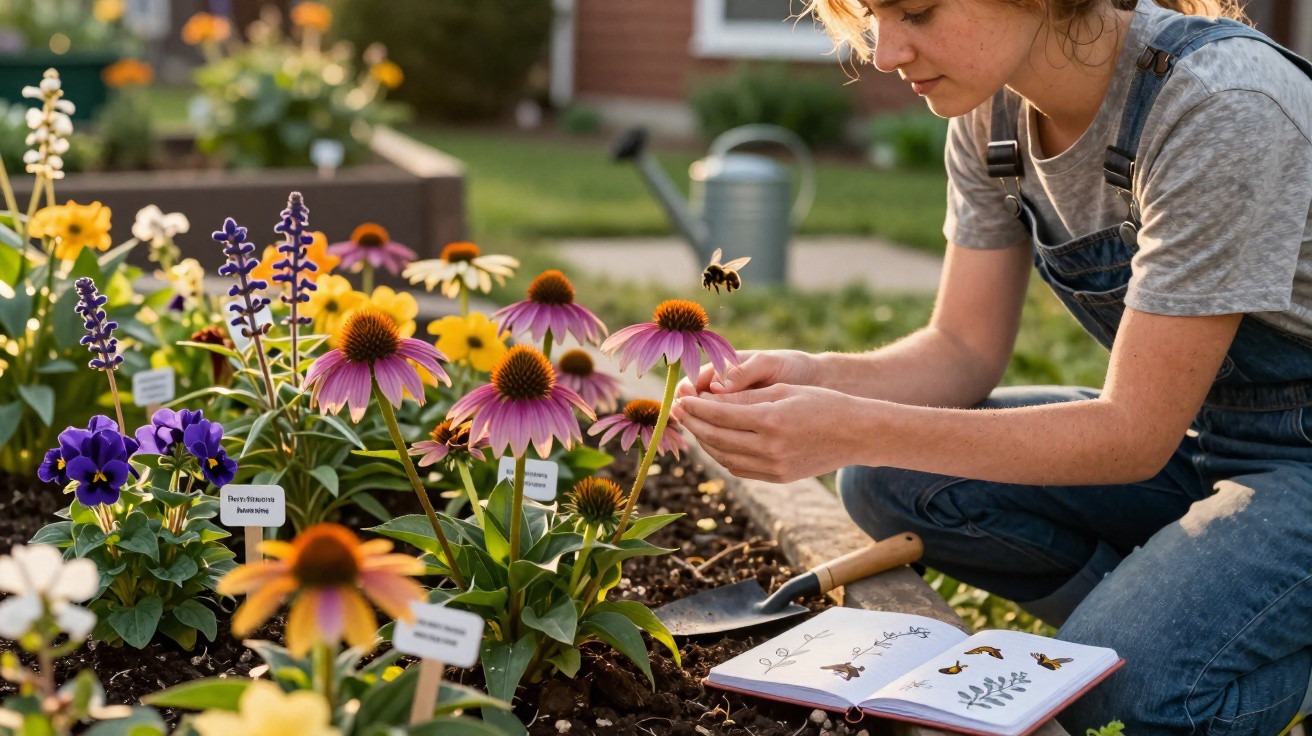
A garden filled with vivid blooms can offer more than visual appeal. It can also provide quiet support for bees, butterflies and numerous other insects that are vital to a healthy natural world.
Although many people believe that only wild plants are effective at this, recent research suggests that orderly, colourful garden varieties can make a contribution too.
How gardens support pollinators
Research from Northwestern University and the Chicago Botanic Garden offers encouraging news for gardeners: selectively bred garden plants can continue to draw pollinators.
These plants are commonly selected for their tidy form, bold colours and ease of cultivation. Even though they have been shaped by human breeding, some still provide insects with food and shelter.
For instance, the cultivated black-eyed Susan Rudbeckia fulgida ‘Goldsturm’ and the foxglove beardtongue Penstemon digitalis ‘Husker Red’ drew pollinators at almost the same rate as wild plants.
However, some other varieties were less successful. This demonstrates that the choice of plant remains important, including among cultivated varieties.
Why pollinator gardens matter today
Pollinator gardens have grown in popularity over recent years. The change began after scientists identified a steep fall in honeybee numbers. Since then, people have planted flowers at home, in parks and along roadsides to help support insects.
“The pollinator garden movement is a somewhat new approach to the conservation of biodiversity,” said Nicholas Dorian from the Chicago Botanic Garden.
Conservation is no longer restricted to extensive forests and national parks. Small steps taken at home can now contribute to safeguarding nature.
Making pollinator gardening easier for beginners
Starting a pollinator garden can feel daunting for many newcomers. An entirely wild garden may appear untidy and hard to look after, and this concern can prevent people from getting started.
“Our findings emphasize that ecological value and aesthetics don’t have to be at odds with each other,” said Dorian.
“There are many people who might be interested in getting involved in the pollinator gardening movement but feel intimidated. Turning a garden or front yard into a wild space can feel daunting.
“A key takeaway from our study is that cultivated plants with aesthetic appeal can still bring pollinators into your yard and may be a really nice gateway for people who are on the fence or don’t have time or resources to seek out wild-type plants.”
This message gives more people an opportunity to give pollinator gardening a try.
Testing plant performance
Scientists from Northwestern University and the Chicago Botanic Garden set up closely controlled experiments.
At the Chicago Botanic Garden, researchers grew wild plants alongside cultivated varieties. Specialists regularly monitored insect visits over a two-year period.
Every observation ran for ten minutes. In that time, the scientists recorded bees, butterflies, beetles and other insects visiting the blooms. The approach enabled them to identify genuine differences between the plant types.
Volunteers from across the eastern United States also took part, strengthening the research.
Participants grew comparable flowers in their own gardens and logged insect visits using the same approach. This gave the team an insight into how the plants perform in everyday conditions.
Not all flowers work in the same way
The study results showed a distinct trend. Overall, wild plants attracted the greatest number of insects. Yet some cultivated plants were equally effective, while others attracted fewer pollinators.
“None of the plants were completely ignored by insects,” Dorian said. This indicates that even the lower-performing plants retain some value. In comparison with plain grass lawns, nearly any flowering plant offers greater support for pollinators.
The finding also explains why views on cultivated plants are often divided. Some perform well and others do not, making careful selection essential.
A practical choice for everyday gardens
Wild plants can be hard to obtain in many areas, while garden centres generally sell cultivated varieties. That makes the findings particularly relevant to ordinary gardeners.
“If you’re trying to attract insects to a green space and all you can find is one of the cultivars that we evaluated, it’ll be certainly better than turf grass,” Dorian said. Even a modest adjustment can have an effect.
Growing a combination of wild and cultivated flowers provides a practical option. It can keep a garden looking tidy while continuing to benefit nature.
Flowers to support gardens
The researchers also advised caution. In major conservation schemes, cultivated plants should not take the place of wild plants, as natural species are needed to protect ecosystems effectively.
Dorian also highlighted particular flower forms. “Importantly, none of the cultivars in our study exhibited extra petal production, known as ‘doubled flowers,’” Dorian said.
These flowers can prevent insects from reaching nectar, which makes them less beneficial. Selecting suitable plants is still crucial to success.
The research delivers an optimistic message. Helping pollinators does not demand expert knowledge or a garden with a completely wild appearance. Small, considered decisions can have a beneficial effect.
“We want to empower people to feel they have agency over the future of biodiversity where they live,” Dorian concluded.



Comments
No comments yet. Be the first to comment!
Leave a Comment